The Replay Attack That Could Cost You Millions
In a world where every second counts and fraud is just a replay away, engineering leaders must rethink their security posture.

In a world of increasing fraud, your capture endpoints must be your first line of defense.Back to all posts
The Replay Attack That Could Cost You Millions
In today's digital landscape, the stakes are alarmingly high. Imagine this: your video verification system is compromised by a clever replay attack, allowing a fraudulent candidate to slip through unnoticed. The result? A costly hire that not only drains resources but also jeopar dizes your organization's integrity and reputation. This is not just a hypothetical scenario; it’s a reality that many engineering leaders face as they navigate the complexities of identity verification and security.
Why This Matters
Replay attacks exploit the very systems designed to protect you. When capture endpoints fail to incorporate robust security measures, they become prime targets for malicious actors. A single lapse can lead to significant financial losses, regulatory scrutiny, and a damaged brand. As engineering leaders, it’s your responsibility to execute a proactive strategy that transforms your security posture into automated, testable controls.
How to Implement It
To effectively combat these threats, start by implementing a multi-layered security approach. This includes automated testing of all capture endpoints to ensure they can withstand replay and injection attacks. Utilize advanced techniques such as liveness detection to differentiate between genuine interactions and deceptive replays. Moreover, establish a robust observability framework that allows real-time monitoring of your systems, enabling quick detection and response to any anomali es that may arise. Here's how to implement these strategies step by step: 1. Automated CI Checks: Integrate continuous integration (CI) checks that automatically validate the integrity of capture endpoints. Use tools like Selenium or Cypress for automated testing. 2. Liven ess Detection: Deploy liveness detection technology that requires users to perform specific actions to verify their presence. This could be as simple as asking them to blink or turn their head during a video capture. 3. Anomaly Detection: Incorporate machine learning models

Key Takeaways
As you implement these strategies, keep these key takeaways in mind: 1. Always validate the authenticity of capture endpoints through automated testing. 2. Liveness detection is not just an option; it’s a necessity in today’s threat landscape. 3. Observability should be integrat ed into your security framework to ensure that you can respond to threats quickly and effectively.
Key takeaways
- Implement automated testing for all capture endpoints.
- Utilize liveness detection to prevent replay attacks.
- Maintain an observability framework to monitor for anomalies.
Implementation checklist
- Set up automated CI checks for capture endpoints.
- Integrate liveness detection mechanisms in your pipelines.
- Establish response protocols for detected anomalies.
Questions we hear from teams
- What are replay attacks and how do they work?
- Replay attacks involve capturing and reusing legitimate credentials or data to gain unauthorized access. They exploit weaknesses in the capture endpoints.
- How can I test my capture endpoints for vulnerabilities?
- Automated CI checks and penetration testing are effective methods to identify vulnerabilities in your capture endpoints.
- What tools can I use for liveness detection?
- Tools like AWS Rekognition, Google Cloud Vision, and specialized SDKs provide liveness detection capabilities.
Ready to secure your hiring pipeline?
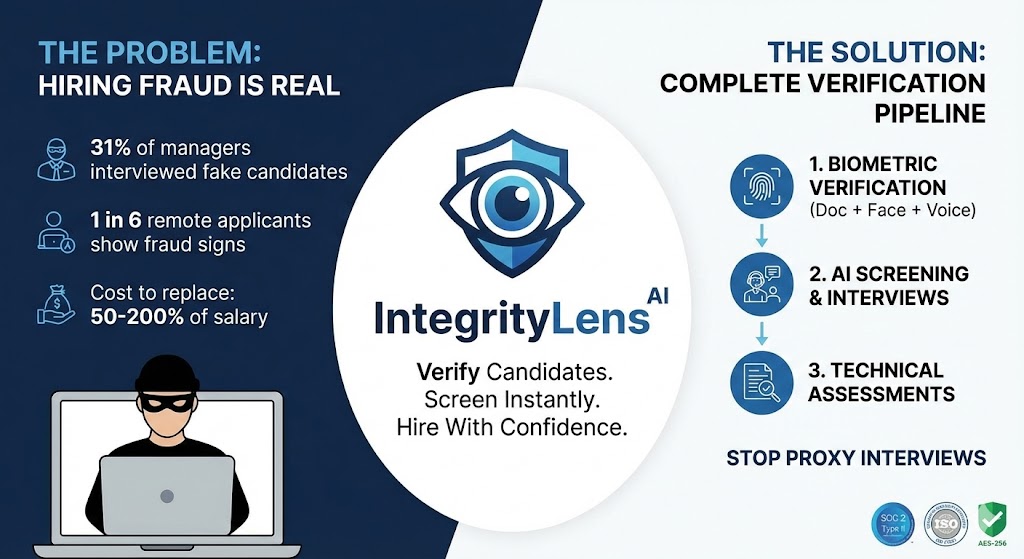
Let IntegrityLens help you verify identity, stop proxy interviews, and standardize screening from first touch to final offer.
Watch IntegrityLens in action
See how IntegrityLens verifies identity, detects proxy interviewing, and standardizes screening with AI interviews and coding assessments.