Harden Your Logging: Protecting PII While Keeping Proofs Across Environments
Learn how to secure your logging practices without compromising on proof and operational efficiency.
Secure logging practices can save your organization from costly breaches and reputational damage.Back to all posts
The $50K Hallucination
Your AI model just hallucinated in production, leading to a $50K customer refund fiasco. The root cause? Insufficient logging practices that failed to capture critical context while inadvertently exposing PII. This incident not only drained financial resources but also tarnished your brand's reputation. In a world where data breaches can cost millions and erode customer trust, the stakes have never been higher. Every log entry must serve dual purposes: retaining valuable proof for audits and investigations, while also ensuring that sensitive information is protected from leaks. Engineering leaders face a daunting challenge: how to implement logging practices that are both robust and secure. The balance between operational responsiveness and regulatory compliance is delicate. Failure to manage it effectively can lead to catastrophic outcomes, as illustrated above. It's time to rethink your logging strategy, integrating automated controls that enhance security without sacrificing performance.
Why This Matters
For engineering leaders, the implications of poor logging practices extend beyond immediate financial losses. Regulatory fines, loss of customer confidence, and operational setbacks can all stem from inadequate data handling. In sectors like finance and healthcare, where compliance is non-negotiable, the urgency to fortify logging systems is amplified. The core of effective logging is about creating a culture of accountability and transparency. By ensuring that logs are comprehensive yet devoid of personal identifiers, teams can maintain a high level of observability while adhering to data protection regulations such as GDPR and CCPA. This proactive approach not only mitigates risks but also fosters trust among stakeholders, ensuring that your organization remains resilient in the face of scrutiny.
How to Implement It
Step 1: Establish a logging policy that clearly defines what data needs to be logged, how long it will be retained, and the processes for anonymizing PII. Use frameworks like ISO/IEC 27001 to guide your policy development. Step 2: Leverage logging tools like the ELK Stack or Spl unk to manage logs at scale. These platforms allow for real-time analysis and can be configured to automatically redact sensitive information. Step 3: Automate compliance checks as part of your CI/CD pipeline. Implement scripts that validate log entries against your logging policy and alert teams to any discrepancies or unauthorized access attempts. This ensures that your logging practices evolve continuously and remain aligned with regulatory requirements. Step 4: Regularly audit your logs for anomalies. Use machine learning algorithms to detect unusual access patterns or data leaks. This proactive monitoring helps identify potential security incidents before they escalate into crises, allowing for timely intervention and remediation.
Key Takeaways
Implement logging frameworks that anonymize PII. Automate compliance checks to ensure regulatory adherence. Regularly audit logs for anomalies and data leaks. Establish a logging policy that defines data retention and anonymization protocols. Utilize tools like ELK Stack or Splunk for scalable log management. Automate alerts for any unauthorized access to logs.
Key takeaways
- Implement logging frameworks that anonymize PII.
- Automate compliance checks to ensure regulatory adherence.
- Regularly audit logs for anomalies and data leaks.
Implementation checklist
- Establish a logging policy that defines data retention and anonymization protocols.
- Utilize tools like ELK Stack or Splunk for scalable log management.
- Automate alerts for any unauthorized access to logs.
Questions we hear from teams
- How can we ensure our logs are compliant with data protection regulations?
- Establish a clear logging policy that includes data anonymization and retention protocols. Regular audits and automated compliance checks can also help.
- What tools can help us manage and secure our logs?
- Consider using the ELK Stack or Splunk for scalable log management, along with automated scripts for compliance checks.
- How often should we audit our logs?
- Regular audits should be conducted at least quarterly, but implementing real-time monitoring can help catch anomalies as they occur.
Ready to secure your hiring pipeline?
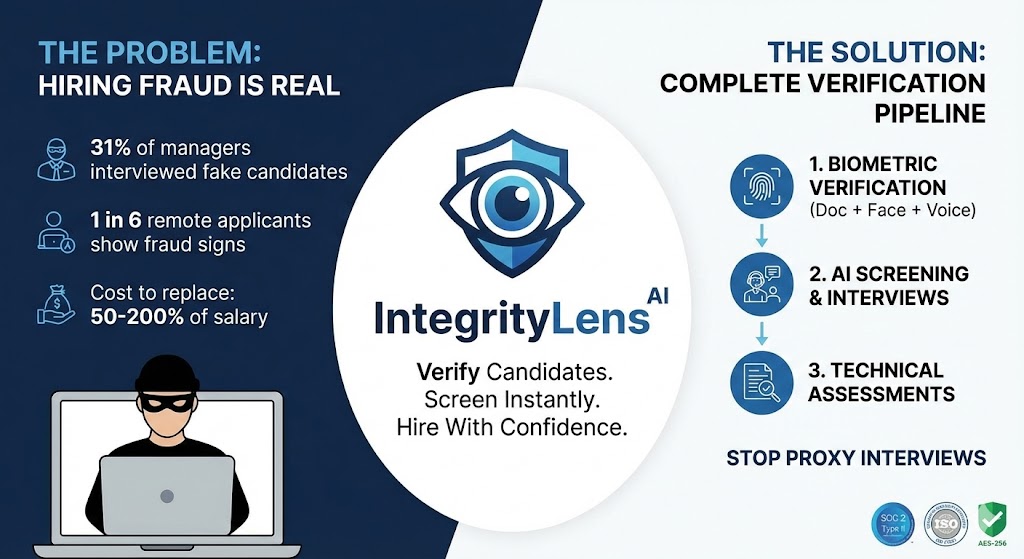
Let IntegrityLens help you verify identity, stop proxy interviews, and standardize screening from first touch to final offer.
Watch IntegrityLens in action
See how IntegrityLens verifies identity, detects proxy interviewing, and standardizes screening with AI interviews and coding assessments.