ROI Quantification: Hours Saved & Manual Review Collapse
An operator playbook for COOs to prove time savings, precision lift, and lower reviewer load—without betting on vanity metrics.
If you can't tie risk controls to reviewer hours, precision, and queue SLA, you don't have ROI—you have friction.Back to all posts
The war-room ROI question after a hiring incident
It's 6:40 a.m. and you're in a makeshift incident channel: "new hire may have used a proxy interviewer." Comms wants a statement, Security wants containment, and Legal wants evidence—while your headcount plan still has to land this quarter. By the end of this article, you will be able to quantify ROI for hiring integrity in three operator-grade measures: hours saved per role, precision lift, and reduced manual review—using data you can defend when Audit asks.
COOs don't run on applicants—they run on verified-qualified throughput
Applicant counts are vanity metrics. Operations runs on flow efficiency: how many verified-qualified candidates you can produce per week, at predictable cost, with controlled risk. Fraud controls that aren't measurable become a tax: hidden reviewer hours, stalled reqs, and reputation risk if a bad hire becomes a public incident. The win condition is a defensible pipeline where high-risk cases get attention and low-risk candidates move fast.
Time: reviewer + recruiter minutes burned per filled role (and where it spikes).
Precision: confirmed fraud catches vs false positives that create funnel leakage.
Load: manual review rate and queue SLA—leading indicators for staffing and burnout.
clarify accountability before you measure
If ownership is ambiguous, every dashboard becomes a debate. Set governance first: who configures policy, who adjudicates, and what system is the source of truth for each stage. Define what is automated vs manually reviewed so your "hours saved" calculation doesn't accidentally include work that never should have been human in the first place.
Recruiting Ops owns policy configuration, queue staffing, candidate comms, and weekly reporting.
Security/CISO org owns risk thresholds, access controls, retention, and incident escalation criteria.
Hiring managers own final decisions, interview discipline, and escalation participation (not ad-hoc investigations).
ATS: stage transitions, req metadata, offer outcomes.
Verification layer: identity results, risk tier, biometric checks status.
Interview/assessment: completions, scoring, integrity events, session metadata.
the minimum viable ROI model (hours, precision, review rate)
A robust ROI model ties effort to outcomes. Start with three measures you can compute from timestamps and adjudication results—then expand once the team trusts the numbers. Avoid "estimated savings" narratives until you've instrumented actual reviewer minutes and queue behavior.
Baseline: sample manual review minutes per candidate for a week (or two) and record reviewer counts.
Compute: manual review hours per hire = (review_minutes * candidates_reviewed) / 60 / hires.
Track separately: rework loops (reopened cases, rescheduled interviews due to identity issues).
True Positive: flagged and confirmed via adjudication + Evidence Pack.
False Positive: flagged but cleared.
Precision = TP / (TP + FP).
Manual Review Rate = candidates requiring human adjudication / candidates processed.
Pair it with queue SLA: time from escalation created → adjudication decision.
Use risk tiers to target reviews (illustrative goal: keep human review for the riskiest subset, not the full funnel).
use external stats to justify measurement, not to claim your baseline
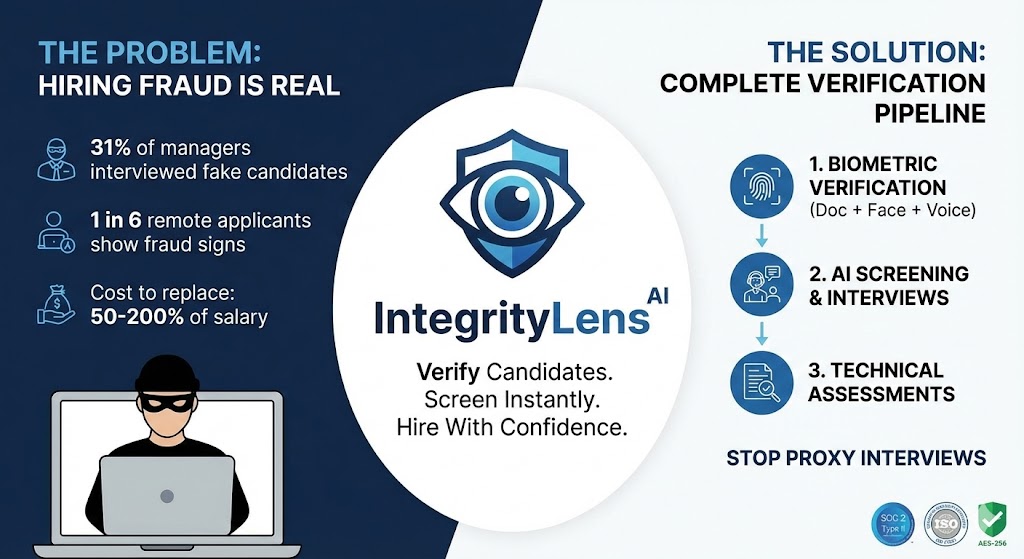
Two directional signals are worth bringing to the exec table—carefully interpreted. Checkr reports that 31% of hiring managers say they've interviewed a candidate who later turned out to be using a false identity. Directionally, that implies identity deception is common enough to warrant controls and measurement. It does not prove your internal incidence rate or apply uniformly across roles and regions. Pindrop notes 1 in 6 applicants to remote roles showed signs of fraud in one real-world pipeline. Directionally, that suggests remote funnels may have material fraud pressure. It does not mean 1/6 are confirmed fraud everywhere; "showed signs" is broader than adjudicated cases.

Treat these stats as a mandate to instrument leading indicators (risk signals, queue spikes, withdrawal patterns).
Build your ROI story from your own confirmed outcomes and time logs—not survey prevalence.
SQL to compute hours/role, precision, and review rate
This is a practical query pattern for a weekly ops dashboard. It joins ATS outcomes with verification/adjudication events to compute reviewer hours per hire, precision, and manual review rate by role family. Adapt table/field names to your warehouse.
Run weekly; slice by role family, location, and source to find where friction and fraud pressure concentrate.
Treat weeks with low resolved adjudications as "insufficient data" for precision—don't over-read noise.
Feed findings into staffing (reviewers per queue) and policy (risk-tier thresholds).
a 90-day rollout COOs can operationalize
Treat hiring integrity like capacity planning plus incident readiness. You're building predictable throughput with controlled escalations, not creating a slow compliance gate. Below is a pragmatic sequence that avoids the common failure mode: turning on aggressive detection without queue staffing or appeal flows.
Add required fields: risk_tier, escalation_reason, adjudication_outcome, review_open_ts, review_close_ts.
Ensure candidate_id and req_id are consistent across ATS, verification, interviews, and assessments.
Create a queue health view: pending escalations, SLA, and reviewer utilization.
Auto-clear low-risk candidates with fast verification and minimal friction.
Step up checks only when signals cross thresholds (e.g., device anomalies, mismatch confidence bands, assessment integrity events).
Define an appeal path and who can override (with logging).
Standardize what evidence is captured for each escalation type.
Train adjudicators on a consistent rubric to reduce variance (and reduce false positives).
Set access controls: least privilege for evidence viewing, with immutable audit logs.
If pending escalations rise, adjust staffing before tightening thresholds further.
If false positives rise, refine signals or tier rules to stop bleeding good candidates.
If withdrawals rise at verification, improve comms and reduce friction for low-risk tiers.
Anti-patterns that make fraud worse
These patterns increase both fraud risk and operational drag. Fix them before you add more tooling or headcount.
Routing high-risk cases to "whoever is free" instead of trained adjudicators with a written rubric.
Optimizing for flag volume instead of confirmed outcomes (precision) and queue SLA (reviewer fatigue).
Storing evidence in screenshots, email threads, and Slack—guaranteeing inconsistent decisions and weak audit posture.
Where IntegrityLens fits
IntegrityLens AI ("Verify Candidates. Screen Instantly. Hire With Confidence.") unifies ATS workflow, biometric identity verification, fraud detection, AI screening interviews, and technical assessments into one defensible pipeline—so you can quantify ROI without stitching together four vendors and three data models. For COOs, the operational win is a single joined record that ties time-to-decision, risk tier, and adjudication outcomes to each role's throughput and reviewer load.

ATS workflow as the lifecycle backbone (TA leaders + recruiting ops).
2–3 minute identity verification (document + voice + face) before interviews; typically under three minutes (ops + security).
24/7 AI screening interviews to reduce scheduling drag while standardizing early screens (TA + ops).
Technical assessments across 40+ languages with integrity telemetry (hiring teams + TA).
Risk-Tiered Verification, Evidence Packs, and idempotent webhooks for clean integrations and defensible auditing (recruiting ops + CISOs).
the COO scorecard for hiring integrity ROI
If you can't explain where hours went, why flags were correct, and how many cases needed humans, you don't have an ROI story—you have opinions. Run a weekly ops cadence around these measures and tie them to staffing and policy changes. You'll move faster and reduce risk without punishing good candidates.
Verified-Qualified Candidates/week (by role family) vs applicant volume.
Manual review rate + queue SLA (are we creating a bottleneck?).
Precision on resolved cases (are we getting noisier?).
Withdrawal/no-show rate at verification (is friction causing leakage?).
Confirmed fraud cases with complete Evidence Packs (are we defensible?).
Sources
Checkr (2025): Hiring Hoax (Manager Survey): https://checkr.com/resources/articles/hiring-hoax-manager-survey-2025 Pindrop: Why Your Hiring Process Is Now a Cybersecurity Vulnerability: https://www.pindrop.com/article/why-your-hiring-process-now-cybersecurity-vulnerability/
Related Resources
Key takeaways
- ROI is defensible when it's tied to measurable operator pain: reviewer hours, rework loops, and false-positive-driven funnel leakage.
- Use a Risk-Tiered Verification model to shift effort from "review everything" to "review the right 2–10%" (illustrative range).
- Measure precision lift with confirmed outcomes (true/false positives), not just flags, to avoid rewarding noisy detection.
- Build Evidence Packs automatically so Security and Legal stop chasing screenshots and ad-hoc notes after an incident.
- Democratize funnel stats: recruiters should see verified-qualified throughput and queue health, not only applicant counts.
Computes three COO-grade metrics by role family: (1) reviewer hours per hire, (2) precision on resolved escalations, (3) manual review rate.
Assumes you have candidate-stage outcomes in the ATS and adjudication events from IntegrityLens (or your verification layer). Replace table names as needed.
/* Weekly ROI + integrity operations metrics by role family */
WITH offers AS (
  SELECT
    a.req_id,
    a.candidate_id,
    a.role_family,
    a.offer_accepted_ts,
    DATE_TRUNC(a.offer_accepted_ts, WEEK) AS offer_week
  FROM analytics.ats_candidates a
  WHERE a.offer_accepted_ts IS NOT NULL
),
processed AS (
  SELECT
    a.req_id,
    a.candidate_id,
    a.role_family,
    DATE_TRUNC(a.verification_started_ts, WEEK) AS process_week
  FROM analytics.ats_candidates a
  WHERE a.verification_started_ts IS NOT NULL
),
adjudication AS (
  SELECT
    e.req_id,
    e.candidate_id,
    e.risk_tier,
    e.escalation_reason,
    e.review_open_ts,
    e.review_close_ts,
    e.adjudication_outcome,
    DATE_TRUNC(e.review_open_ts, WEEK) AS review_week,
    TIMESTAMP_DIFF(e.review_close_ts, e.review_open_ts, MINUTE) AS review_minutes
  FROM analytics.integritylens_adjudication_events e
  WHERE e.review_open_ts IS NOT NULL
),
weekly_rollup AS (
  SELECT
    p.role_family,
    p.process_week AS week,
    COUNT(*) AS candidates_processed,
    COUNTIF(a.review_open_ts IS NOT NULL) AS candidates_manually_reviewed,
    SUM(COALESCE(a.review_minutes, 0)) AS total_review_minutes,
    COUNTIF(a.adjudication_outcome = 'confirmed-fraud') AS true_positives,
    COUNTIF(a.adjudication_outcome = 'cleared') AS false_positives
  FROM processed p
  LEFT JOIN adjudication a
    ON a.req_id = p.req_id
   AND a.candidate_id = p.candidate_id
   AND a.review_week = p.process_week
  GROUP BY 1, 2
),
weekly_hires AS (
  SELECT
    o.role_family,
    o.offer_week AS week,
    COUNT(*) AS hires
  FROM offers o
  GROUP BY 1, 2
)
SELECT
  r.role_family,
  r.week,
  r.candidates_processed,
  r.candidates_manually_reviewed,
  SAFE_DIVIDE(r.candidates_manually_reviewed, r.candidates_processed) AS manual_review_rate,
  r.total_review_minutes,
  SAFE_DIVIDE(r.total_review_minutes, 60.0) AS total_review_hours,
  h.hires,
  SAFE_DIVIDE(r.total_review_minutes, 60.0) / NULLIF(h.hires, 0) AS review_hours_per_hire,
  r.true_positives,
  r.false_positives,
  SAFE_DIVIDE(r.true_positives, NULLIF(r.true_positives + r.false_positives, 0)) AS precision
FROM weekly_rollup r
LEFT JOIN weekly_hires h
  ON h.role_family = r.role_family
 AND h.week = r.week
ORDER BY r.week DESC, r.role_family;
Outcome proof: What changes
Before
Fraud concerns were handled ad-hoc: inconsistent identity checks, high manual review load during surges, and scattered evidence across email/Slack when escalations occurred.
After
Risk-Tiered Verification was standardized across roles, Evidence Packs were generated per escalation, and Recruiting Ops ran a weekly dashboard tracking reviewer hours per hire, manual review rate, and precision on resolved cases.
Implementation checklist
- Define one source of truth for each stage (ATS, verification, interview, assessment) and reconcile IDs.
- Instrument queue metrics (pending reviews, SLA to decision, reviewer utilization) before changing policy.
- Adopt Risk-Tiered Verification: low-friction defaults + stepped-up checks for high-risk signals.
- Create an "Evidence Pack" schema for every adverse action and every confirmed fraud case.
- Publish a weekly ops dashboard: hours saved per role (calculated), precision, and manual review rate.
Questions we hear from teams
- What if we can't measure reviewer time today?
- Start with two timestamps: review_open_ts and review_close_ts on every escalation. Even if you only capture it inside IntegrityLens adjudication initially, you can compute reviewer minutes and build a defensible baseline within 1–2 weeks.
- How do we avoid optimizing for fraud detection at the expense of speed?
- Use Risk-Tiered Verification: auto-clear low-risk candidates quickly, and only step up friction when signals cross a threshold. Then watch withdrawal rate at verification and queue SLA as leading indicators of excessive friction.
- How do we explain precision to executives without a data science lecture?
- Precision answers one question: "When we flag someone, how often are we right?" It's the simplest way to show you reduced noise and manual work while keeping risk controls meaningful.
- What's the one dashboard a COO should demand weekly?
- Verified-Qualified Candidates/week by role family, with manual review rate, queue SLA, and precision on resolved escalations. That combination tells you throughput, staffing pressure, and signal quality in one view.
Ready to secure your hiring pipeline?
Let IntegrityLens help you verify identity, stop proxy interviews, and standardize screening from first touch to final offer.
Watch IntegrityLens in action
See how IntegrityLens verifies identity, detects proxy interviewing, and standardizes screening with AI interviews and coding assessments.