Behavioral Panels: Calibrated Rubrics at Scale
A CHRO-grade interview operations playbook for consistent questions, follow-ups, and defensible scoring across AI and live panels.

Behavioral interviews do not fail because people are careless. They fail because the system lets drift become policy.Back to all posts
The panel that "went great" until it didnt
A director-level candidate clears a behavioral panel with perfect stories and polished reflections. Two weeks after the offer, a reference call suggests the person on video was not the person who will show up on day one. Your engineering leaders call it wasted time. Legal asks what evidence you have. Your employer brand team worries about public backlash. By the end of this article, you will be able to run structured behavioral interviews at scale with consistent rubrics, controlled follow-ups, and calibrated scoring across AI and live panels.
Why this matters for CHROs
Behavioral interviews are often the largest unstructured surface area in the hiring funnel. When they drift, you pay three times: slower time-to-fill from scheduling churn, higher cost from interviewer fatigue, and higher risk from inconsistent documentation. Checkr reports that 31% of hiring managers say they have interviewed a candidate who later turned out to be using a false identity. Directionally, that means identity controls belong inside interview operations, not only in background checks. It does not prove the rate in your organization or that behavioral panels are uniquely vulnerable, but it is enough to justify building a defensible process.
Debriefs become evidence-led instead of preference-led.
Interviewers spend less energy inventing follow-ups and more on evaluating signal.
PeopleOps gets consistent documentation for audits and candidate disputes.
Ownership and flow
Before you touch rubrics, decide who owns what, what is automated, and where truth lives. Otherwise, every exception becomes a Slack debate and every audit becomes a scavenger hunt. Recruiting Ops owns the interview system: kits, training, calibration, QA. Hiring Managers own role-specific examples and final decision rationale. Security and Legal own identity, consent, retention, and access guardrails. Automation should deliver prompts, enforce rubric completion, and route exceptions. Human reviewers should handle identity anomalies, scoring variance, and appeals. Your ATS must remain the system of record for stages and decisions. The interview layer is the source for rubric scores and structured notes. Verification is the source for identity signals and Evidence Packs.
When a candidate is allowed to schedule a panel
When identity verification is required (ideally before any synchronous time is spent)
Who can override an exception route and how it is logged
Step-by-step interview ops (AI + live panels)
Define 4-6 competencies per role family and anchor what a 1, 3, and 5 mean using observable behaviors, not vibe proxies.
Create an interview kit per role family: one primary question per competency and a small library of pre-approved follow-ups categorized as clarify vs stress test.
Enforce idempotent scoring: each interviewer submits scores and evidence quotes before seeing other panelists' feedback, reducing groupthink.
Calibrate every 2 weeks using a small sample set. Track variance by competency and interviewer to find confusing anchors and training gaps.
Route exceptions: identity flags and high scoring variance should trigger a structured debrief template or a short controlled re-verification.
Make debriefs fast: start with rubric deltas and evidence quotes, then decide hire, no-hire, or hold with one targeted follow-up.
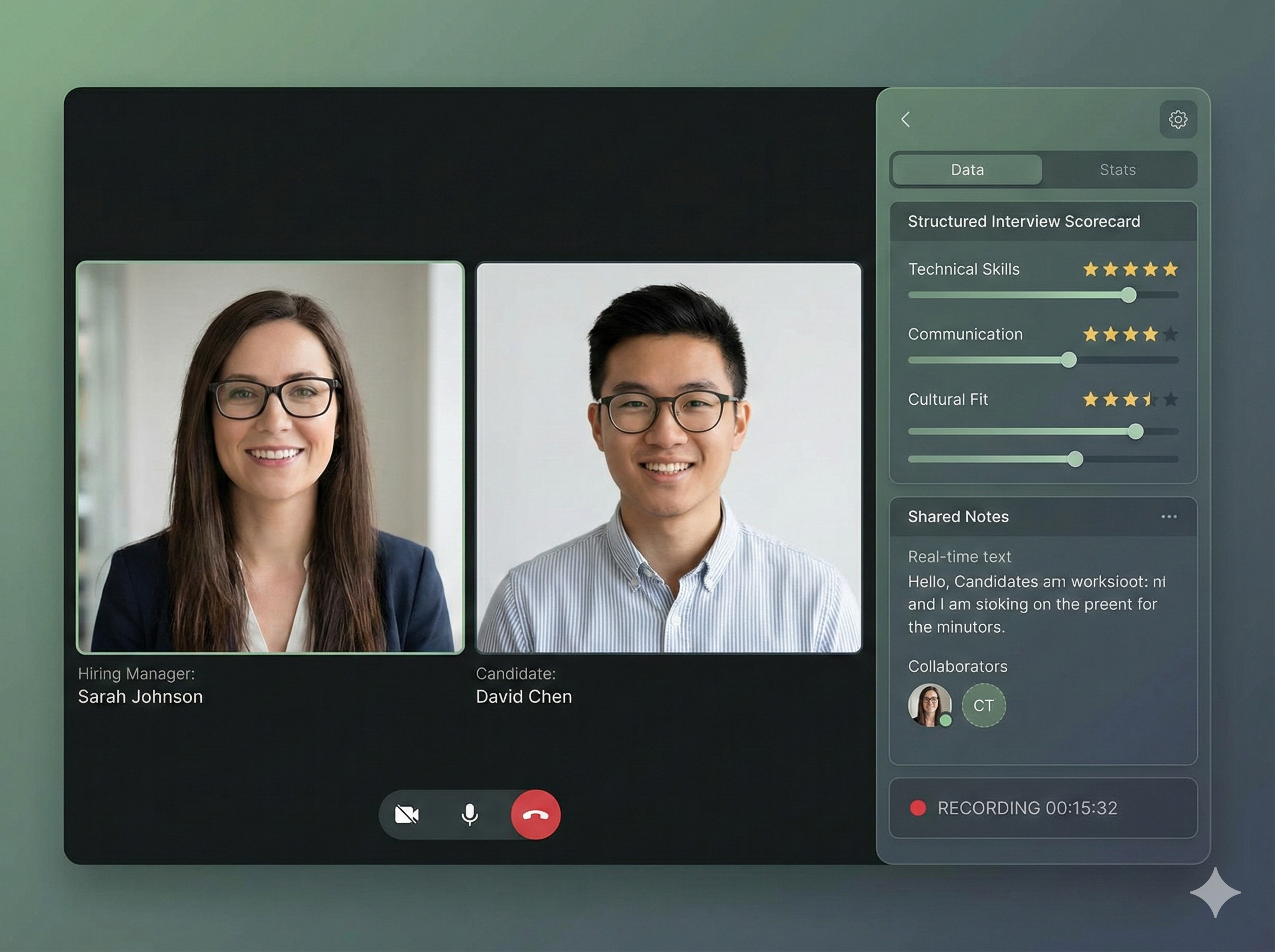
Blind scoring to prevent anchoring
Evidence quotes to force specificity
Variance routing to avoid 30-minute opinion loops
Interview kit policy config
Use a versioned, role-family interview kit so Recruiting Ops can audit changes, enforce follow-ups, and keep scoring consistent across AI interviews and live panels.
Anchors that describe observable behavior
Follow-ups that are pre-approved and competency-specific
Integrity controls that bind a session to a verified person
Anti-patterns that make fraud worse
- Sharing interview links in email without identity gates or replay controls. - Allowing "informal" backchannel interviews that are not recorded in the ATS and have no rubric. - Reusing the same behavioral questions verbatim across candidates for months (it trains coaching markets).
Where IntegrityLens fits
IntegrityLens AI ("Verify Candidates. Screen Instantly. Hire With Confidence.") is the first hiring pipeline that combines a full ATS with advanced biometric identity verification, AI screening interviews, and technical assessments in one defensible flow. It supports structured behavioral interview operations by standardizing rubrics, binding sessions to verified identity, and packaging evidence for fast reviews and clean audits. TA leaders and recruiting ops use it to reduce scheduling churn and debrief time, while CISOs use it to reduce identity and access risk introduced through hiring.
ATS workflow for stages, rubric enforcement, and decision capture
Biometric identity verification in under three minutes before interviews
AI screening interviews available 24/7 for consistent prompt delivery
Fraud detection signals and Evidence Packs for exception handling
Technical assessments across 40+ languages when roles require it
Outcome proof: what you can expect
When you standardize behavioral kits and enforce evidence-based scoring, the first visible impact is debrief efficiency: fewer circular debates and fewer "strong yes" ratings without supporting examples. With consistent pre-interview identity verification, anomalies are handled as routed exceptions with documented review, not last-minute gut calls. That protects interviewer time and reduces reputational risk when a candidate disputes a decision. Any numeric lift in time-to-fill or quality-of-hire will vary by baseline process and role mix, so treat metrics as implementation-dependent rather than guaranteed.
Explicit consent flows for recording and biometric steps
Zero-Retention Biometrics where applicable and retention minimization for interview artifacts
Role-based access controls for notes, recordings, and Evidence Packs
Documented appeal flow with human review and rationale capture
FAQ: common CHRO concerns
If this feels scripted, you are over-constraining rapport. Keep the rubric fixed and let the human conversation breathe inside that frame. If Hiring Managers resist, make rubric completion a gate in the ATS. Exceptions should be rare and logged with PeopleOps visibility. AI interviews can standardize early behavioral signal and reduce scheduling load, but nuanced evaluation and final decisions should remain human-owned.
Related Resources
Key takeaways
- Treat behavioral interviews like an operating system: defined prompts, controlled follow-ups, and auditable scoring.
- Separate "question consistency" from "human judgment": lock the rubric and allow notes, not new criteria.
- Prevent reviewer fatigue by standardizing follow-ups and reducing debrief time with Evidence Packs.
- Use automation for scheduling, question delivery, and evidence capture, but keep final decisions human-owned.
- Make fraud harder by tying interviews to verified identity and controlling link sharing and replays.
A versioned interview kit that locks competencies, anchored scoring, pre-approved follow-ups, variance routing, and integrity controls. Designed for Recruiting Ops to audit changes and for panels to execute consistently.
interviewKit:
  roleFamily: "Customer Success Manager"
  version: "2025-12-01"
  stage: "Behavioral Panel"
  competencies:
    - key: "ownership"
      question: "Tell me about a time you inherited a failing customer relationship. What did you do in the first 14 days?"
      followUps:
        clarify:
          - "What information did you request, and from whom?"
          - "What did you change in your operating cadence?"
        stressTest:
          - "What would you do differently if the customer was strategic and escalated to the CEO?"
      anchors:
        score1: "Describes actions but cannot explain prioritization, stakeholders, or outcomes. No concrete timeline."
        score3: "Shows a clear plan, engages stakeholders, and tracks outcomes. Tradeoffs are explained."
        score5: "Demonstrates proactive risk sensing, aligns cross-functionally, and prevents recurrence. Uses data and retros."
      evidenceRequired:
        - "One concrete decision made in week 1"
        - "Metric or observable signal used to assess progress"
    - key: "judgment"
      question: "Describe a time you had incomplete information and still had to commit to a decision."
      followUps:
        clarify:
          - "What options did you consider, and why did you eliminate others?"
        stressTest:
          - "What was the cost of being wrong, and how did you bound that risk?"
      anchors:
        score1: "Decision rationale is vague or purely authority-based. Risk not articulated."
        score3: "Articulates options, assumptions, and a reasonable risk bound."
        score5: "Uses explicit decision framework, sets monitoring triggers, and adapts quickly with new data."
  scoringRules:
    scale: [1, 2, 3, 4, 5]
    requireEvidenceQuote: true
    allowNotObserved: true
    notObservedMaxCompetencies: 1
    blindScoring: true
    varianceRouting:
      thresholdPoints: 2
      action: "required-structured-debrief"
  integrityControls:
    sessionBinding:
      requireVerifiedIdentityBeforeStart: true
      allowLinkForwarding: false
      replayEnabled: false
    consent:
      recordingDefault: "off"
      requireExplicitOptIn: true
      retentionDays: 30
      access:
        roleBased:
          - "recruiting-ops"
          - "hiring-manager"
          - "legal-audit"
Outcome proof: What changes
Before
Behavioral interviews varied by interviewer, follow-ups drifted, and debriefs frequently relied on subjective impressions. Notes were inconsistent, making audits and candidate disputes hard to resolve quickly.
After
Role-family interview kits standardized prompts and follow-ups, blind rubric scoring reduced groupthink, and variance routing focused debriefs on evidence. Identity verification before interviews reduced ambiguity when anomalies appeared.
Implementation checklist
- Publish one rubric per role family with 4-6 competencies and anchored scoring definitions.
- Pre-approve follow-up questions per competency to prevent interviewer improvisation.
- Require structured notes with evidence quotes, not vibes.
- Run calibration every 2 weeks using a small, consistent sample set.
- Decide what gets auto-routed vs manually reviewed (identity flags, scoring variance).
- Set consent and recording rules by region and enforce them in tooling.
Questions we hear from teams
- How do we maintain consistency without harming candidate experience?
- Keep the structure invisible to the candidate. Use consistent core questions and follow-ups, but allow natural rapport. The candidate experiences fairness and clarity, while you get comparable evidence.
- What should be automated vs reviewed by humans?
- Automate prompt delivery, scheduling, rubric enforcement, and exception routing. Keep humans for final decisions, interpreting nuance, reviewing identity anomalies, and handling appeals.
- How often should we recalibrate rubrics?
- Every 2 weeks during rollout, then monthly once variance stabilizes. Treat calibration like QA: small sample, clear deltas, and a backlog of rubric improvements.
Ready to secure your hiring pipeline?
Let IntegrityLens help you verify identity, stop proxy interviews, and standardize screening from first touch to final offer.
Watch IntegrityLens in action
See how IntegrityLens verifies identity, detects proxy interviewing, and standardizes screening with AI interviews and coding assessments.