Re-Engage Silver Medalists With Audit-Ready Notes in 14 Days
A People Analytics briefing for turning six-month-old interview evidence into a controlled, measurable re-engagement loop without creating new legal or fraud exposure.
Re-engagement is not a campaign. It is a re-authorization workflow that must be fast, logged, and defensible.Back to all posts
What breaks when you re-engage silver medalists from 6 months ago?
Re-engaging silver medalists should be a cycle-time win. In practice, it is where teams accidentally create the least defensible decisions in the funnel. Scenario: a priority role reopens on Monday. Recruiting Ops exports last quarter's "strong finalists" into a spreadsheet, sends bulk outreach, and fast-tracks scheduling. By Thursday, Legal asks why one candidate received a new interview slot without a documented re-review of prior concerns. Security asks whether identity was re-verified before privileged technical interviews. People Analytics is asked to explain why reactivated candidates are converting at half the expected rate. This is not a messaging problem. It is a controls problem. Six-month-old notes become operational risk when they are unstructured, not tied to a rubric, and not anchored to an immutable event log. Cost is also real: a mis-hire can require replacement at 50-200% of annual salary depending on role, and reactivation programs amplify that risk if you accelerate decisions without evidence. Your re-engagement loop must be fast, but it also must be provable.
If it is not logged, it is not defensible.
A decision without evidence is not audit-ready.
Time delays cluster at moments where identity is unverified.
WHY LEGACY TOOLS FAIL: Why the market still misses this workflow
Most ATS and interview tools were designed for in-flight candidates, not for reactivation governed by prior evidence. The market failure is structural: You get sequential checks that slow everything down: search notes, locate scorecards, chase reviewer context, then schedule. Under pressure, teams bypass steps to hit time-to-offer targets. You also get no unified evidence pack. Prior interview notes sit in one system, outreach in another, scheduling in email, and approvals in chat. That creates shadow workflows and data silos where sourcing insights never reach the interview loop in a consumable, auditable form. Finally, rubric storage is inconsistent. If your six-month-old notes are free text, you cannot reliably map them to today's leveling guide or role requirements. That is where automation becomes legally dangerous: automated outreach and routing based on ambiguous notes can look like "robot rejection" or unreviewed adverse action if not governed with explicit review steps and stored reasoning.
No SLA-bound queue for re-review of prior concerns.
No timestamped record of who approved re-entry to the funnel.
No policy versioning for the rubric used 6 months ago vs today.
OWNERSHIP & ACCOUNTABILITY MATRIX: Who owns what so it stays defensible
Recommendation: treat silver-medalist re-engagement like access re-authorization. People Analytics should define eligibility rules and measurement, but operational ownership must be explicit so approvals and timestamps exist. Below is a practical ownership split that prevents "everyone touched it, no one owns it."
Recruiting Ops owns workflow orchestration: reactivation campaigns, review queues, SLA monitoring, and ATS write-backs (ATS is the source of truth for stage and disposition).
Hiring Manager owns scoring and rubric discipline: confirms role similarity, approves re-entry, and records decision reason (interview rubric store is the source of truth for scoring criteria).
Security owns access control and audit policy: defines identity gate requirements, step-up verification triggers, and retention rules (verification service is the source of truth for identity events).
People Analytics owns measurement and segmentation: defines risk-tiered funnel metrics, monitors disparate impact signals, and audits data completeness (analytics warehouse is source of truth for reporting, never for decisions).
Automated: candidate selection by explicit eligibility rules, outreach initiation, queue creation, scheduling holds pending identity gate completion. Manually reviewed: any rejection, any "do not re-engage" label, any exception to policy.
MODERN OPERATING MODEL: How to run re-engagement as an instrumented workflow
Recommendation: convert reactivation into an event-based, risk-tiered funnel with identity gating before access. The objective is speed with proof: every step produces an immutable event log entry, and every decision references structured evidence. Operating model components:
Standardized rubrics and clean data entry. Your notes must be structured fields, not narrative. Minimum fields: role family, level, rubric criteria scores, decision reason code, reviewer identity, timestamp, and policy version. Without this, any automated re-engagement logic becomes unverifiable.
Event-based triggers. Reactivation is triggered by a requisition event (role reopened), not by a recruiter remembering candidates exist. Triggers create queues with idempotency keys so replays do not spam candidates.
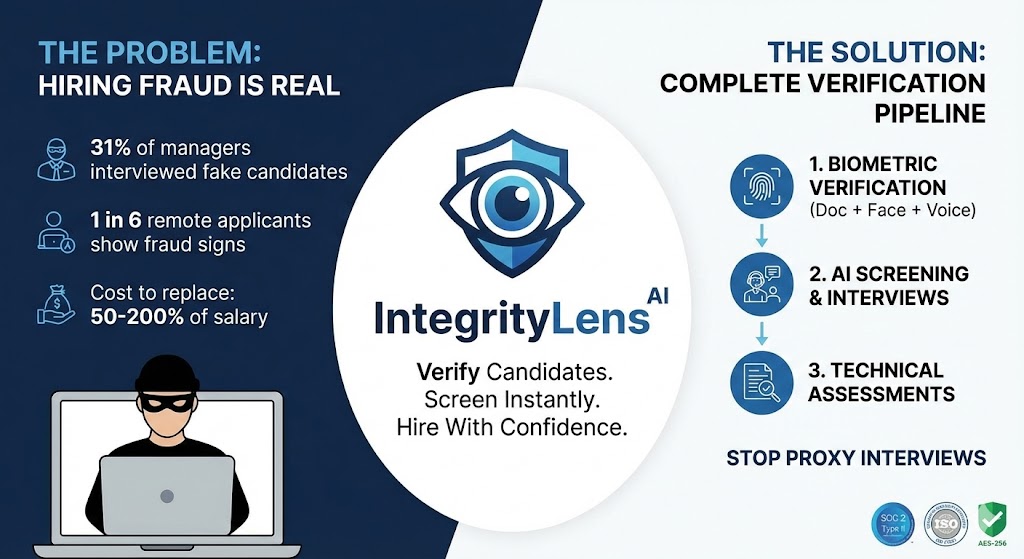
Identity verification before access. Before any new interview slot is granted, require identity gating for candidates re-entering the funnel, especially for remote roles where proxy interviewing and deepfake risk is higher. Industry reporting underscores the exposure: 1 in 6 applicants to remote roles showed signs of fraud in one real-world pipeline, and 31% of hiring managers report interviewing someone who later turned out to be using a false identity.
Automated evidence capture. Outreach template ID, consent, verification outcome, reviewer approvals, and rubric versioning should roll into an evidence pack linked to the ATS candidate record.
Segmented risk dashboards. Track time-to-event and leakage by risk tier (example: prior "hire" recommendation vs "inclined" vs "mixed"), and by policy exceptions. This is how People Analytics surfaces bottlenecks without guessing.
T0: Requisition reopened event time.
T1: Reactivation shortlist created (with eligibility rule ID).
T2: Outreach sent (template ID logged).
T3: Consent captured for reprocessing and identity check.
T4: Identity verified (or step-up invoked).
T5: Hiring Manager re-approval recorded.
T6: Interview completed and rubric stored.
SLA breakpoints: any stage where p95 time-to-event exceeds policy.
The control plane for reactivation
IntegrityLens AI fits as the ATS-anchored control plane that turns six-month-old interview evidence into a governed re-entry workflow. It does this by making identity a gate, not a checkbox, and by packaging every action into an audit-ready evidence trail that People Analytics can measure without reconstructing events from email and spreadsheets.
Identity gate before access using biometric identity verification (liveness, face match, document authentication) with typical end-to-end verification in 2-3 minutes so scheduling does not become a manual hold.
Immutable evidence packs: timestamped logs, reviewer notes, policy versions, and tamper-resistant feedback linked to the ATS candidate record.
Risk-tiered verification and step-up triggers for reactivated candidates based on prior signals and role sensitivity.
AI screening interviews available 24/7 to absorb time zone and calendar constraints without creating unlogged side channels.
Zero-retention biometrics architecture to support strict retention policies while keeping verification outcomes and proofs audit-ready.
ANTI-PATTERNS THAT MAKE FRAUD WORSE
Do not accelerate re-engagement by removing controls. These three patterns increase fraud and legal exposure at the same time:

Do not bulk-reactivate from a spreadsheet export without ATS write-back and immutable event logs. That is a shadow workflow and an integrity liability.
Do not reuse six-month-old notes as an automatic pass or reject without a rubric re-mapping step and a logged reviewer approval. Unreviewed automation is where bias and adverse-action claims land.
Do not schedule technical interviews before identity gating is complete. Fast-tracking access before verification increases proxy interview risk and makes incident response harder.
IMPLEMENTATION RUNBOOK: SLAs, owners, and what gets logged
Recommendation: implement reactivation as a policy-driven job that creates review-bound queues, not as a one-time campaign. Below is a minimal runbook that People Analytics can monitor and Recruiting Ops can operate. Use SLAs that match business urgency. The point is not perfection. The point is that SLA misses are visible, attributable, and explainable.
Step 1: Create eligibility cohort (SLA: 4 business hours). Owner: People Analytics. Log: eligibility rule ID, query hash, candidate count, run timestamp.
Step 2: Data quality gate on notes (SLA: 8 business hours). Owner: Recruiting Ops. Log: % missing rubric fields, list of candidates routed to manual remediation queue.
Step 3: Hiring Manager re-approval to re-enter funnel (SLA: 1 business day). Owner: Hiring Manager. Log: approval event with reason code, rubric version mapping, approver identity.
Step 4: Outreach send with consent capture (SLA: 2 business hours after approval). Owner: Recruiting Ops. Log: template ID, send timestamp, consent timestamp, channel.
Step 5: Identity gate before scheduling interview (SLA: 24 hours from consent). Owner: Security defines policy, Recruiting Ops operates queue. Log: verification start and end timestamps, outcome, step-up invoked or not, policy version.
Step 6: Route to interview or assessment (SLA: schedule within 2 business days after verification). Owner: Recruiting Ops. Log: scheduled event, interviewer assignment, access expiration timestamp.
Step 7: Structured interview capture (SLA: rubric submitted within 24 hours of interview). Owner: Hiring Manager. Log: rubric completion timestamp, criteria scores, written justification fields, tamper-resistant submission record.
Step 8: Decision and evidence pack finalization (SLA: 1 business day). Owner: Recruiting Ops. Log: disposition, decision reason code, link to evidence pack, any exception approvals.
Reactivation policy you can hand to Ops and Legal
Use a policy file like this to keep re-engagement rules explicit, reviewable, and versioned. It also makes audit questions answerable because every decision references a policy version.
CLOSE: If you want to implement this tomorrow
Recommendation: start with one role family, one region, and one eligibility window. Prove that you can move faster while producing defensible, ATS-anchored evidence. You are optimizing for four outcomes: reduced time-to-hire, defensible decisions, lower fraud exposure, and standardized scoring across teams.
Pick a single reopened requisition and define the silver-medalist cohort using explicit rules (date window, prior stage, rubric threshold).
Add a data quality gate: do not allow reactivation unless required rubric fields and reviewer identity are present.
Create an SLA-bound re-approval queue for Hiring Managers and require a reason code for re-entry.
Automate outreach only after re-approval and consent, and log template IDs and timestamps.
Enforce identity gate before any new interview access. Treat this like privileged access: no verification, no schedule.
Require rubric submission within 24 hours and store it as structured data tied to a rubric version.
Generate an evidence pack per reactivated candidate and link it to the ATS record as the single source of truth.
Stand up a People Analytics dashboard for time-to-event and leakage by risk tier, plus a weekly exception report (who approved what, when, and under which policy).
Related Resources
Key takeaways
- Treat silver-medalist re-engagement as a controlled workflow: eligibility rules, risk-tiering, and timestamps for every step.
- Six-month-old notes are only usable if they are structured, versioned, and tied to a rubric. Free-text summaries create defensibility gaps.
- Automate outreach, but keep human review for any step that changes candidate disposition or applies a rejection reason.
- Identity gate before any new interview access to reduce proxy and deepfake exposure during fast reactivation cycles.
- Measure time-to-event (reactivation invite sent, consent captured, identity verified, interview completed), not just time-to-fill.
Versioned policy that defines eligibility, required evidence fields, identity gate rules, and SLAs.
Use this as the control document for Recruiting Ops execution and Legal review.
version: "1.0"
policy_name: "silver-medalist-reactivation"
scope:
  role_families: ["Software Engineering", "Data"]
  regions: ["NA", "EMEA"]
  eligible_window_days:
    min: 120
    max: 240
eligibility_rules:
  prior_stage_in: ["Final Interview", "Onsite", "Offer Review"]
  disposition_exclusions:
    - "Do Not Hire"
    - "Withdrew"
  rubric_thresholds:
    overall_recommendation_in: ["Hire", "Leaning Hire", "Strong Yes"]
required_evidence_fields:
  - "rubric_version"
  - "level_mapping"
  - "criteria_scores"
  - "decision_reason_code"
  - "reviewer_user_id"
  - "review_timestamp"
automation_guards:
  allow_auto_outreach: true
  allow_auto_reject: false
  require_hm_reapproval: true
identity_gate:
  required_before: "schedule_interview"
  default_mode: "standard"
  step_up_triggers:
    - condition: "remote_role == true"
      mode: "step-up"
    - condition: "prior_proxy_signal == true"
      mode: "step-up"
slas:
  create_cohort_hours: 4
  data_quality_gate_hours: 8
  hm_reapproval_business_days: 1
  outreach_send_hours_after_approval: 2
  identity_verification_hours_after_consent: 24
  schedule_business_days_after_verification: 2
  rubric_submit_hours_after_interview: 24
audit_logging:
  write_events_to: "immutable_event_log"
  required_event_types:
    - "cohort.created"
    - "notes.quality_checked"
    - "hm.reapproved"
    - "outreach.sent"
    - "consent.captured"
    - "identity.verified"
    - "interview.scheduled"
    - "rubric.submitted"
    - "decision.recorded"
  link_to_ats_record: true
retention:
  evidence_pack_days: 365
  biometrics: "zero-retention"
exceptions:
  require_security_approval_for_identity_bypass: true
  require_legal_approval_for_policy_change: true
Outcome proof: What changes
Before
Silver-medalist reactivation was run via spreadsheet exports and email. Prior interview notes were free-text and inconsistently linked to rubric versions. Identity verification was applied inconsistently, often after scheduling to avoid delays.
After
Reactivation moved to an ATS-anchored, policy-driven workflow with structured rubrics, SLA-bound approval queues, and identity gating before interview access. Each reactivated candidate produced a single evidence pack with timestamps and approvals.
Implementation checklist
- Confirm structured note fields exist (rubric criteria, level mapping, decision reason, reviewer identity, timestamp).
- Define silver-medalist eligibility window (example: 120-240 days) and role similarity rules.
- Set review-bound SLAs for outreach approval, consent capture, and identity verification.
- Implement identity gate before scheduling any new interview loop.
- Require evidence pack creation for each re-engagement: policy version, outreach template ID, consent, verification result, reviewer approvals.
- Instrument dashboards for time-to-event and leakage by stage and risk tier.
Questions we hear from teams
- How old is too old for silver-medalist notes?
- Use an explicit policy window (example: 120-240 days) and require rubric version mapping. If the role definition or leveling changed, force a Hiring Manager re-approval with a logged reason code before re-entry.
- What if structured notes are missing for strong candidates?
- Route them to a remediation queue with an SLA and a named owner. Do not auto-reactivate based on narrative notes. Missing structure is a data quality incident, not a reason to bypass controls.
- Can we automate rejection for reactivated candidates who do not respond?
- Automate follow-ups and expiration of invitations, but do not auto-reject with a reason code. Expire access by default and log the expiration event; require human review for any rejection disposition.
Ready to secure your hiring pipeline?
Let IntegrityLens help you verify identity, stop proxy interviews, and standardize screening from first touch to final offer.
Watch IntegrityLens in action
See how IntegrityLens verifies identity, detects proxy interviewing, and standardizes screening with AI interviews and coding assessments.