When Liveness Detection Failed During Peak Hiring: Lessons Learned
How to make verification latency and decision confidence first-class metrics in your hiring process.
In hiring, every second counts; make latency and confidence your top metrics.Back to all posts
The Liveness Detection That Failed During Peak Hiring
Imagine this: It’s Black Friday, and your hiring pipeline is bustling with candidates. Suddenly, a liveness detection failure allows a proxy candidate to slip through, costing your company thousands in wasted interviews and potential fraud. In today’s fast-paced hiring... Your systems need to be resilient against sophisticated fraud tactics, including deepfakes and proxy candidates. The crux of the issue lies in how we measure and optimize verification latency and decision confidence. Treating these metrics as first-class citizens in your hiring..
Why This Matters
For engineering leaders, the implications of verification failures extend beyond immediate financial losses. A compromised hiring process can damage your brand reputation and lead to compliance issues, especially in regulated industries. When your systems lack the necessary rigor By focusing on verification latency and decision confidence, you can create a hiring environment that is not only efficient but also secure. These metrics allow you to fine-tune your processes, ensuring that each candidate is thoroughly vetted while minimizing friction in the...
How to Implement It
Step 1: Define Your SLIs and SLOs. Start by establishing clear Service Level Indicators (SLIs) for verification latency (e.g., time taken to verify a candidate) and decision confidence (e.g., accuracy of verification results). Set Service Level Objectives (SLOs) that reflect your Step 2: Instrument Your Systems. Use monitoring tools to capture real-time data on verification metrics. Implement logging mechanisms to track latency and accuracy under various candidate conditions, ensuring that you have a comprehensive view of your system’s performance. Step 3: Dynamic Threshold Tuning. Regularly analyze your verification metrics to identify trends and anomalies. Adjust your thresholds based on real-time fraud signals. For example, if you notice an uptick in proxy candidates, consider tightening your verification criteria... Step 4: Implement Step-Up Checks. Add additional verification steps only when risk signals justify them. For instance, if a candidate’s profile raises red flags, deploy more stringent checks like biometric verification or video interviews, thereby ensuring that your resources are
Key Takeaways
Always prioritize verification latency and decision confidence as critical metrics in your hiring process. Implement monitoring and logging to capture real-time data, allowing for informed decision-making. Regularly adjust your thresholds and verification methods based on real-time risk signals to maintain a balance of reliability and efficiency in your hiring flow. By treating these metrics as first-class citizens, you can significantly enhance your organization's hiring integrity
Key takeaways
- Prioritize verification latency and decision confidence as key metrics.
- Implement risk-tiered step-ups based on real-time signals.
- Continuously tune thresholds to optimize verification accuracy.
Implementation checklist
- Establish clear SLIs and SLOs for verification metrics.
- Monitor metrics under real-world candidate conditions.
- Adjust thresholds dynamically based on fraud signals.
Questions we hear from teams
- What are SLIs and SLOs in verification?
- SLIs (Service Level Indicators) measure the performance of your verification processes, while SLOs (Service Level Objectives) define the targets you aim to achieve for those indicators.
- How can I dynamically tune thresholds?
- Regularly analyze your verification metrics for trends and anomalies, adjusting thresholds based on real-time fraud signals to optimize performance.
- What are step-up checks?
- Step-up checks are additional verification steps implemented only when risk signals indicate a need for more stringent scrutiny of a candidate.
Ready to secure your hiring pipeline?
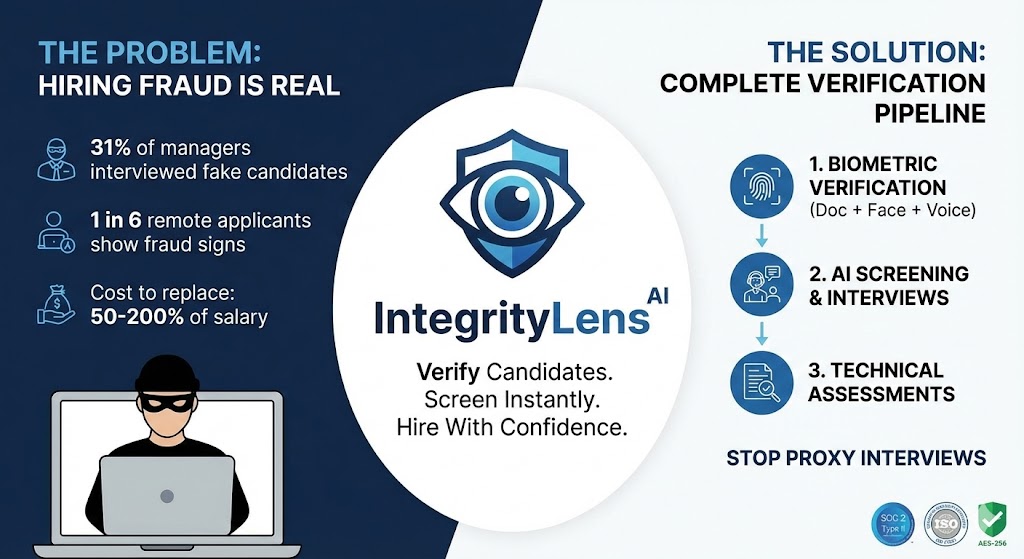
Let IntegrityLens help you verify identity, stop proxy interviews, and standardize screening from first touch to final offer.
Watch IntegrityLens in action
See how IntegrityLens verifies identity, detects proxy interviewing, and standardizes screening with AI interviews and coding assessments.