Verification SLIs and SLOs: The Metrics That Hold Up in Audit
A compliance-first briefing to instrument identity verification like an access-control system: measurable SLIs, enforceable SLOs, explicit ownership, and evidence packs you can produce under audit.
If legal asked you to prove who approved this candidate, can you retrieve it in one timeline with timestamps, owners, and evidence pack IDs?Back to all posts
Real Hiring Problem
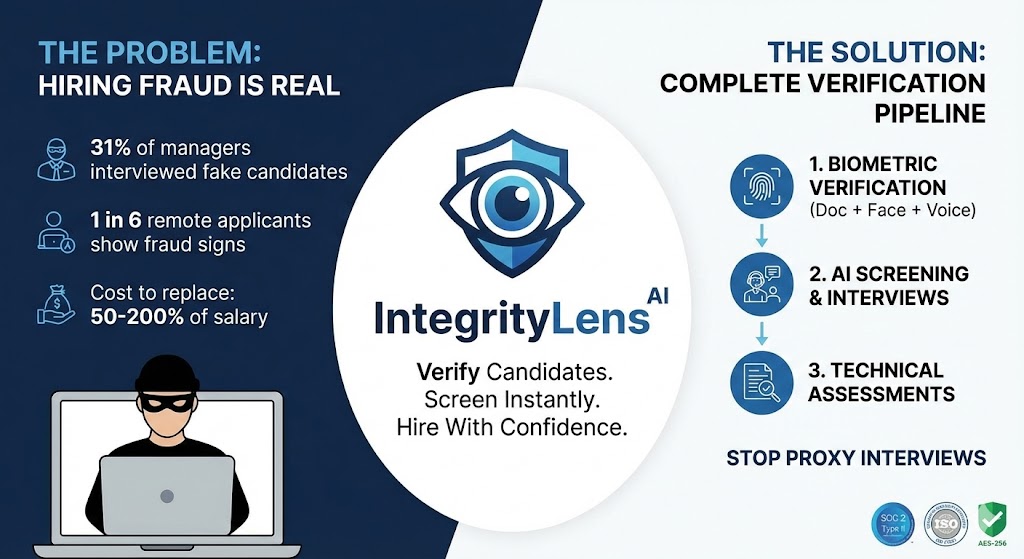
Recommendation: treat verification as an identity gate, not a checkbox. Without SLIs and SLOs, you will fail the first serious audit question: who approved this candidate, when, and based on what evidence. Scenario: a remote hire receives privileged access, then an incident triggers an internal investigation. The ATS shows a status change but no evidence pack, and manual exceptions were handled in email. Quantified exposure: replacement costs can be 50-200% of annual salary depending on role. Offer delays and offer-to-start fallout increase when unverified identity causes rework late in the funnel. Threat baseline: Checkr reports 31% of hiring managers say they have interviewed someone later found using a false identity. Pindrop reports 1 in 6 remote applicants showed signs of fraud in one pipeline.
Why Legacy Tools Fail
Recommendation: stop relying on an ATS plus point solutions to produce audit-ready controls. The market failed because most tools were built for sequential checks, not event-based orchestration. Legacy patterns create operational risk: sequential checks that slow hiring, no immutable event logs, no unified evidence packs, no review-bound SLAs, no standardized rubric storage, and shadow workflows across portals and spreadsheets. Compliance impact: a pass/fail screen is not defensible. If it is not logged, it is not defensible.
Ownership and Accountability Matrix
Recommendation: assign ownership per metric and per decision so Compliance sets policy, Recruiting Ops runs the workflow, and Security controls access and review operations. Recruiting Ops owns workflow orchestration and is accountable for completion rate and latency SLO adherence at the funnel level. Security owns identity gating policy, reviewer access control, and fraud policy. Security is accountable for fraud adjudication and evidence sufficiency. Hiring Manager owns rubric discipline and must not score unverified candidates for defined risk tiers. Analytics owns metric definitions, dashboard correctness, and segmentation so teams can self-serve time-to-event and failure modes. Sources of truth: ATS for lifecycle state; verification service for identity artifacts and outcomes; interview and assessment systems for artifacts tied to verified identity event IDs.
Modern Operating Model: Define Verification SLIs and SLOs
Recommendation: instrument verification like secure access management. SLIs are operational health signals and SLOs are enforceable targets with escalation paths. Define SLIs with explicit numerators and denominators: completion rate, verification latency (p50 and p95), manual review rate, and fraud catch rate tied to evidence packs. Set SLOs by risk tier and role criticality, not one global number. Define completion minima, latency p95 maxima, review queue age limits, and evidence pack completeness requirements. Operational rule: time delays cluster at moments where identity is unverified. Use time-to-event analytics to find the exact step where the queue ages. Governance rule: a decision without evidence is not audit-ready. Fraud catch rate is only meaningful if every flag has a timestamped reason code and attached artifacts.

Where IntegrityLens Fits
IntegrityLens AI enables an ATS-anchored control plane that treats verification as identity gating before access, with logs and evidence packs that are reconstructable under audit. Typical end-to-end verification time is 2-3 minutes for document plus voice plus face, enabling early gating without late-stage rework. Capabilities that matter operationally: - Advanced biometric identity verification (liveness, face match, document auth) that emits timestamped events. - Fraud prevention including deepfake detection, proxy interview detection, and behavioral signals to justify step-up verification. - Immutable evidence packs and compliance-ready audit trails tied to ATS lifecycle events. - AI screening interviews available 24/7 to parallelize checks instead of waterfall workflows. - Technical assessments with execution telemetry and plagiarism detection across 40+ languages to reduce integrity ambiguity.
Anti-Patterns That Make Fraud Worse
- Allowing interviews or assessments before the identity gate because the manual review queue is backed up. - Accepting a vendor portal pass/fail without importing timestamps, reason codes, and reviewer identity into an ATS-anchored audit trail. - Using a single global SLO for all roles, which forces either over-review (queue explosion) or under-control (missed fraud) depending on volume.
Implementation Runbook
Define risk tiers and a versioned verification policy. Owner: Compliance with Security. SLA: 5 business days. Evidence: policy version, required artifacts, exception criteria, and retention boundaries logged.
Place identity gating before privileged moments (interview, assessment, offer approval) by tier. Owner: Recruiting Ops. SLA: same day configuration. Evidence: verification_requested event, gate enforcement event, and stage transitions in ATS.
Define metric queries and dashboards. Owner: Analytics with Compliance sign-off. SLA: 2 business days. Evidence: metric definitions, query versions, dashboard owner list.
Configure review-bound SLAs and escalation. Owner: Security for reviewer ops; Recruiting Ops for routing. SLA: p95 review resolution per tier with escalation at 50% of window. Evidence: reviewer assignment, timestamps, decision reason codes.
Enforce evidence pack completeness. Owner: Compliance. SLA: immediate. Evidence: evidence pack ID, required fields, artifact hashes, linkage to policy version.
Weekly governance and staffing adjustments. Owner: Recruiting Ops and Security, Compliance attends. SLA: weekly 30 minutes. Evidence: review queue age, manual review rate, completion rate, p95 latency, exception counts, and policy changes logged.
Sources
Close: Implementation Checklist
If you want to implement this tomorrow: - Write SLI definitions with numerators and denominators for completion rate, latency, manual review rate, and fraud catch rate. - Publish tiered SLOs and an exceptions policy with version control. - Move identity gating earlier and hard-block unverified candidates from defined stages by tier. - Stand up review-bound SLAs with queue age limits, named reviewers, and escalation routing. - Require ATS-anchored audit trails: who approved, when, and the evidence pack ID. If it is not logged, it is not defensible. - Deploy segmented risk dashboards recruiters can access without a ticket: time-to-event, failure reasons, review queue age, exceptions. - Run weekly governance that ties telemetry to staffing and policy tuning, not anecdotes. Expected outcomes: reduced time-to-hire via measurable queue control, defensible decisions via evidence packs, lower fraud exposure via step-up adjudication, and standardized scoring via rubric discipline tied to verified identity events.
Related Resources
Key takeaways
- Treat verification as identity gating before privileged access, with explicit SLIs and SLOs tied to timestamps.
- Completion rate and latency are leading indicators for offer delays and funnel leakage, not vanity metrics.
- Review rate is a staffing and policy-control metric: if it spikes, you either understaffed reviewers or overtuned policy.
- Fraud catch rate is only defensible when paired with immutable evidence packs and logged reviewer decisions.
- Democratized data matters: Recruiting Ops should see their own time-to-event and failure modes without waiting on Analytics.
Versioned policy template that defines four core verification SLIs and tiered SLOs, plus evidence pack requirements and alert thresholds.
Use this to align Recruiting Ops, Security, and Compliance on what gets measured, who is paged, and what must be stored for audit. It is designed to prevent shadow workflows by enforcing ATS-anchored logs.
verificationObservabilityPolicy:
  policyVersion: "2026-01-01"
  scope:
    appliesTo: ["employees", "contractors"]
    channels: ["remote", "hybrid"]
  slis:
    completionRate:
      definition: "completed_verifications / verification_requests"
      segmentBy: ["role_family", "geo", "risk_tier"]
    verificationLatencySeconds:
      definition: "time(verification_resolved) - time(verification_requested)"
      reportPercentiles: [50, 95]
    manualReviewRate:
      definition: "manual_review_cases / verification_requests"
      segmentBy: ["risk_tier", "failure_reason"]
    fraudCatchRate:
      definition: "fraud_confirmed_cases / verification_requests"
      requiresEvidencePack: true
  slos:
    tier1_low_risk:
      completionRateMin: 0.90
      latencyP95SecondsMax: 600
      manualReviewRateMax: 0.10
      reviewQueueAgeP95MinutesMax: 60
    tier2_standard:
      completionRateMin: 0.92
      latencyP95SecondsMax: 900
      manualReviewRateMax: 0.15
      reviewQueueAgeP95MinutesMax: 90
    tier3_high_risk:
      completionRateMin: 0.95
      latencyP95SecondsMax: 1200
      manualReviewRateMax: 0.25
      reviewQueueAgeP95MinutesMax: 120
  evidencePack:
    requiredFields:
      - candidateId
      - verificationRequestId
      - verificationResolvedTimestamp
      - verificationOutcome
      - outcomeReasonCodes
      - reviewerIdIfManual
      - artifactHashes
      - policyVersion
  alerts:
    pageOnCallIf:
      - "reviewQueueAgeP95Minutes > reviewQueueAgeP95MinutesMax"
      - "latencyP95Seconds > latencyP95SecondsMax"
    weeklyGovernanceIf:
      - "manualReviewRate > manualReviewRateMax"
      - "completionRate < completionRateMin"
Outcome proof: What changes
Before
Verification outcomes lived in a vendor portal and email. Manual reviews had no queue age SLA, and the ATS showed stage changes without linked evidence. When exceptions occurred, teams bypassed steps to protect time-to-offer, creating integrity liabilities.
After
Tiered verification SLIs/SLOs were published as policy, identity gating was moved earlier, and every verification decision produced an evidence pack ID written back into the ATS with timestamps and reviewer attribution. Weekly governance used time-to-event dashboards to staff review queues and tune policy thresholds.
Implementation checklist
- Define SLIs: completion rate, verification latency, manual review rate, fraud catch rate (with evidence requirements).
- Set SLOs by risk tier and role criticality, not one global number.
- Implement review-bound SLAs with named owners and escalation paths.
- Require ATS-anchored audit trails: who approved, when, and based on what evidence pack.
- Dashboard leading indicators weekly: time-to-event by step, review queue age, failure reasons, fraud signals by cohort.
Questions we hear from teams
- What is the difference between an SLI and an SLO in hiring verification?
- An SLI is the measured health indicator of a verification step, such as completion rate or p95 latency. An SLO is the enforceable target for that SLI, such as a maximum p95 time-to-resolution, with owners, escalation rules, and logged evidence when breached.
- Which verification metric should Compliance care about most?
- Compliance should care most about evidence-backed outcomes: fraud catch rate tied to evidence pack IDs and audit trails, plus review-bound SLAs that prevent unlogged exceptions. Speed metrics matter because latency spikes create shadow workflows that are not defensible.
- How do you set SLOs without causing unnecessary manual review?
- Set SLOs by risk tier and monitor manual review rate and review queue age. If review rate rises, adjust policy thresholds or staffing to keep queue age within SLA, and log the policy version change so decisions remain traceable.
- How do you make verification decisions audit-ready?
- Require ATS-anchored audit trails that capture verification requested and resolved timestamps, reviewer identity for manual cases, outcome reason codes, and an immutable evidence pack ID. If it is not logged, it is not defensible.
Ready to secure your hiring pipeline?
Let IntegrityLens help you verify identity, stop proxy interviews, and standardize screening from first touch to final offer.
Watch IntegrityLens in action
See how IntegrityLens verifies identity, detects proxy interviewing, and standardizes screening with AI interviews and coding assessments.