The Latency Trap: How Slow Verification Can Cost You Candidates
Explore how to instrument verification latency and decision confidence as first-class SLIs to enhance your hiring process.
Slow verification can cost you top candidates and damage your brand reputation.Back to all posts
The Latency Trap: A High-Stakes Scenario
Imagine a candidate who has just completed an extensive interview process, only to be left hanging for days while their verification is processed. This delay not only frustrates the candidate but also puts your organization at risk of losing top talent to competitors who can move faster. In a world where speed is critical, the cost of slow verification can be substantial, impacting both your hiring success and your brand reputation.
Why This Matters
For engineering leaders, understanding the implications of verification latency is crucial. Slow processes can lead to candidate drop-off, missed opportunities, and ultimately, revenue loss. Moreover, in the context of compliance, delayed verifications may expose your company to regulatory risks. By treating latency and decision confidence as first-class metrics, you can make data-driven decisions that enhance your hiring process and reduce risk. Furthermore, a well-optimized verification process fosters a positive candidate experience. Candidates are more likely to accept offers when they feel valued and respected throughout the hiring journey.

How to Implement It
Step 1: Set up SLIs for verification latency and decision confidence. Use monitoring tools to capture real-time data on how long verifications take and how confident the system is in its decisions. Step 2: Establish clear SLOs that define acceptable levels for latency and confidence. For instance, aim for a verification latency of under 5 minutes with a decision confidence rate of 95% or higher. Step 3: Regularly review and adjust thresholds based on operational performance. If latency consistently exceeds your SLOs, investigate the bottlenecks and optimize your processes accordingly.
Key Takeaways
Always instrument latency and decision confidence as first-class metrics to enhance visibility into your verification processes. Implement risk-based step-ups only when justified by data, minimizing friction for low-risk candidates while maintaining security. Continuously tune and adjust your verification systems based on real-time performance data to stay competitive.
Related Resources
Key takeaways
- Instrument latency and confidence as first-class metrics.
- Implement risk-based step-ups to enhance security without unnecessary friction.
- Continuously tune thresholds based on real-world performance.
Implementation checklist
- Set up SLIs for verification latency and decision confidence.
- Establish clear SLOs for acceptable latency and confidence levels.
- Regularly review and adjust thresholds based on operational performance.
Questions we hear from teams
- What are SLIs and SLOs in the context of verification?
- SLIs (Service Level Indicators) are metrics that measure the performance of your verification processes, while SLOs (Service Level Objectives) are the target levels you aim to achieve for those metrics.
- How can I minimize friction in my verification process?
- Implement risk-based step-ups, applying additional verification checks only when candidates exhibit high-risk indicators.
- What tools can help monitor verification latency?
- Consider using APM (Application Performance Monitoring) tools that provide real-time insights into your system's performance metrics.
Ready to secure your hiring pipeline?
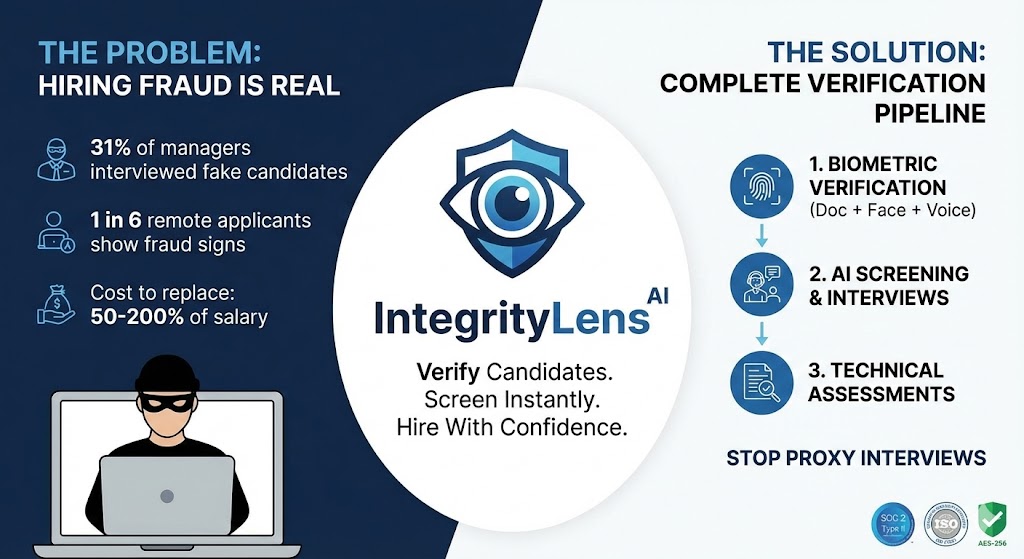
Let IntegrityLens help you verify identity, stop proxy interviews, and standardize screening from first touch to final offer.
Watch IntegrityLens in action
See how IntegrityLens verifies identity, detects proxy interviewing, and standardizes screening with AI interviews and coding assessments.