The Deepfake That Almost Cost Us the Hire
How to fortify your hiring process against modern identity verification threats.
Proactive red-team exercises can save you from costly hiring mistakes.Back to all posts
The Deepfake That Almost Cost Us the Hire
In today's tech landscape, the stakes for hiring security have never been higher. Imagine this: during a critical hiring phase, your system fails to detect a deepfake candidate, leading to a $100K loss in training costs and reputational damage. The consequences of inadequate IDV— Incorporating quarterly red-team exercises can serve as your best defense against evolving threats. These simulations help you identify weaknesses in your capture and interview flows, from detecting voice mismatch to recognizing anomalies in document verification. By proactively, To implement effective red-team exercises, start by defining the scope. Identify the key areas of your hiring process that rely on identity verification, such as video interviews and document submissions. Develop metrics for capture anomalies, including thresholds for voice mism,
Why This Matters
For engineering leaders, the importance of robust identity verification cannot be overstated. With the rise of AI-generated content, the risk of encountering deepfakes in hiring processes is increasing. A single failure can lead to significant financial losses and tarnished reput The implications extend beyond immediate costs. Poor identity verification can damage your brand's reputation and trustworthiness. Candidates who experience fraud can become vocal critics, impacting your ability to attract top talent in the future. By implementing rigorous red-team exercises, you not only enhance your hiring security but also create a culture of continuous improvement. This proactive approach can lead to better processes and ultimately, better hires.
How to Implement It
Step 1: Schedule your quarterly red-team exercises. Define the scope and objectives, focusing on key areas like video interviews and document submissions. Step 2: Develop metrics for capture anomalies. Set thresholds for voice mismatches and mismatch-to-ID ratios to guide your simulations. Step 3: Create a structured response runbook. Outline clear steps for reviewers when anomalies are detected, ensuring quick and effective responses.
Key Takeaways
Conduct quarterly red-team exercises to identify vulnerabilities in your hiring process. Implement clear response runbooks for anomaly detection to streamline your review process. Utilize specific metrics to measure system effectiveness, aiming for a FAR below 1%.
Key takeaways
- Conduct quarterly red-team exercises to identify vulnerabilities.
- Implement clear response runbooks for anomaly detection.
- Utilize specific metrics to measure system effectiveness.
Implementation checklist
- Establish a red-team schedule and scope for quarterly exercises.
- Define capture anomaly metrics and thresholds.
- Create a runbook for reviewing and responding to anomalies.
Questions we hear from teams
- What should I include in a red-team exercise?
- Focus on key areas such as video interviews and document submissions, and define metrics for capture anomalies.
- How often should I conduct these exercises?
- Quarterly is recommended to continuously assess and improve your identity verification processes.
- What metrics should I track for effectiveness?
- Key metrics include false acceptance rate (FAR), false rejection rate (FRR), and capture anomaly rates.
Ready to secure your hiring pipeline?
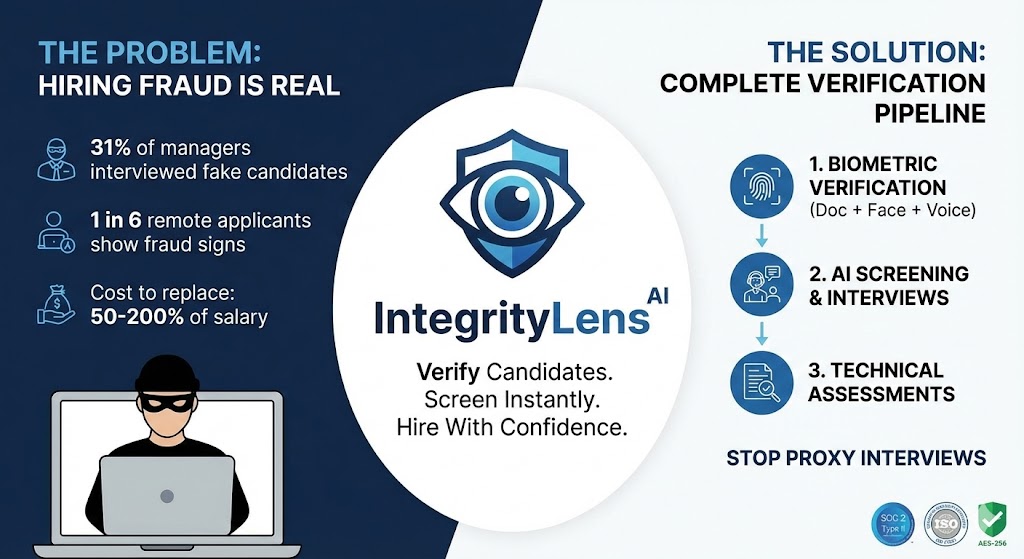
Let IntegrityLens help you verify identity, stop proxy interviews, and standardize screening from first touch to final offer.
Watch IntegrityLens in action
See how IntegrityLens verifies identity, detects proxy interviewing, and standardizes screening with AI interviews and coding assessments.