The Deepfake That Almost Cost Us a Hire: Designing a Robust Multi-Modal Verification Flow
Integrating document, face, and voice verification to mitigate identity fraud risks.
Identity fraud is a reality; don’t let your verification process be the weak link.Back to all posts
The Deepfake That Almost Cost Us a Hire
Your AI model just failed to detect a deepfake during a critical hiring round, leading to the loss of a valuable candidate and costing your company thousands in wasted resources. This scenario is not just hypothetical; it’s a reality faced by engineering leaders today. Asidentity fraud becomes more sophisticated, the stakes are high. A single lapse in verification can lead to severe financial repercussions, compliance exposure, and damage to your brand reputation.
Implementation Steps: Building Your Multi-Modal Verification Flow
Set Up Baseline Metrics: Start by defining your key performance indicators (KPIs). Focus on metrics like false acceptance rate (FAR), false rejection rate (FRR), latency, and user completion rates. Aim for a FAR below 0.1% and an FRR no higher than 5% under real-world conditions.
Establish Risk-Based Step-Ups: Instead of applying all verification methods to every candidate, create a risk-based framework. For instance, if a candidate's document verification fails, trigger additional checks like voice or facial recognition.
Continuous Monitoring and Adaptation: Collect data from each verification attempt and analyze it to adjust your thresholds
Key Takeaways
- Always validate AI outputs against real-world data to fine-tune your verification thresholds. - Implement risk-based step-ups to avoid overwhelming candidates with unnecessary checks. - Continuous monitoring is essential; adapt your verification flow based on emerging threats. feedback from your team. - For engineering leaders, the challenge of balancing security and user experience is critical.
Why This Matters
For engineering leaders, the challenge of balancing security and user experience is critical. Identity fraud is not just a financial risk; it can also lead to compliance issues and reputational damage. By implementing a multi-modal verification flow, you not only enhance security but also streamline the hiring process, making it more efficient and user-friendly. This is essential in today’s competitive job market, where the best candidates are often in high demand and can be lost to cumbersome processes.
Example: A Real-World Case Study
Consider a tech startup that implemented a multi-modal verification flow. Initially, they faced a 15% drop-off rate during the verification process. After integrating risk-based step-ups and fine-tuning their verification thresholds, they reduced drop-offs to just 5%. This not only improved their hiring efficiency but also significantly reduced the number of fraudulent applications, saving the company thousands of dollars in potential losses.
Key takeaways
- Implement risk-based step-ups to enhance security without sacrificing user experience.
- Tune verification thresholds based on real-world data for better accuracy.
- Utilize continuous monitoring to adapt to emerging threats.
Implementation checklist
- Establish baseline metrics for verification accuracy and latency.
- Set up a feedback loop for tuning verification thresholds based on candidate data.
- Implement a risk-based step-up system that triggers additional checks only when necessary.
Questions we hear from teams
- What is multi-modal verification?
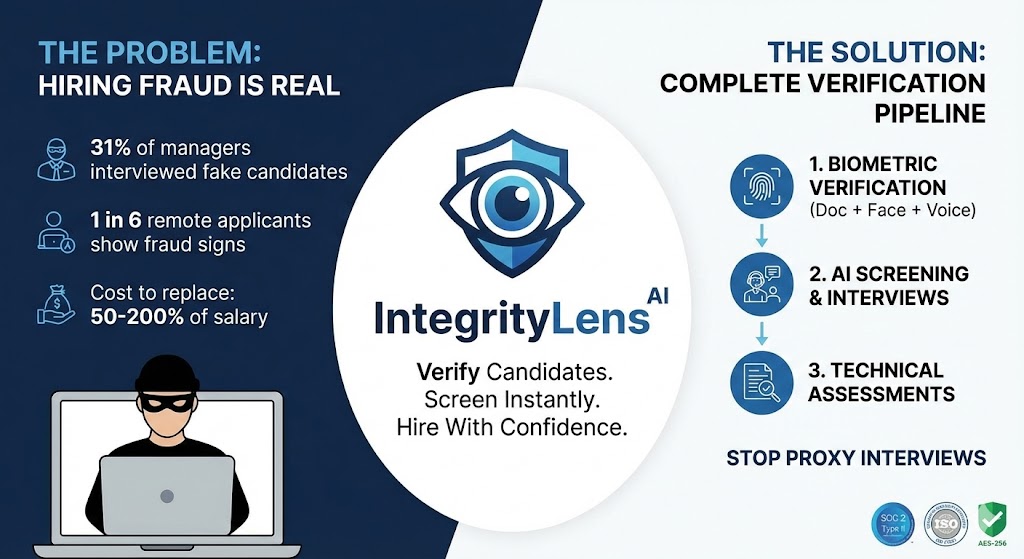
- Multi-modal verification combines different methods—such as document, facial recognition, and voice verification—to enhance identity validation.
- How can I implement risk-based step-ups in my verification process?
- Risk-based step-ups involve configuring your verification system to trigger additional checks only when certain risk signals are detected, allowing for a more efficient and user-friendly process.
- What metrics should I focus on for verification accuracy?
- Key metrics include false acceptance rate (FAR), false rejection rate (FRR), latency, and user completion rates.
Ready to secure your hiring pipeline?
Let IntegrityLens help you verify identity, stop proxy interviews, and standardize screening from first touch to final offer.
Watch IntegrityLens in action
See how IntegrityLens verifies identity, detects proxy interviewing, and standardizes screening with AI interviews and coding assessments.