Sync Structured Interview Data Into ATS Scorecards
An operator briefing for compliance leaders who need faster decisions that remain defensible under audit and resilient to fraud.
If it is not logged in the ATS, it is not defensible.Back to all posts
Real hiring problem: when Legal asks "why them," you have screenshots
You do not get sued or audited because you made a decision. You get exposed because you cannot reproduce how you made it. Here is the failure pattern Compliance sees in the war room: a hiring manager rejects a candidate after a structured interview, but the "structured" evidence is a mix of calendar invites, a standalone video interview tool, and free-text notes in a doc. Weeks later, Legal asks: "Show us the rubric, the scores, who submitted them, and whether anyone edited them after the decision." The team can only produce screenshots and Slack exports. Operationally, that breaks three things at once: - Audit defensibility: a decision without evidence is not audit-ready. If it is not logged, it is not defensible. - SLA reliability: time delays cluster at moments where identity is unverified or evidence is missing, because everyone stops to chase artifacts. - Mis-hire cost exposure: when evidence is weak, you either over-hire risk or you re-run interviews. Replacement costs are commonly estimated at 50-200% of annual salary, role-dependent. Fraud makes the black box worse. If you cannot bind the interview evidence to a verified identity, you cannot prove the person evaluated is the person you hired. Industry surveys routinely show this is not edge-case behavior: 31% of hiring managers say they have interviewed a candidate who later turned out to be using a false identity.
Why legacy tools fail: the market optimized for steps, not evidence continuity
Most hiring stacks were built as a chain of tools, not as an instrumented workflow. The market failure is structural: ATS platforms optimize for requisitions and stages; interview tools optimize for scheduling and feedback capture; assessment tools optimize for test delivery. None of them are accountable for an end-to-end, ATS-anchored evidence trail. The predictable result is operational debt: - Sequential checks slow everything down. Identity, interview, and assessment evidence arrive in a waterfall, so recruiters wait for artifacts before moving the candidate. - No unified evidence packs. Each vendor keeps its own records, often without a consistent candidate identifier you can defend. - No immutable event logs. You cannot reliably prove when a score was submitted, by whom, and whether it changed after a hiring decision. - No standardized rubric storage. "Strong hire" means different things across teams when rubrics are not enforced as structured fields. - Shadow workflows and data silos. Teams route missing evidence through email or chat, which becomes an integrity liability and a discovery risk. Compliance ends up auditing human memory and screenshots, not tamper-resistant records.
Who owns what: the accountability matrix that makes decisions reproducible
Before implementation, lock ownership. If ownership is vague, evidence capture becomes "someone else" work and your audit trail fractures. Recommended ownership model: - Recruiting Ops owns workflow: stage gates, scorecard schema, required fields, and SLA definitions. - Security owns access control and audit policy: identity gating requirements, step-up verification thresholds, retention settings, and who can view/edit evidence. - Hiring Manager owns scoring discipline: rubric calibration, interviewer assignment, and final decision sign-off tied to evidence-based scoring. - Analytics (or Ops Analytics) owns dashboards: time-to-event metrics, missing-evidence rates, SLA breaches, and segmented risk dashboards by role type.
Automate: scorecard creation at stage entry, required-field enforcement, ATS write-back, timestamped submission receipts, and exception routing.
Manual review: identity exceptions, fraud flags, outlier scoring (for calibration), and any post-decision edits (should require Security-approved override with reason code).
ATS: system of record for stage status, scorecard fields, and final decision approval.
Interview capture system: source for raw interview artifacts (video, transcript, structured responses) but must write back normalized fields to ATS.
Verification service: source for identity events (document auth, liveness, face match) that must be linked to candidate record and included in evidence pack.
What is an instrumented hiring workflow? Treat interviews like privileged access
Recommendation: instrument the interview step so every decision artifact is generated as an event, stored as structured data, and written back to the ATS as the single pane of glass. A modern operating model has five controls:
Identity verification before access. Identity gate the interview and assessment entry, not the offer stage. Use step-up verification for higher-risk roles or anomalous signals.
Event-based triggers. When a candidate enters an interview stage, trigger scorecard creation, rubric assignment, and evidence capture tasks automatically.
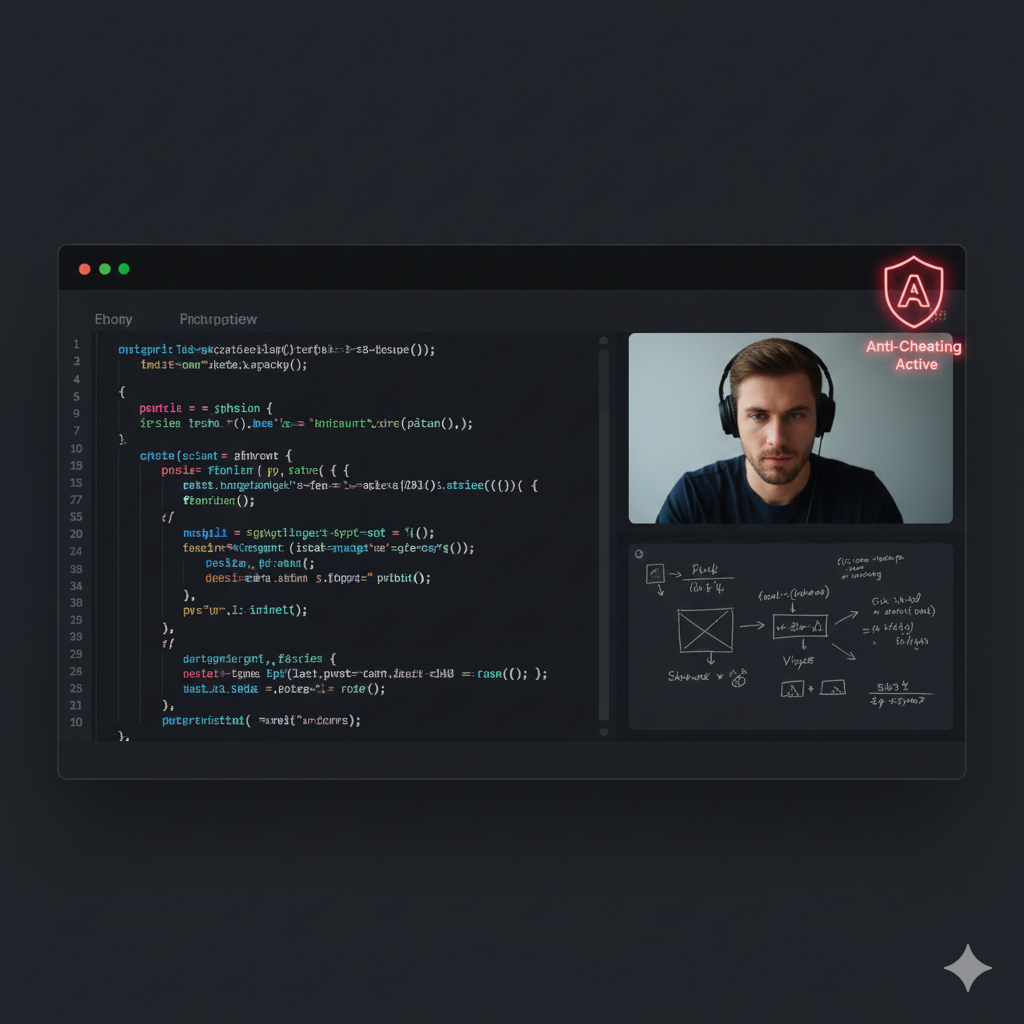
Automated evidence capture. Scores, justification text, and artifacts (links, transcripts, code telemetry) are captured in structured form and attached to the candidate record.
Analytics dashboards. Track time-to-event (time from interview complete to score submitted), missing evidence rate, and SLA breaches by team and role.
Standardized rubrics. Rubrics are versioned, stored as structured fields, and enforced with required evidence to prevent narrative-only decisions.
If Legal asked you to prove who approved this candidate, can you retrieve it in one export from the ATS?
Can you show a tamper-resistant timeline: identity verified, interview completed, score submitted, decision approved?
Can you prove the rubric version used at the time of the decision?
Where IntegrityLens fits in this workflow
IntegrityLens AI operates as the ATS-anchored control plane that keeps interview evidence and identity evidence continuous, reviewable, and attributable. Operationally, IntegrityLens enables: - Biometric identity gating with liveness checks, document authentication, and face matching before interview access, so evidence is bound to a verified person. - Workflow orchestration with configurable SLAs, automated triggers, and ATS write-back, so structured interview data lands in the scorecard without manual copying. - Multi-layer fraud prevention signals (deepfake detection, proxy interview detection, behavioral signals) to drive step-up verification instead of blanket delays. - Immutable evidence packs with timestamped logs and reviewer notes, giving Compliance a single exportable record per candidate. - Zero-retention biometrics as an operating constraint, reducing sensitive data persistence while keeping audit trails intact.
Anti-patterns that make fraud worse
Do not implement controls that create new shadow workflows. Three common anti-patterns: - Letting interview feedback live in free-text docs or chat threads, then manually summarizing into the ATS. This destroys chain-of-custody and creates discovery risk. - Allowing post-decision score edits without an immutable event log and reason code. If you cannot show who changed what and when, you cannot defend the decision. - Running identity checks after interviews "to save time." This is backward. It grants unverified individuals access to privileged interview interactions and contaminates your evidence trail.
Implementation runbook: sync structured interview evidence into the ATS scorecard
Define the scorecard contract (Day 0) - Owner: Recruiting Ops - SLA: 2 business days to publish v1 rubric schema per role family - Log/evidence: rubric version ID, required fields, scoring scale, and required artifact types stored in ATS config and immutable change history
Identity gate before interview scheduling - Owner: Security - SLA: verify identity in under 3 minutes before interview start for standard risk; step-up path for exceptions - Log/evidence: document auth result, liveness result, face match result, timestamps, reviewer ID for exceptions, linked to candidate record
Auto-create structured scorecard on stage entry - SLA: instantaneous trigger at "Interview Scheduled" event - Log/evidence: event timestamp, scorecard ID, assigned interviewers, rubric version pinned to candidate
Capture structured responses and lock submission - Owner: Hiring Manager (process), Interviewers (execution) - SLA: scorecard submitted within 24 hours of interview end; escalation at 24 hours, hard breach at 48 hours - Log/evidence: per-interviewer submission timestamp, required fields completion, artifact links, attestation checkbox ("I completed this interview")
Automated ATS write-back and evidence pack assembly - Owner: Recruiting Ops (workflow), Security (policy) - SLA: write-back within 5 minutes of submission; evidence pack generated at stage exit - Log/evidence: immutable event log entries for write-back, hash or immutable reference for artifacts, evidence pack ID and export receipt
Decision gate with required evidence - Owner: Hiring Manager (decision), Compliance (policy) - SLA: decision must occur within 48 hours of last scorecard submission to maintain time-to-offer control - Log/evidence: decision timestamp, approver identity, score rollup, reason code, and confirmation that required evidence fields are present
Exception handling queue (missing evidence, identity anomalies, fraud flags) - Owner: Security (identity/fraud), Recruiting Ops (missing evidence) - SLA: review queue first response within 4 business hours; resolution target within 1 business day - Log/evidence: queue entry timestamp, assigned reviewer, disposition code, notes, and any step-up verification events To operationalize this, enforce it as policy, not guidance. The moment you allow "just this once" exceptions without logs, you recreate the black box.
Sources
- Checkr, Hiring Hoax (Manager Survey, 2025): https://checkr.com/resources/articles/hiring-hoax-manager-survey-2025
SHRM, replacement cost estimates (50-200% of salary, role-dependent): https://www.shrm.org/in/topics-tools/news/blogs/why-ignoring-exit-data-is-costing-you-talent
Close: If you want to implement this tomorrow, start here
If your goal is reduced time-to-hire without increasing legal exposure, focus on data continuity and timestamps. Implement in this order: - Make the ATS scorecard the single source of truth for structured interview outcomes. - Require rubric versioning and required evidence fields so scoring is evidence-based, not narrative. - Identity gate before interview access, with step-up verification for exceptions. - Enforce review-bound SLAs: 24 hours to submit, 48 hours to decide, and a 4-hour first-response queue for exceptions. - Generate an evidence pack per candidate so audit requests are exports, not investigations. Business outcomes you can measure immediately: fewer SLA breaches (time from interview end to score submission), fewer re-interviews (missing evidence rate), and lower fraud exposure (verified identity bound to interview artifacts).
Related Resources
Key takeaways
- If it is not logged in the ATS, it is not defensible during audit or litigation.
- Structured interviews only reduce risk when the rubric, evidence, and approver identity are captured as tamper-resistant records.
- Syncing structured interview data into ATS scorecards turns scattered notes into reviewable, SLA-bound decision artifacts.
- Treat interview access like privileged access: identity gate before interview access and step-up verification when risk signals spike.
- A decision without evidence is not audit-ready: require evidence packs per candidate, not narrative summaries.
Defines required scorecard fields, SLAs, identity gating, and immutable logging expectations so Compliance can audit by configuration, not by interviews.
Recruiting Ops owns rubric and SLA values. Security owns identity thresholds and exception handling.
version: "1.0"
policy_id: "scorecard-sync-no-black-box"
scope:
  role_families: ["engineering", "finance", "customer-support"]
  stages:
    - "Interview Scheduled"
    - "Interview Complete"
    - "Decision"
identity_gate:
  required_before_stage: "Interview Scheduled"
  standard_verification_target_minutes: 3
  methods:
    - document_auth
    - liveness
    - face_match
  step_up_triggers:
    - name: "risk-role"
      condition: "role_family in ['finance']"
      action: "require_continuous_reauth"
    - name: "anomalous-signal"
      condition: "fraud_signals.deepfake_suspected == true or fraud_signals.proxy_interview_suspected == true"
      action: "route_to_security_review_queue"
scorecard:
  source_of_truth: "ATS"
  rubric_version_pinned_at_stage: "Interview Scheduled"
  required_fields:
    - competency: "role_skills"
      scale: "1-5"
      evidence_required: true
    - competency: "problem_solving"
      scale: "1-5"
      evidence_required: true
    - competency: "communication"
      scale: "1-5"
      evidence_required: true
  required_artifacts:
    - "interview_video_link_or_transcript"
    - "interviewer_attestation"
slas:
  scorecard_submit_hours_after_interview: 24
  scorecard_escalation_hours: 24
  scorecard_breach_hours: 48
  decision_sla_hours_after_last_submission: 48
  exception_queue_first_response_hours: 4
  exception_queue_resolution_business_days: 1
logging:
  immutable_event_log: true
  events:
    - "identity.verification.completed"
    - "interview.completed"
    - "scorecard.created"
    - "scorecard.submitted"
    - "scorecard.edited"
    - "ats.writeback.completed"
    - "decision.approved"
  required_event_fields:
    - "candidate_id"
    - "requisition_id"
    - "actor_id"
    - "timestamp_utc"
    - "rubric_version"
    - "reason_code"  # required for edits and overrides
exceptions:
  allow_post_decision_edits: false
  override_path:
    owner: "Security"
    required_reason_code: true
    required_reviewer_notes: true
    creates_event: "scorecard.override.approved"
retention:
  zero_retention_biometrics: true
  store_verification_outcomes_only: true
  evidence_pack_exportable: true
Outcome proof: What changes
Before
Interview feedback captured in a video tool and summarized into the ATS as free text. Missing scorecards were chased in chat. Compliance could not reconstruct who submitted what when, and identity verification happened late in the funnel.
After
Structured interview rubrics were enforced as required ATS fields with auto-write back. Identity was gated before interview access, and every submission produced an immutable event record and an exportable evidence pack per candidate.
Implementation checklist
- Define the ATS scorecard schema (competencies, scale, required evidence fields).
- Require interviewer identity and timestamped submission for every scorecard.
- Auto-write back structured scores, notes, and artifacts into the ATS within an SLA.
- Block stage progression if required fields are missing or evidence is not attached.
- Route exceptions (late submissions, missing evidence, risk flags) into SLA-bound review queues.
- Generate an evidence pack per candidate including identity verification events and scorecard history.
Questions we hear from teams
- What makes a hiring decision "defensible" in an audit?
- A decision is defensible when you can reproduce the decision path from the ATS record: who verified identity, who submitted each scorecard, which rubric version was used, timestamps for each event, and an immutable history of any edits or overrides.
- Do structured interviews help if interviewers still write free-text notes?
- Not reliably. Free text without required evidence fields and rubric versioning recreates the black box. The control is structured capture plus ATS write-back plus immutable event logs.
- Where do SLAs actually reduce risk?
- SLAs reduce risk at handoff points. Track time from interview end to score submission, and time from last submission to decision. These are where delays, shadow workflows, and post-hoc edits cluster.
- How should Compliance handle exceptions without slowing hiring?
- Use an SLA-bound exception queue with clear dispositions. Missing evidence goes to Recruiting Ops; identity anomalies and fraud flags go to Security. Keep the candidate moving only when the exception is logged and resolved.
Ready to secure your hiring pipeline?
Let IntegrityLens help you verify identity, stop proxy interviews, and standardize screening from first touch to final offer.
Watch IntegrityLens in action
See how IntegrityLens verifies identity, detects proxy interviewing, and standardizes screening with AI interviews and coding assessments.