Parallelize Hiring Checks Without Breaking Audit Trails
A practical orchestration pattern for running identity verification, background screens, and reference checks concurrently while keeping the ATS as the system of record and preserving defensible controls.
Parallelize the starts, gate the decisions, and keep the ATS as the record. That is how you get speed without audit surprises.Back to all posts
The offer window collapses at 4:58 PM Friday
A finalist accepts verbally, but your team cannot send the offer because identity is still unverified, background screening has not been initiated, and references are sitting in someone's inbox. The hiring manager pings you, Finance wants headcount certainty, and Legal asks what evidence you have if the candidate later proves fraudulent. This is where parallel processing pays off. If identity verification, background screening initiation, and reference collection had started together, you would be waiting on the slowest signal only once, not three times in series. By the end of this playbook, you will be able to run these checks concurrently with explicit gates so you move fast without creating an audit gap.
Parallel processing reduces calendar time without weakening controls
Recommendation: initiate identity, background, and reference workflows in parallel as soon as a candidate enters a qualifying ATS stage, then gate interview and offer actions on the minimum defensible evidence. The risk you are managing is not just fraud. It is variance: unpredictable time-to-offer creates funnel leakage, renegotiations, and rushed exceptions that later show up as audit findings. Directional context: Checkr reports that 31% of hiring managers say they have interviewed a candidate who later turned out to be using a false identity. This implies identity risk is common enough to justify a systematic control before you invest more interview time. It does not prove your org's rate, nor does it specify industries or role types where the risk is concentrated, so you still need internal measurement.
Ownership, automation, and sources of truth
Recommendation: define one operational owner, one security owner, and one system of record so parallelization does not create conflicting statuses. Ownership model that works in practice: Recruiting Ops owns orchestration and SLAs, Security owns verification policy and exception thresholds, and Hiring Managers own interview decisions but do not override gates. Automation vs manual review: automation initiates checks, collects artifacts, and applies clear pass or fail outcomes. Manual review is reserved for step-up cases (for example, liveness ambiguity, document mismatch, or inconsistent employment history) with an SLA-bound queue to prevent reviewer fatigue. Sources of truth: the ATS is the authoritative state machine for the candidate stage. The verification service is the authoritative source for identity evidence. Background and reference vendors are authoritative for their adjudication artifacts. Your orchestration layer writes summarized outcomes back to the ATS and stores an Evidence Pack pointer for defensibility.
Before interview: verified identity (document + face + voice) or approved step-up exception.
Before offer: background adjudication complete (or conditionally cleared per policy) plus reference collection complete or timeboxed with documented attempt history.
Before start date: any post-offer screens (where applicable) completed and attached to the candidate record.
How to orchestrate concurrent checks step by step
Recommendation: treat the ATS stage change as the trigger, fire three idempotent jobs in parallel, then reconcile outcomes back into a single gating decision. Step 1: Pick the trigger stage and correlation id. Common trigger: ATS stage "Finalist" or "Offer Prep". Generate a stable correlation id (for example, integritylens_candidate_id) and propagate it to all vendors for observability. Step 2: Initiate checks concurrently. Call identity verification immediately. In parallel, initiate the background screen (at least the order creation) and send reference invites. The key is to start the clock on all three at once. Step 3: Apply Risk-Tiered Verification. Low-risk candidates complete standard verification. Medium or high risk triggers a step-up (additional liveness check, re-capture, or manual review) before you let interviews proceed. Step 4: Reconcile with a gate, not a spreadsheet. A gate is a deterministic policy: "Offer can be generated only if identity=verified AND background=complete_or_conditionally_clear AND references=complete_or_timeboxed". Write the gate outcome to the ATS as a field and attach an Evidence Pack link. Step 5: Build failure handling like you expect incidents. Use retries, dead-letter queues, and idempotent webhooks so you do not double-order background checks or lose a verification result when the ATS is down. Step 6: Add a kill switch and canary rollout. Start with one job family or one region. If fraud flags spike or a vendor degrades, disable auto-advancement while still allowing checks to run and evidence to collect.
Queue vendor results keyed by the correlation id and replay when the ATS recovers.
Never advance stages based on vendor callbacks alone; advancement must be an ATS write that can be audited.
Expose a reconciliation dashboard that shows "vendor complete but ATS not updated" as an exception class.
Use OAuth/OIDC for vendor and internal service auth where supported. Avoid long-lived API keys in CI.
Trace every event with the same correlation id across logs, webhooks, and ATS notes.
Publish a sandbox stage in the ATS and a test vendor environment so changes do not hit production candidates.
A policy config you can actually run
Recommendation: encode the gate as configuration, not tribal knowledge. This reduces exceptions and gives Legal something concrete to review.
Anti-patterns that make fraud worse
Do not do these if you want speed and safety at the same time:
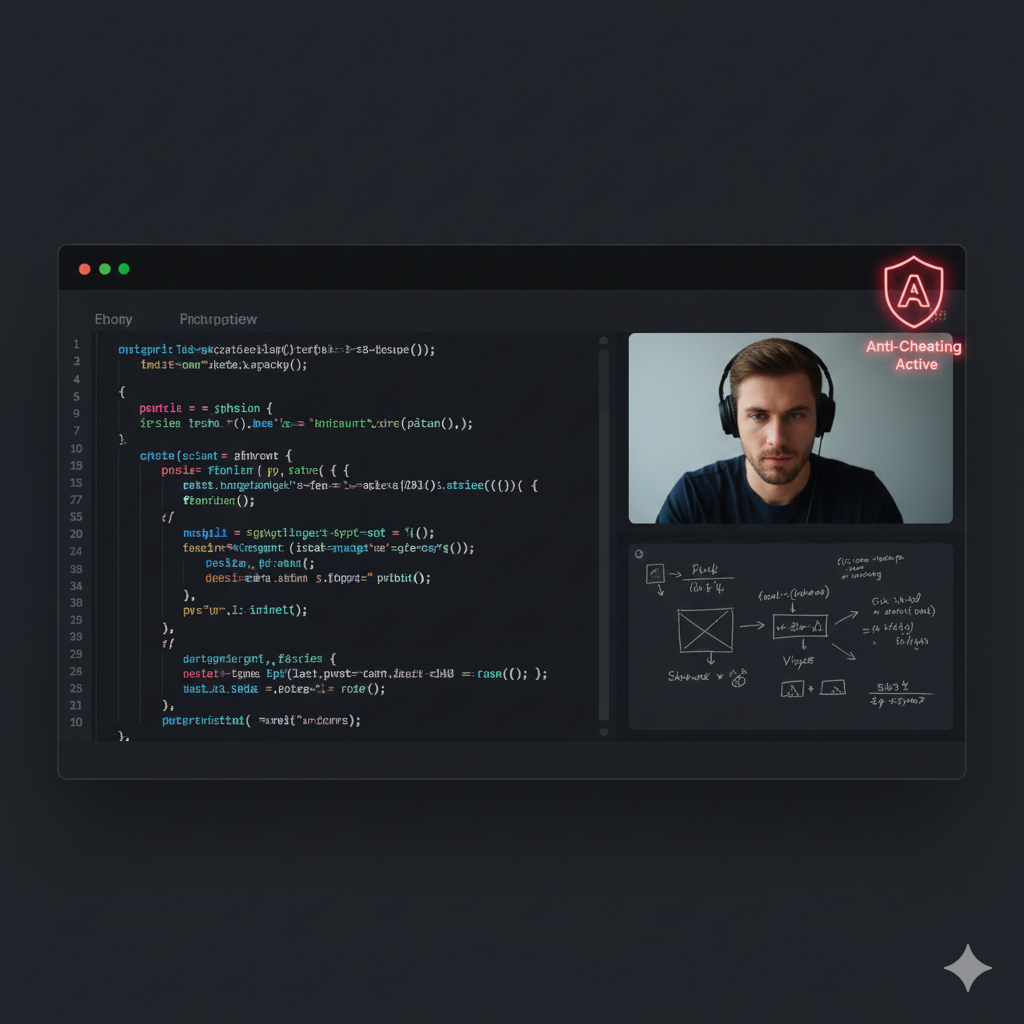
Serializing checks by habit: waiting for background to finish before initiating identity verification or references, creating predictable bottlenecks and rushed exceptions.
Letting hiring managers bypass gates in chat: approvals without evidence packs create an audit hole and normalize workarounds.
Splitting evidence across tools with no correlation id: results become untraceable, manual reviewers re-check work, and false positives rise from missing context.
Where IntegrityLens fits
IntegrityLens AI is the hiring pipeline that lets you run parallel checks while keeping one defensible system of record. It combines ATS workflow, advanced biometric identity verification, fraud detection, AI screening interviews, and coding assessments in a single platform. For TA leaders, recruiting ops, and CISOs, the platform supports Risk-Tiered Verification and produces Evidence Packs tied to the candidate record so decisions are explainable later. Practical fit for parallel processing: - Trigger parallel workflows from ATS stage changes (source candidates - verify identity - run interviews - assess - offer). - Verify identity in under three minutes before the interview starts (typical end-to-end 2-3 minutes: document + voice + face). - Use 24/7 AI interviews and 40+ language coding assessments without jumping between tools. - Keep security posture consistent with 256-bit AES encryption and SOC 2 Type II and ISO 27001-certified infrastructure controls.
Sources
- Checkr, Hiring Hoax (Manager Survey, 2025): https://checkr.com/resources/articles/hiring-hoax-manager-survey-2025
Related Resources
Key takeaways
- Parallel processing works when you parallelize initiation, not approvals: start checks together, but gate decisions on verified identity and completed risk signals.
- Define sources of truth up front: ATS for status, verification service for identity evidence, screening vendors for adjudication artifacts.
- Use risk-tiered gating to avoid funnel leakage: low-risk candidates move with minimal friction, high-risk candidates trigger step-ups.
- Make it observable: a single candidate correlation id across ATS, verification, background, and references reduces reviewer fatigue and audit findings.
- Build for failures: idempotent webhooks, retries, and an ATS-down fallback prevent silent control gaps.
Use this as a reference policy for an orchestration service that listens to ATS stage changes, starts three checks concurrently, and only allows offer generation when the gate is satisfied.
This pattern assumes idempotent job keys, webhook signature verification, and an Evidence Pack URL written back to the ATS. Replace vendor placeholders with your providers.
version: 1
policyName: parallel-processing-offer-gate

eventTriggers:
  - source: ats
    eventType: candidate.stage_changed
    when:
      stage_in: ["Finalist", "Offer Prep"]

correlation:
  candidateIdField: integritylens_candidate_id
  idempotencyKeyTemplate: "${ats.candidate_id}:${ats.stage}:${policyName}"

parallelJobs:
  - name: identity_verification
    owner: security
    start:
      provider: integritylens
      endpoint: /v1/verifications
      auth: oauth2
      payload:
        candidateId: "${correlation.candidateId}"
        mode: "risk_tiered"
        evidencePack: true
    completionSignals:
      - event: integritylens.verification.completed
        acceptStates: ["verified", "failed", "manual_review"]

  - name: background_screen
    owner: recruiting_ops
    start:
      provider: background_vendor
      endpoint: /v2/screens
      auth: oauth2
      idempotencyKey: "${correlation.idempotencyKeyTemplate}:bg"
      payload:
        candidateExternalId: "${correlation.candidateId}"
        package: "standard"
    completionSignals:
      - event: background.screen.adjudicated
        acceptStates: ["clear", "consider", "fail"]

  - name: references
    owner: recruiting_ops
    start:
      provider: reference_vendor
      endpoint: /v1/invites
      auth: oauth2
      idempotencyKey: "${correlation.idempotencyKeyTemplate}:ref"
      payload:
        candidateExternalId: "${correlation.candidateId}"
        template: "role_standard"
        timeboxHours: 72
    completionSignals:
      - event: reference.collection.completed
        acceptStates: ["complete", "partial", "expired"]

gates:
  - name: allow_interview
    decision: ats.write
    allowedWhen:
      identity_verification.state_in: ["verified"]
    else:
      atsTag: "HOLD_IDENTITY"
      routeToQueue: "identity-step-up-review"

  - name: allow_offer_generation
    decision: ats.write
    allowedWhen:
      identity_verification.state_in: ["verified"]
      background_screen.state_in: ["clear", "consider"]
      references.state_in: ["complete", "expired"]
    requiredArtifacts:
      - type: evidence_pack_url
        from: identity_verification
      - type: adjudication_pdf
        from: background_screen
      - type: reference_audit_log
        from: references
    else:
      atsTag: "HOLD_PREOFFER_GATE"
      routeToQueue: "preoffer-exceptions"

controls:
  webhookSecurity:
    requireSignature: true
    maxSkewSeconds: 300
  retries:
    maxAttempts: 8
    backoff: "exponential"
  killSwitch:
    disableAutoAdvance: true
    flagFieldInATS: "integritylens_kill_switch"

observability:
  traceId: "${correlation.candidateId}"
  emitMetrics:
    - verification_duration_seconds
    - webhook_delivery_failures
    - manual_review_backlog
    - gate_hold_rate_by_stage
Outcome proof: What changes
Before
Checks were effectively serialized. Background screening was ordered after identity questions were resolved, references started late, and exceptions lived in email. Leadership saw unpredictable offer timing and occasional "rush approvals" with thin documentation.
After
Identity verification, background order creation, and reference collection were initiated in parallel from a single ATS stage trigger. Offers were gated by a clear policy and every decision had an attached Evidence Pack pointer inside the ATS.
Implementation checklist
- Map your current hiring stages to evidence requirements (what must be true before interview, before offer, before start date).
- Decide which checks can start in parallel vs which must be gated (initiate background and references early; gate offer on identity + adjudication).
- Implement idempotent webhooks with a shared candidate correlation id across systems.
- Add a kill switch to stop auto-advancement if a vendor degrades or fraud signals spike.
- Instrument SLIs: time-to-verify, webhook delivery rate, manual review backlog, and exception rate by stage.
Questions we hear from teams
- What should run in parallel vs stay gated?
- Run initiation in parallel for identity verification, background order creation, and reference invites. Keep gating on decisions: interview should require verified identity, and offer generation should require verified identity plus background adjudication and reference completion or a documented timebox outcome.
- How do we prevent double-ordering background checks when webhooks retry?
- Use idempotency keys tied to the ATS candidate id and stage, and store a vendor order id in the ATS. Treat every webhook as at-least-once delivery and reconcile by correlation id, not by "latest message wins".
- What is the minimum audit trail we need for a defensible gate?
- At minimum: who triggered the check, the candidate correlation id, timestamps for start and completion, the adjudication outcome, and a stable link to the underlying artifacts (Evidence Pack URL, adjudication PDF, reference audit log) stored or referenced from the ATS.
Ready to secure your hiring pipeline?
Let IntegrityLens help you verify identity, stop proxy interviews, and standardize screening from first touch to final offer.
Watch IntegrityLens in action
See how IntegrityLens verifies identity, detects proxy interviewing, and standardizes screening with AI interviews and coding assessments.