Risk-Tiered Verification Workflows Without Slowing Hiring
A practical integration playbook to keep low-risk candidates moving while safely escalating identity and fraud checks when risk signals spike.
Risk-tiering keeps your funnel moving and your evidence intact, while Support stops being the exception factory.Back to all posts
The day your candidate queue becomes a support incident
It is 9:10 AM on a Monday. Your candidate support inbox jumps from a steady trickle to dozens of tickets in an hour: "Why do I need to scan my ID?" "Your system says I failed, but I am me." At the same time, a recruiter pings you: a hiring manager suspects a proxy interview because the voice changed mid-call. Security asks whether you can prove who accessed the assessment link. This is the moment Support and CS leaders get squeezed on all sides: speed pressure from Recruiting, risk pressure from Security, and reputation pressure from candidates. A risk-tiered workflow prevents the stampede by keeping most candidates in a fast-lane while making step-up checks predictable, explainable, and reversible.
What you will be able to do by the end
Implement a two-lane hiring flow where low-risk candidates complete lightweight verification quickly, and elevated-risk candidates are automatically routed to step-up checks with clear ownership, SLAs, and an audit-ready Evidence Pack tied to the ATS record.
Why risk-tiering is a Support and CS problem, not just a Security one
Support and CS teams end up owning the human cost of friction. Every false positive becomes a ticket, every unclear policy becomes a social post, and every manual exception creates inconsistency that candidates compare in public. Two approved signals show why you should plan for fraud without turning your funnel into a fortress. Checkr reports that 31% of hiring managers say they have interviewed a candidate who later turned out to be using a false identity. This implies identity risk is not hypothetical in manager-reported experience, so gating before interviews is reasonable. It does not prove that 31% of all candidates are fraudulent, nor that your industry matches the survey mix. Pindrop reports that 1 in 6 applicants to remote roles showed signs of fraud in one real-world hiring pipeline. Directionally, remote pipelines need systematic controls rather than ad hoc hunches. It does not tell you your exact fraud rate, and "signs of fraud" varies by implementation.
Lower ticket volume from predictable, explainable step-up triggers
Shorter time-to-resolution through automated routing and clear SLAs
Fewer reputation hits because the policy is consistent and appealable
Reduced reviewer fatigue by limiting manual review to truly elevated cases
Ownership, automation, and systems of truth
Before you ship workflow logic, decide who owns what. Risk-tiering fails when Support is forced to invent exceptions on the fly or when Security cannot reconstruct why a candidate was escalated. Use this operating model:
Recruiting Ops owns the workflow policy, tier definitions, and ATS stage transitions.
Security owns the risk signals allowed in the model, retention rules, and access controls for Evidence Packs.
Hiring Managers own interview decisions but should not be able to bypass identity gates.
Support and CS own candidate communications, recovery flows, and SLA-based escalation paths.
Automated: risk scoring, tier assignment, verification triggers, webhooks into the ATS, and candidate messaging templates.
Manual: only the exceptions that breach defined thresholds (example: repeated verification failures, mismatch signals, or suspected proxy indicators).
Support is not a fraud adjudication team. Give them bounded decision trees, not open-ended judgment calls.
ATS is the system of record for candidate identity status and stage progression.
IntegrityLens verification service is the system of record for verification decisions and underlying evidence references.
Interview and assessment systems are sources of signal, but their events should be stitched to the ATS candidate ID for traceability.
Design the tiers so they are explainable to candidates
Support cannot defend what it cannot explain. Your tiers need to be grounded in observable events, not opaque scoring that looks discriminatory or random. A pragmatic baseline is two tiers plus a quarantine state:
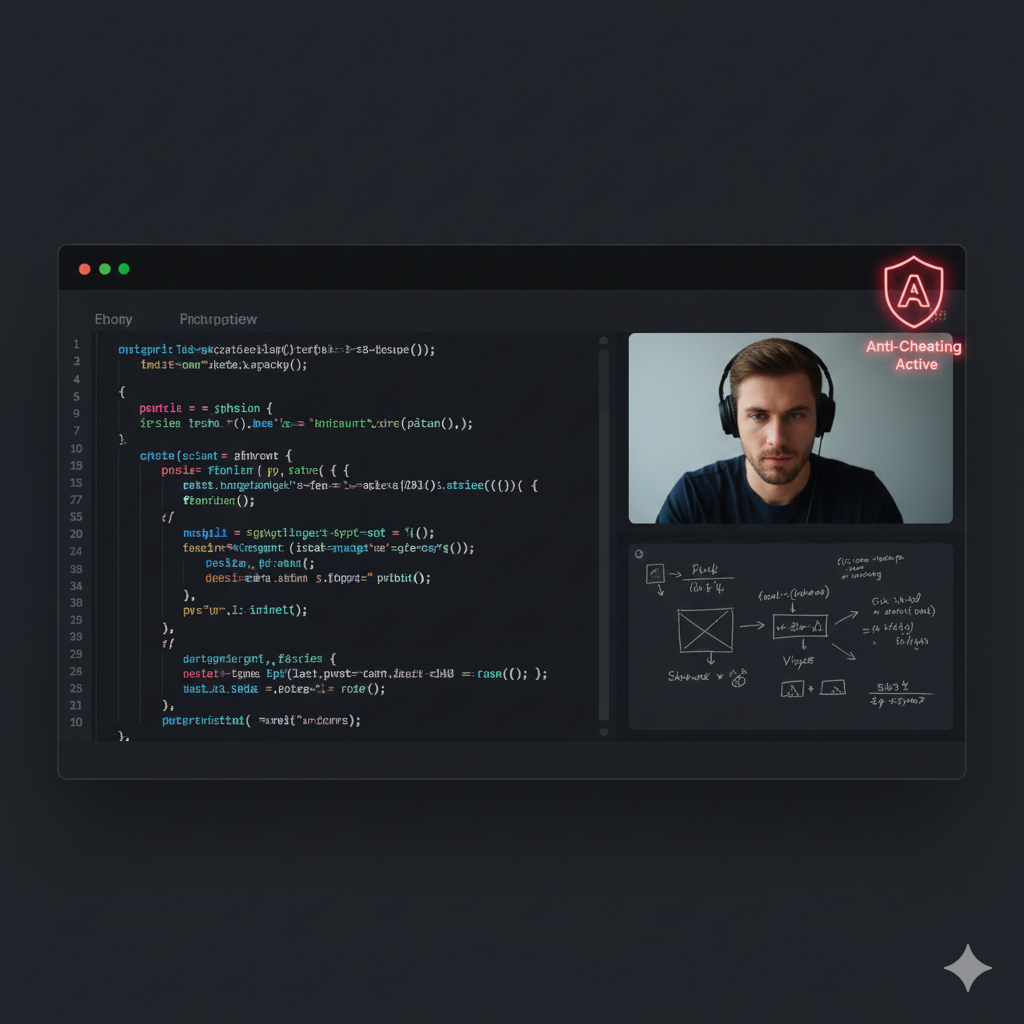
Trigger: normal application path, no anomalous signals, first-time verification attempt.
Action: verify identity in under three minutes before interviews (document + voice + face typically 2-3 minutes).
Outcome: issue interview and assessment access only after verification succeeds.
Trigger: risk signals like repeated failed verification attempts, suspicious device changes, inconsistent identity attributes, or proxy indicators flagged by interview telemetry.
Action: require stronger verification or additional review, and tighten link controls (short TTL, single-use).
Outcome: continue candidate progress only when the step-up check clears or a reviewer resolves the case.
Trigger: high-confidence mismatch or conflicting evidence across checks.
Action: block access, open a case with an SLA, and generate an Evidence Pack for audit and appeal.
Outcome: either clear and continue with a note, or reject with documented reason codes.
A risk-tier policy you can actually deploy
Below is a deployable-style policy that maps events to tiers, specifies step-up actions, and includes safety controls (kill switch, canary rollout, idempotency keys). Adapt field names to your ATS and event schema.
Step-by-step implementation with resilient connectivity
This is the integration sequence that keeps Support out of the blast radius when something breaks.
Define event contracts and candidate identifiers. Pick one canonical candidate_id from the ATS and propagate it through IntegrityLens, interview scheduling, and assessments. Require an idempotency key on every webhook so retries do not duplicate stage changes.
Wire verification gating to interview access. Candidates should not receive interview links until the ATS has a verified status. If you must pre-schedule, issue links that remain inactive until verification clears.
Implement step-up triggers as event-driven routing. Do not let humans "toggle" step-up in chat. Make step-up a deterministic outcome of signals so Support can say, "Your account was escalated because X occurred," and show the appeal path.
Build rollbacks and kill switches. If verification latency spikes or a vendor outage occurs, Support needs a controlled degradation mode (example: pause step-up, keep fast-lane, or queue verifications). Log when the kill switch was used and who approved it.
Add observability that traces one candidate across tools. Your dashboards should answer: Where is this candidate stuck? Which check failed? Did the ATS receive the webhook? This reduces ticket handle time and prevents duplicate outreach.
Harden auth for integrations. Prefer OAuth/OIDC over static API keys for ATS and downstream tools. Rotate secrets, scope permissions, and audit access to Evidence Packs.
If ATS is down: queue outbound updates and show a candidate-friendly holding message, do not ask them to repeat verification.
If verification service is degraded: auto-enable a temporary bypass only for low-risk candidates, and require a follow-up check before offer stage (policy-driven, time-bounded).
If a webhook is retried: enforce idempotency and do not regress a candidate stage.
Anti-patterns that make fraud worse
- Letting hiring managers share assessment links outside the ATS, breaking chain-of-custody and making proxying easier. - Handling exceptions in email threads, which creates inconsistent decisions and zero auditability when Legal asks for evidence. - Running heavy verification on every candidate, which increases abandonment and pushes fraudsters to optimize around a single predictable checkpoint.
Where IntegrityLens fits
IntegrityLens AI is the first hiring pipeline that combines a full Applicant Tracking System with advanced biometric identity verification, AI screening, and technical assessments. Stop juggling multiple tools, manage your entire hiring lifecycle in one secure platform. For risk-tiered workflows, TA leaders and Recruiting Ops configure stages and triggers, CISOs approve controls and retention, and Support relies on consistent outcomes and Evidence Packs. Key capabilities for this playbook: - ATS workflow anchored to Source candidates - Verify identity - Run interviews - Assess - Offer - Risk-Tiered Verification with under-three-minute identity checks before interviews - 24/7 AI interviews and 40+ language coding assessments tied to verified candidate IDs - Evidence Packs for audit and appeal, with Zero-Retention Biometrics options - Idempotent webhooks and integration-friendly events for reliable ATS sync

What changes after you ship this
A realistic outcome is not "fraud goes to zero." It is that fraud becomes containable and candidate friction becomes predictable. Teams that implement tiering typically report qualitative improvements: fewer high-urgency escalations because triggers are consistent, faster ticket resolution because Support can see the exact tier and reason code, and cleaner audit responses because Evidence Packs are attached to the ATS record instead of scattered screenshots. As an illustrative example (not a claim), many operators set an internal goal that 80-90% of candidates stay in fast-lane, with step-up reserved for the minority who trigger defined signals.
Fast-lane completion time and abandonment rate
Step-up rate by role, region, and source channel (watch for bias and false positives)
Manual review queue age and SLA breaches (reviewer fatigue early warning)
Webhook delivery success rate and idempotency conflicts (integration health)
Candidate ticket volume tagged to verification reasons (Support load)
Sources
- Checkr, Hiring Hoax (Manager Survey, 2025): https://checkr.com/resources/articles/hiring-hoax-manager-survey-2025
Pindrop, hiring process as a cybersecurity vulnerability: https://www.pindrop.com/article/why-your-hiring-process-now-cybersecurity-vulnerability/
Related Resources
Key takeaways
- Risk-tiered workflows reduce funnel leakage by reserving heavy checks for candidates who trigger clear, auditable risk signals.
- For Support and CS, the goal is fewer escalations, fewer angry tickets, and fewer "why was I singled out" complaints through consistent, explainable policy.
- Treat step-up verification as an integration problem: idempotent events, ATS as system of record, and observability that traces one candidate across tools.
- Design for failure: outages, ATS downtime, and false positives need recovery paths with SLAs and an appeal flow.
- Roll out safely using canary cohorts, kill switches, and metric guardrails that prioritize candidate experience and fraud containment.
Deployable-style configuration that routes candidates into fast-lane or step-up based on explicit signals.
Includes canary rollout, kill switch, idempotency requirements, and ATS stage updates for auditability.
version: "2026-01-20"
policy_id: "risk-tiered-fastlane-stepup"
controls:
  kill_switch:
    enabled: false
    reason: ""
    approved_by: ""
    expires_at: null
  rollout:
    mode: "canary" # canary | full
    canary_percentage: 10
    canary_rules:
      include_roles: ["Support Engineer", "Customer Success Engineer", "Sales Engineer"]
      exclude_sources: ["referral"]
  idempotency:
    required: true
    header: "Idempotency-Key"

systems_of_truth:
  ats:
    name: "Greenhouse"
    candidate_id_field: "ats.candidate_id"
    stage_field: "ats.stage"
  verification:
    provider: "IntegrityLens"
    decision_field: "il.verification.decision"
    evidence_pack_ref_field: "il.evidence_pack_id"

risk_tiers:
  - tier: "fast-lane"
    description: "Low-friction verification before interview access."
    entry_criteria:
      all:
        - event: "application.submitted"
        - not:
            any:
              - signal: "verification.failed_attempts"
                gte: 2
              - signal: "identity.attribute_mismatch"
                eq: true
              - signal: "proxy_indicator"
                eq: true
    actions:
      - action: "start_verification"
        methods: ["document", "face", "voice"]
        sla_minutes: 10
      - action: "update_ats"
        when: "verification.passed"
        set:
          ats.stage: "Verified"
          ats.custom_fields.verification_tier: "fast-lane"
      - action: "grant_access"
        when: "verification.passed"
        resources: ["interview_scheduling", "assessment_link"]

  - tier: "step-up"
    description: "Elevated-risk candidates get stricter controls and possible manual review."
    entry_criteria:
      any:
        - signal: "verification.failed_attempts"
          gte: 2
        - signal: "identity.attribute_mismatch"
          eq: true
        - signal: "device_fingerprint.changed"
          eq: true
        - signal: "proxy_indicator"
          eq: true
    actions:
      - action: "start_verification"
        methods: ["document", "face", "voice"]
        options:
          liveness_strict: true
          link_ttl_minutes: 15
          link_single_use: true
      - action: "open_case"
        owner: "Support"
        queue: "candidate-verification"
        sla_minutes: 120
        required_fields:
          - "reason_code"
          - "candidate_message_template_id"
      - action: "generate_evidence_pack"
        include: ["verification_events", "device_signals", "attempt_timestamps"]
        retention_days: 30
        access:
          roles_allowed: ["RecruitingOps", "Security", "SupportLead"]
          require_justification: true
      - action: "update_ats"
        when: "case.resolved"
        set:
          ats.custom_fields.verification_tier: "step-up"
          ats.custom_fields.verification_reason_code: "{{case.reason_code}}"
          ats.custom_fields.evidence_pack_id: "{{il.evidence_pack_id}}"

messaging:
  candidate_templates:
    fast_lane_start: "tmpl_fastlane_start"
    step_up_required: "tmpl_stepup_required"
    appeal_instructions: "tmpl_appeal"

observability:
  trace_id_field: "ats.candidate_id"
  emit_events:
    - "tier.assigned"
    - "verification.started"
    - "verification.passed"
    - "verification.failed"
    - "case.opened"
    - "case.resolved"
Outcome proof: What changes
Before
Support handled frequent verification exceptions with inconsistent decisions, and Recruiting Ops had limited visibility into where candidates were stuck. Security lacked a single evidence trail tied to the ATS record.
After
Most candidates stayed in fast-lane with clear, automated outcomes, while elevated-risk cases were routed to step-up with bounded manual review and an Evidence Pack linked to the ATS candidate ID. Support used reason codes and templates instead of freeform judgment.
Implementation checklist
- Define 2-3 risk tiers with explicit triggers and allowed actions
- Choose sources of truth: ATS candidate record, verification decision, interview/assessment logs
- Implement step-up as event-driven routing (not manual "gut feel")
- Add a kill switch and a canary rollout flag for every high-friction check
- Log Evidence Packs per candidate with retention controls and access review
- Create a Support playbook: candidate comms, resubmission path, and escalation SLAs
Questions we hear from teams
- Will risk-tiering increase candidate complaints?
- It reduces complaints when the step-up policy is consistent and explainable. Most complaints come from surprises and dead ends. Use clear messaging, an appeal path, and time-bounded SLAs for manual review.
- How do we avoid bias in step-up triggers?
- Use signals tied to behavior and integrity controls (attempt counts, mismatches, device changes), not protected characteristics. Monitor step-up rates by segment and review false positive patterns with Security and Legal.
- What if the ATS webhook fails and a candidate gets stuck?
- Require idempotency keys, queue outbound updates when the ATS is unavailable, and build a reconciliation job that backfills the ATS with the latest verification decision using the ATS candidate ID as the join key.
Ready to secure your hiring pipeline?
Let IntegrityLens help you verify identity, stop proxy interviews, and standardize screening from first touch to final offer.
Watch IntegrityLens in action
See how IntegrityLens verifies identity, detects proxy interviewing, and standardizes screening with AI interviews and coding assessments.