Risk-Tiered Verification: Fast-Lane vs Step-Up Workflows
A platform and integrations playbook for keeping low-risk candidates moving while forcing high-signal verification when the funnel starts to smell like fraud.
Risk-tiering protects speed by reserving friction for the moments the funnel starts to look like fraud.Back to all posts
the offer that turns into an incident
At 7:12am, the hiring manager wants to extend an offer. Six minutes later, Security flags the candidate as high-risk based on device and liveness signals. You now have to choose between cycle time and reputational risk, with no room for a vague policy. By the end of this guide, you will be able to implement a risk-tiered workflow that keeps low-risk candidates in a fast-lane while automatically stepping up verification and review for elevated-risk cases.
Why this matters when you own speed, cost, and reputation
As Analytics or Chief of Staff, you feel the pressure from every direction: time-to-fill targets, headcount cost scrutiny, and executive intolerance for a hiring integrity blow-up. Blanket verification slows the funnel and creates candidate drop-off. No verification produces audit gaps and postmortems. Risk-tiering is the operator compromise: keep the fast-lane genuinely fast, and reserve heavier checks and review time for candidates with real fraud signals.
Ownership and flow (so this does not become chaos)
Ownership needs to be explicit or the process will drift into shadow approvals and inconsistent enforcement. Recruiting Ops owns stage design and tier routing in the ATS. Security owns risk policy, exceptions, and retention. Hiring Managers consume decisions and do not improvise alternate verification. Automate routing, step-up triggers, and Evidence Packs. Keep manual effort constrained to an amber review queue with SLAs and reason codes. System of record: ATS for stages and disposition. IntegrityLens for verification outcomes, fraud signals, and Evidence Packs.
Recruiting Ops can change stages, not risk thresholds.
Security can adjust tier thresholds with change logging.
Hiring Managers can request review, not override risk outcomes.
build the fast-lane + step-up router
Define three tiers that map to actions, not gut feel: Fast-Lane, Standard, Step-Up.
Choose signals you can defend and measure: identity mismatch, liveness failures, device or IP velocity, geo anomalies, and assessment integrity anomalies.
Keep the ATS as the workflow state engine. Let IntegrityLens compute risk and return tier, decision, and Evidence Pack ids back into ATS stages.
Make routing idempotent. Duplicate webhooks and stage churn will happen. Deduplicate by event id and apply only newer routing versions.
Roll out with canaries and a kill switch. Decide upfront what happens if verification is degraded: pause at a hold stage or fall back to a defined lane.
Instrument observability with correlation ids so you can trace a candidate across ATS, verification, interviews, and assessments.
If the ATS is down, queue and retry writebacks using idempotent webhooks.
If verification is down, route to a dedicated hold stage instead of running ad hoc interviews.
If manual review spikes, adjust thresholds temporarily with a logged policy change and a backtest plan.
a real risk-tier policy you can ship
The YAML below is an operator-ready contract: tier thresholds, step-up triggers, ATS writebacks, and safety rails like canary rollout and a kill switch. It also encodes privacy and security posture via Zero-Retention Biometrics and OAuth2/OIDC.
Anti-patterns that make fraud worse
These three patterns reliably increase funnel leakage and reduce defensibility during audits.
Applying the heaviest checks to everyone, then creating informal bypasses when cycle time pressure hits.
Letting Hiring Managers accept screenshots or chat confirmations instead of Evidence Packs tied to the candidate record.
Using shared API keys across environments so actions are not attributable and rotation becomes risky.
Stats interpretation: what the numbers imply (and do not prove)
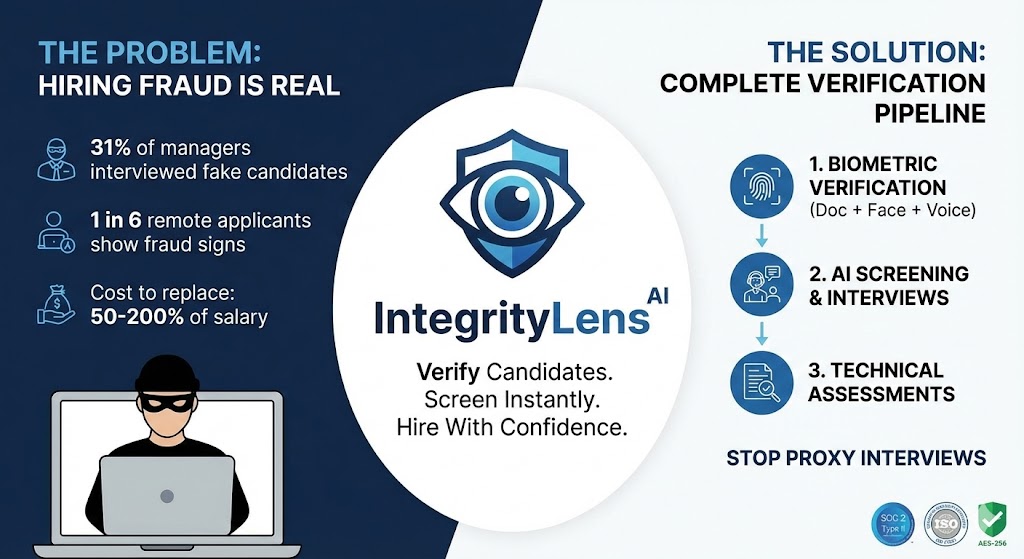
Checkr reports 31% of hiring managers say they have interviewed a candidate who later turned out to be using a false identity. Directionally, this suggests identity fraud is showing up in normal hiring operations, not just edge cases. It does not prove your organization will see the same rate because survey populations, role mix, and definitions vary. Pindrop reports 1 in 6 applicants to remote roles showed signs of fraud in one real-world pipeline. Directionally, this indicates remote funnels deserve stronger controls and measurable signals. It does not mean 1 in 6 are confirmed fraud across all employers since "signs" and pipeline context differ.
Where IntegrityLens fits
IntegrityLens AI is the first hiring pipeline that combines a full ATS with advanced biometric identity verification, fraud detection, AI screening interviews, and technical assessments. In a risk-tiered workflow, IntegrityLens computes tier outcomes, enforces Risk-Tiered Verification, and produces Evidence Packs while your ATS remains the system of record for stages and decisions. TA leaders and recruiting ops teams use it to keep low-risk candidates moving, while CISOs use it to enforce privacy-first controls like Zero-Retention Biometrics, auditable access, and defensible exception handling. - ATS workflow plus stage writeback - Identity verification in under three minutes (typical 2-3 minutes end-to-end: document + voice + face) - 24/7 AI screening interviews - Coding assessments across 40+ languages - Evidence Packs for audit and appeals
Takeaways you can operationalize this quarter
Treat risk-tiering as a router with evidence, not a binary gate. Constrain manual review to an amber queue with SLAs and reason codes to prevent reviewer fatigue. Ship with canaries, idempotent webhooks, and a kill switch so outages do not cause process drift. Measure funnel leakage by tier and reason code so you can tune thresholds without guesswork.
Sources
Related Resources
Key takeaways
- Risk-tiering protects cycle time by reserving heavier checks for candidates with meaningful fraud signals.
- Define sources of truth (ATS vs verification service) and make routing idempotent so retries do not double-trigger checks.
- Treat verification as a workflow router plus Evidence Packs, not a one-time gate that blocks everyone.
- Ship with canaries, kill switches, and clear manual review queues to avoid reviewer fatigue and backlog explosions.
Use this as the contract between Recruiting Ops, Security, and Engineering.
Defines tier thresholds, step-up triggers, ATS writeback stages, and operational safety rails (idempotency, canary rollout, kill switch).
policyVersion: "2025-12-14"
policyName: "risk-tiered-fastlane-stepup"
sourceOfTruth:
  ats: "Greenhouse"
  verification: "IntegrityLens"
identifiers:
  candidateKey: "greenhouse.candidate_id"
  requisitionKey: "greenhouse.job_id"
  idempotencyKey: "event.id"
rollout:
  mode: "canary"
  canaryFilter:
    department_in: ["Engineering", "Data"]
    location_in: ["US", "CA"]
  killSwitch:
    enabled: true
    behaviorWhenVerificationDown: "pause-at-stage"
    pauseStage: "Verification Hold"
thresholds:
  riskScoreScale: "0-100"
  tiers:
    fast_lane_max: 24
    standard_max: 59
    step_up_min: 60
signals:
  - key: "identity.document_mismatch"
    weight: 45
    stepUpWhen: "true"
  - key: "biometric.liveness_failures_24h"
    weight: 25
    stepUpWhen: ">=2"
  - key: "network.impossible_travel"
    weight: 20
    stepUpWhen: "true"
  - key: "device.high_velocity_candidates_7d"
    weight: 15
    stepUpWhen: ">=5"
  - key: "assessment.integrity_anomaly"
    weight: 30
    stepUpWhen: "true"
actions:
  fast_lane:
    atsWritebackStage: "Verified - Fast Lane"
    requiredChecks:
      - "document"
      - "face"
      - "voice"
    biometricMode: "zero-retention"
    manualReview: "never"
  standard:
    atsWritebackStage: "Verified - Standard"
    requiredChecks:
      - "document"
      - "face"
      - "voice"
      - "fraud-signal-scan"
    manualReview: "conditional"
  step_up:
    atsWritebackStage: "Step-Up Required"
    requiredChecks:
      - "document"
      - "face"
      - "voice"
      - "fraud-signal-scan"
      - "live-identity-recheck"
    manualReview:
      queue: "Integrity Review"
      slaHours: 12
      requiredReasonCode: true
evidence:
  pack:
    enabled: true
    include:
      - "verification-timestamps"
      - "signal-reason-codes"
      - "attestations"
      - "audit-log"
  retention:
    mode: "minimized"
    biometric: "zero-retention"
security:
  auth:
    prefer: "OAuth2/OIDC"
    disallowApiKeysForServerToServer: true
observability:
  tracing:
    correlationId: "candidateKey"
  metrics:
    - "tier_distribution"
    - "step_up_rate"
    - "manual_review_sla_breaches"
    - "conversion_by_tier"
Outcome proof: What changes
Before
Verification was inconsistent. Some reqs forced heavy checks on every candidate (drop-off and delays), while others relied on recruiter judgment with weak audit trails.
After
A Risk-Tiered Verification router was deployed with ATS stage writebacks, a dedicated Step-Up manual review queue, and Evidence Packs attached to elevated-risk decisions.
Implementation checklist
- Pick 5-10 risk signals you can measure today (device, IP, velocity, identity mismatch, assessment anomalies).
- Define three tiers with explicit step-up actions and SLAs (Fast-Lane, Standard, Step-Up).
- Make the ATS the process system of record and IntegrityLens the risk and evidence system of record.
- Implement idempotent webhook handling and a single candidate key across ATS, verification, interviews, and assessments.
- Add a kill switch and canary rollout by role, geography, or requisition.
- Instrument funnel leakage by tier and reason code (not just pass/fail).
Questions we hear from teams
- How many tiers should we start with?
- Three. It is enough to protect speed (Fast-Lane), handle the normal path (Standard), and concentrate friction and review (Step-Up). More tiers usually create analytics noise and policy drift.
- What is the fastest place to add value without rebuilding our ATS stages?
- Add a single routing stage writeback (for example, "Verified - Fast Lane", "Verified - Standard", "Step-Up Required") plus an Integrity Review queue. Keep recruiter actions unchanged except for where the candidate is routed.
- How do we stop recruiters from bypassing step-up when they are under pressure?
- Make step-up a hard stage requirement in the ATS, not a guideline, and require Evidence Pack ids for any exception. If exceptions are needed, time-box them and log them as policy changes, not one-off favors.
Ready to secure your hiring pipeline?
Let IntegrityLens help you verify identity, stop proxy interviews, and standardize screening from first touch to final offer.
Watch IntegrityLens in action
See how IntegrityLens verifies identity, detects proxy interviewing, and standardizes screening with AI interviews and coding assessments.