Stop Candidate Drop-Off Without Lowering the Identity Bar
Drop-off is rarely a "candidate experience" problem. It is usually an un-instrumented workflow problem: unclear steps, slow manual reviews, and no risk-tiering to keep low-risk candidates moving.
Reduce drop-off by making security steps predictable and recoverable, not optional. Risk-tiered fast-paths are defensible only when every decision is logged and replayable.Back to all posts
Real Hiring Problem
Drop-off is an integrity and throughput incident: candidates stall at high-friction steps, reviewers override without evidence, and SLAs collapse when manual queues have no time bounds. When Legal or Security asks who approved a borderline verification, most teams can only produce screenshots or chat logs. That is a defensibility failure, not a candidate experience issue. External pressure is increasing: identity fraud and remote hiring fraud signals are common enough that you need risk-tiered controls, not generic friction.
Verification retakes spike after-hours, then candidates abandon because there is no clear recovery path.
Manual review queues grow silently because there is no SLA timer or escalation path.
Overrides happen in chat, not in a tamper-resistant log, creating audit gaps.
WHY LEGACY TOOLS FAIL
Legacy stacks are not designed for parallelized checks and evidence-based scoring across stages. They are designed for tool-by-tool completion. Sequential workflows slow everything down, but worse, they hide where candidates actually drop: not at "verification" broadly, but at specific failure modes like low-light liveness capture, mismatched document fields, or ambiguous face match scores. Without immutable event logs and unified evidence packs, you cannot enforce review-bound SLAs or prove reviewer accountability. Shadow workflows become the system of record, which is an integrity liability.
No single source of truth for pass-fail decisions across identity, interview, and assessment.
No standardized place to store rubrics and reviewer notes tied to timestamps.
Exception handling lives in email and chat, not in ATS-anchored audit trails.
OWNERSHIP & ACCOUNTABILITY MATRIX
Recommendation: assign explicit owners for each control point, and make the ATS the system of record for stage outcomes while Security owns identity policy. Recruiting Ops owns workflow sequencing and SLAs. Hiring Managers own rubric discipline. If you cannot name an owner for a queue, you cannot enforce an SLA on it.
Recruiting Ops: designs the risk-tiered funnel, sets SLAs, monitors drop-off by stage, and manages candidate-facing microcopy and recovery paths.
Security: defines identity gating policy (risk tiers, step-up verification triggers), access control, audit policy, and retention rules (including zero-retention biometrics).
Hiring Manager: owns interview and assessment rubrics, minimum evidence thresholds, and exception justification when overriding a score.
Systems of truth: ATS is the source of truth for stage status and timestamps. Verification and assessment services are sources of evidence that must write back evidence links and structured outcomes into the ATS.
MODERN OPERATING MODEL
Recommendation: treat hiring like secure access management. Identity verification is an identity gate before access to interviews, assessments, and ultimately an offer. Instrument the workflow so every step emits events with timestamps. Use quality scoring to route candidates into one of three paths: accept, one-tap retake, or manual review with an SLA timer. Make perceived speed a control. Candidates will tolerate respectful friction when you tell them what is happening, how long it takes, and how to recover if capture quality is low.
Identity verification before access: verify in under three minutes before the interview starts when possible, so identity uncertainty does not persist into later stages.
Event-based triggers: low-quality capture triggers an immediate retake prompt, not a later rejection email.
Automated evidence capture: every attempt, score, and decision is written into an immutable event log and assembled into an evidence pack.
Analytics dashboards: track time-to-event (time-to-verify, time-to-review, time-to-offer) and drop-off by failure mode, not by stage name.
Standardized rubrics: store rubrics and scoring rationale as structured fields linked to reviewer identity and timestamps.
WHERE INTEGRITYLENS FITS
IntegrityLens AI enables a risk-tiered, SLA-bound funnel by making identity gating and evidence capture native to the hiring pipeline, not a stitched-on step. Operationally, that means you can fast-path low-risk candidates without losing auditability, and you can allow one-tap retakes without creating an exception swamp.
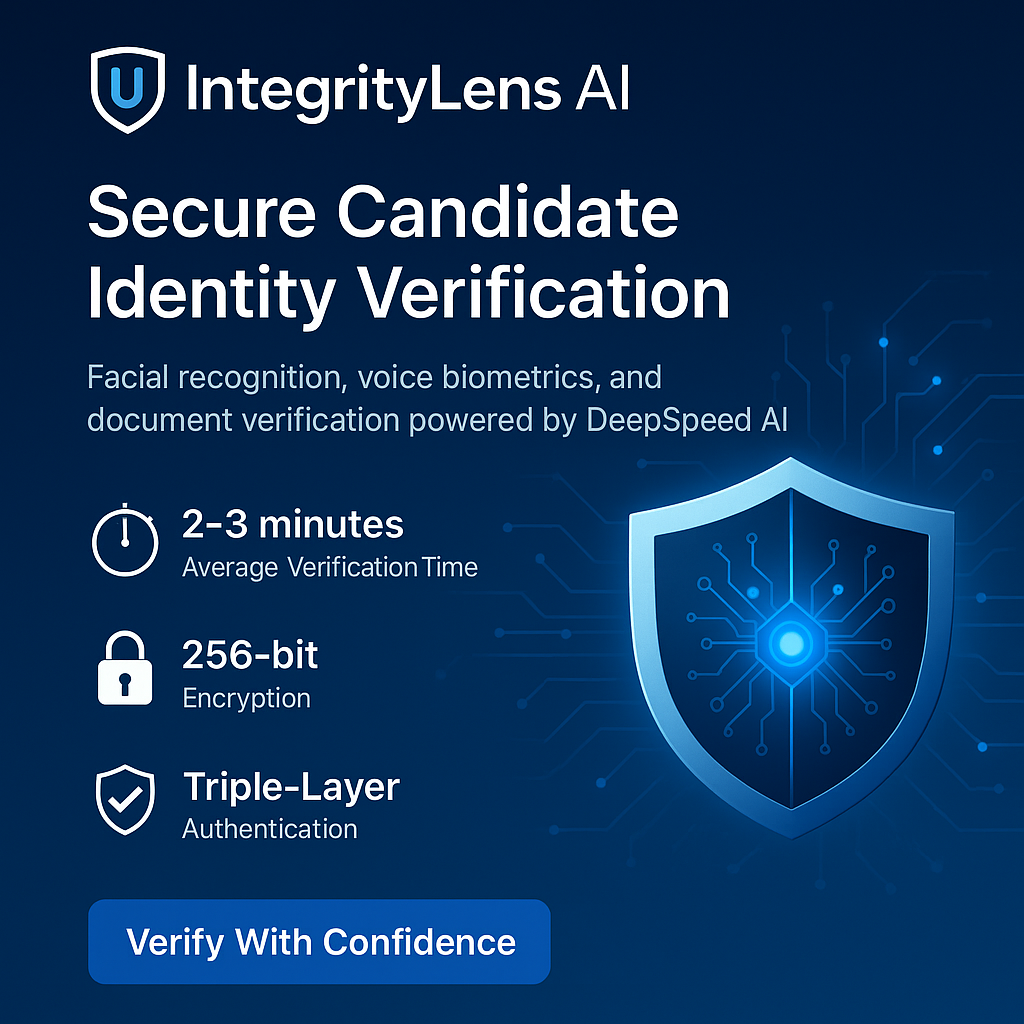
Biometric identity gate using liveness, face match, and document authentication before candidates access interviews or assessments.
Quality scoring that routes candidates to auto-accept, one-tap retake, or manual review queues with SLA timers.
AI screening interviews available 24/7 to reduce scheduling-induced drop-off while keeping outputs tied to the candidate record.
Technical assessments across 40+ languages with plagiarism detection and execution telemetry to support evidence-based scoring.
Immutable evidence packs with timestamped logs, reviewer notes, and zero-retention biometric architecture for defensible decisions.
ANTI-PATTERNS THAT MAKE FRAUD WORSE
Recommendation: do not "reduce friction" by removing controls. Reduce drop-off by making controls predictable, recoverable, and risk-tiered.
Do not allow unlimited retakes without step-up verification. It trains attackers and creates noisy evidence you cannot interpret.
Do not let recruiters override identity or assessment outcomes in chat. If it is not logged, it is not defensible.
Do not batch manual reviews once per day. Review latency increases abandonment and leaves identity unverified longer, exactly where fraud risk concentrates.
IMPLEMENTATION RUNBOOK
Recommendation: implement three controls together: quality scoring, one-tap retakes with guardrails, and a low-risk fast-path. Each control needs an SLA, an owner, and logging requirements. Below is a practical sequence you can roll out in weeks, not quarters.
Step 0: Define risk tiers and thresholds (SLA: 5 business days to publish policy). Owner: Security with Recruiting Ops. Evidence: policy version, approval record, and threshold table stored in your control repository.
Step 1: Identity gate at first "privileged access" moment (SLA: verification attempt starts immediately on link open). Owner: Recruiting Ops. Evidence: attempt timestamp, device metadata, and consent attestation written to ATS.
Step 2: Quality scoring on capture (SLA: real-time). Owner: Security defines thresholds, Recruiting Ops implements routing. Evidence: quality score per attempt, failure mode tags (blur, glare, low light), and model decision logged.
Step 3: One-tap retake path (SLA: retake prompt shown within 2 seconds of failure). Owner: Recruiting Ops. Evidence: retake count, reason, and UI prompt version ID stored in event log.
Step 4: Step-up verification after final retake (SLA: immediate). Owner: Security. Evidence: step-up trigger event, additional verification method used, and outcome stored in evidence pack.
Step 5: Manual review queue for borderline outcomes (SLA: 30 minutes during business hours, 4 hours off-hours with on-call rotation where applicable). Owner: Recruiting Ops runs the queue, Security sets review policy. Evidence: reviewer ID, start and end timestamps, decision, and justification note.
Step 6: Low-risk fast-path (SLA: bypass manual review when all signals are green). Owner: Security defines "green" conditions, Recruiting Ops enforces workflow. Evidence: fast-path eligibility decision recorded with the exact rule evaluation results.
Step 7: Write-back and lock (SLA: within 60 seconds of each decision). Owner: Recruiting Ops. Evidence: ATS stage update, link to immutable evidence pack, and access expiration defaults recorded.
Step 8: Weekly operations review (SLA: weekly). Owner: Recruiting Ops with Analytics. Evidence: time-to-event dashboard, drop-off by failure mode, SLA breach report, and override rates by reviewer.
SOURCES
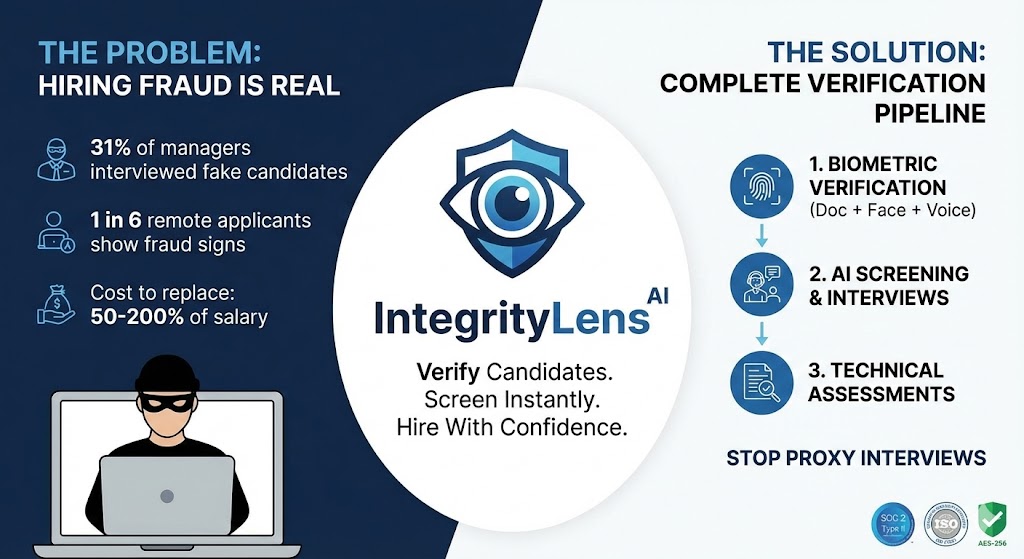
Checkr: Hiring Hoax (Manager Survey, 2025) - 31% of hiring managers say they have interviewed a candidate who later turned out to be using a false identity. Pindrop: Why your hiring process is now a cybersecurity vulnerability - 1 in 6 applicants to remote roles showed signs of fraud in one real-world pipeline. SHRM: Replacement cost estimates - replacing an employee can cost 50-200% of annual salary (role-dependent).
CLOSE: Implementation Checklist
Recommendation: if you want to implement this tomorrow, start by locking the policy and logging, then add retakes and fast-paths. You cannot scale exceptions without audit trails. Business outcomes to target and report up: reduced time-to-verify, fewer SLA breaches, lower drop-off at verification, fewer overrides, and tighter evidence packs for Legal.
Publish a retake policy: max retakes per step, when step-up verification triggers, and who can approve exceptions.
Add quality scoring tags to every failed attempt (blur, glare, mismatch, low audio) and report drop-off by tag weekly.
Stand up a review queue with explicit SLAs and an escalation path. Measure SLA breaches by hour-of-day.
Define a low-risk fast-path rule set and require that the rule evaluation is logged for every fast-path candidate.
Require that every override includes a structured reason code and a reviewer ID in the immutable event log.
Update candidate-facing microcopy to be explicit: what is happening, expected duration, how retakes work, and how to request accessibility support (WCAG 2.1-aligned).
Instrument dashboards around timestamps: time-to-verify, time-in-review, time-to-offer, and abandonment at each checkpoint.
Audit test: pick 10 candidates and answer, in under 10 minutes, "Who approved them, when, and with what evidence?" If you cannot, fix logging before tuning thresholds.
Related Resources
Key takeaways
- Drop-off clusters where candidates are asked to redo steps without clarity, or where low-risk candidates are forced into high-friction reviews.
- Quality scoring is an operations control: it decides whether you auto-accept, allow a one-tap retake, or route to a review-bound SLA queue.
- Fast-paths are defensible when they are risk-tiered, logged, and anchored to an immutable evidence pack.
- One-tap retakes reduce abandonment, but only when retake limits, step-up verification, and reviewer accountability are explicit.
- If it is not logged, it is not defensible. Every pass, fail, retake, and override needs timestamps and an owner.
Use this as a control document your Security team can sign and Recruiting Ops can operationalize. It defines fast-path eligibility, retake limits, step-up triggers, and review SLAs.
Store this policy in version control. Log the policy version ID into each candidate evidence pack so decisions are replayable.
policyVersion: "2026-10-01"
owners:
  recruitingOps: "workflow-slas-candidate-messaging"
  security: "identity-policy-audit-retention"
  hiringManager: "rubrics-score-override-justification"
controls:
  identityGate:
    requiredBeforeStages: ["ai_interview", "coding_assessment", "live_interview"]
    typicalEndToEndMinutes: 3
  qualityScoring:
    decisionBands:
      green:
        minLiveness: 0.85
        minFaceMatch: 0.85
        minDocumentAuth: 0.85
        action: "auto-accept"
      yellow:
        minLiveness: 0.70
        minFaceMatch: 0.70
        minDocumentAuth: 0.70
        action: "one-tap-retake"
      red:
        belowAny: ["0.70"]
        action: "manual-review"
  retakes:
    maxRetakesPerStep: 2
    afterFinalRetake:
      stepUpVerification: true
      stepUpMethods: ["additional-document", "voice-check"]
  reviewQueue:
    slaMinutesBusinessHours: 30
    slaMinutesOffHours: 240
    requiredReviewerFields: ["reviewerId", "startTs", "endTs", "decision", "reasonCode"]
  fastPath:
    eligibleWhen:
      - "identityGate.result == PASS"
      - "qualityScoring.band == green"
      - "noDeepfakeSignals == true"
      - "noProxyInterviewSignals == true"
    evidenceRequired:
      - "immutableEventLogLink"
      - "evidencePackId"
      - "policyVersion"
Outcome proof: What changes
Before
High verification abandonment during off-hours, manual review backlog, and frequent exceptions handled in chat. Legal could not reliably reconstruct why borderline candidates were advanced.
After
Risk-tiered routing reduced unnecessary manual reviews for low-risk candidates, one-tap retakes reduced abandonment from preventable capture issues, and every exception was captured as a structured, timestamped decision tied to an evidence pack.
Implementation checklist
- Define pass, retake, and manual-review thresholds for each step (ID doc, liveness, face match, interview, assessment).
- Implement one-tap retakes with a hard cap and step-up verification after the final retake.
- Create a low-risk fast-path that bypasses manual review when quality scores are high and signals are consistent.
- Put SLAs on every queue and alert on SLA breaches by stage.
- Write every decision back to the ATS with a candidate-level evidence pack link.
- Publish candidate-facing microcopy for: what is happening, how long it takes, how retakes work, and how accessibility support is requested.
Questions we hear from teams
- How do fast-paths avoid creating a compliance loophole?
- Fast-paths are defensible when eligibility is rule-based, risk-tiered, and logged. The control is not the shortcut. The control is the recorded rule evaluation, tied to a policy version and evidence pack, so you can prove why a candidate bypassed manual review.
- What should be automated vs manually reviewed?
- Automate deterministic routing and evidence capture: quality scoring, retake prompts, step-up triggers, and ATS write-backs. Reserve manual review for borderline cases and require reviewer identity, timestamps, and reason codes so exceptions do not become shadow workflows.
- How many retakes should you allow?
- Set a hard cap (commonly 2 per step) and trigger step-up verification after the final retake. Unlimited retakes increase attacker learning and create noisy evidence that is hard to defend in an audit.
- What metrics should Recruiting Ops report weekly?
- Time-to-verify, time-in-review queue, SLA breach rate by stage, abandonment by failure mode tag (blur, glare, mismatch), override rate by reviewer, and fast-path volume with downstream performance signals.
Ready to secure your hiring pipeline?
Let IntegrityLens help you verify identity, stop proxy interviews, and standardize screening from first touch to final offer.
Watch IntegrityLens in action
See how IntegrityLens verifies identity, detects proxy interviewing, and standardizes screening with AI interviews and coding assessments.