Project Take-Homes That Resist Cheating in 120 Minutes
A defensible way to run take-homes that are hard to fake, fast to review, and respectful of candidate time.
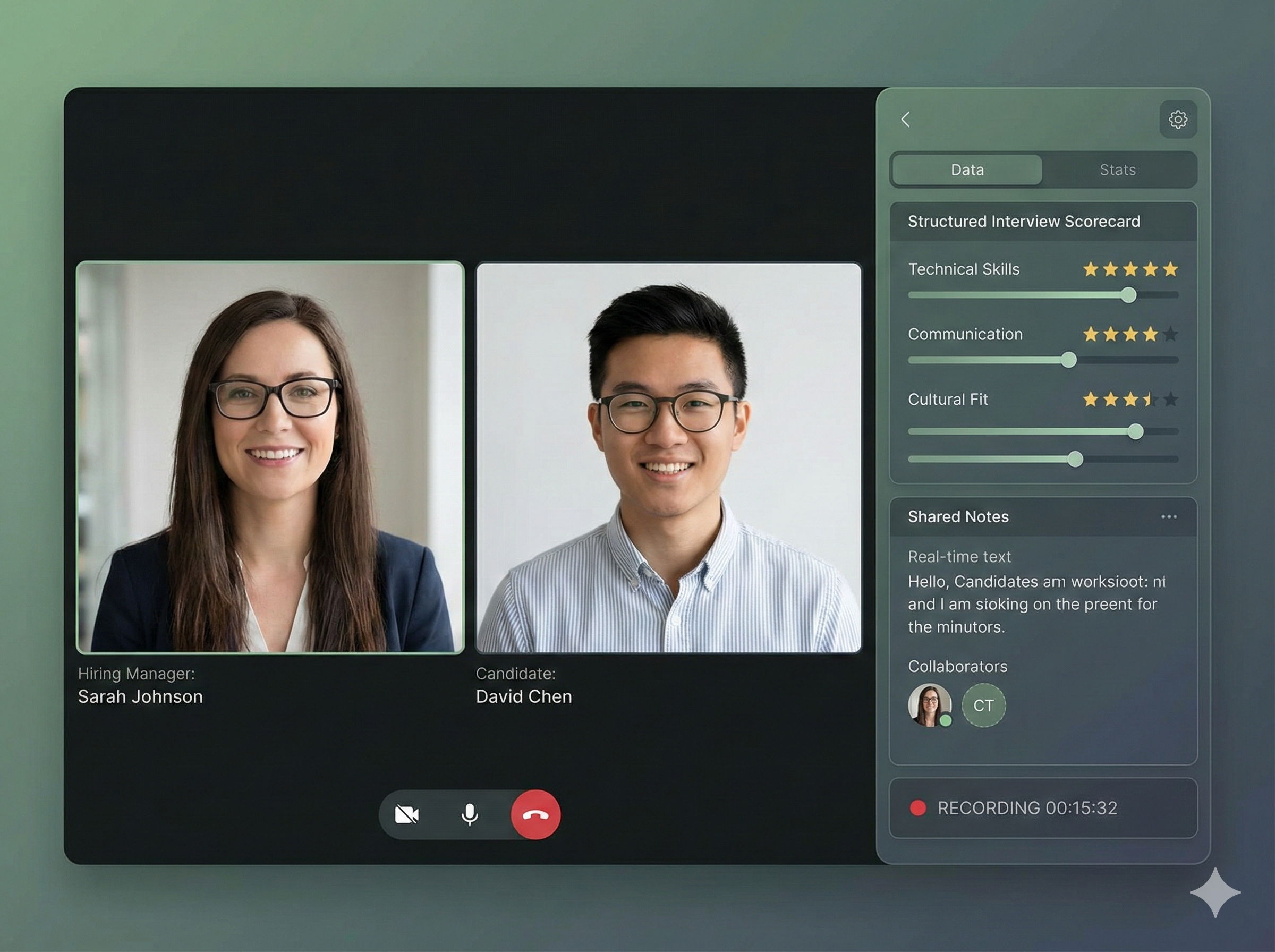
The best take-home is not the hardest problem. It is the one that forces traceable work in a strict time box, then verifies authorship with a short live edit.Back to all posts
The week your finalist fails the walkthrough
It is Thursday. Your team is about to close a critical analytics hire that unblocks a roadmap. The candidate submitted a clean take-home, but in the 15-minute debrief they cannot explain why a join changed row counts, cannot reproduce their own chart, and asks to "check later" when you request a small edit. You now have a reputation risk (was your process sloppy?), a speed risk (back to pipeline), and a governance risk (you cannot defend why you advanced them). By the end of this playbook, you will be able to design a project-based take-home that stays under a strict time cap while generating enough integrity signals to catch proxy work and heavy AI-assisted fabrication without punishing honest candidates.
Project take-homes work when you constrain the surface area
A project-based take-home becomes hard to fake when it forces role-relevant tradeoffs and produces intermediate artifacts that are difficult to counterfeit consistently. The mistake is turning it into a mini-consulting engagement, which increases funnel leakage and creates reviewer fatigue. Directional risk context: Checkr reports that 31% of hiring managers say they have interviewed a candidate who later turned out to be using a false identity. That implies identity and authorship risk is operationally common in hiring workflows, not just a niche edge case. It does not prove your company has the same rate, and it is survey-based, but it is a strong signal that "trust the resume" is not a control.
Signal-to-noise: fewer tasks, higher diagnostic value
Reviewer time: rubric scoring should be faster than reading prose
Candidate trust: time caps and transparency reduce rage-quit risk
Defensibility: artifacts should survive a post-hoc challenge
Ownership, automation, and systems of record
Treat take-homes like a controlled workflow, not a one-off email attachment. You need clear owners, a review queue, and a source of truth so you can explain decisions later without reconstructing Slack threads.
Recruiting Ops owns: assessment templates, time caps, candidate comms, and SLA enforcement
Hiring Manager owns: rubric criteria, pass thresholds, and the debrief script
Security or GRC advises: integrity escalation rules, retention, and access controls for evidence
Automated: identity gating before assessment access, plagiarism or similarity checks, environment telemetry capture where permitted, and policy-based flagging into a review queue
Manual: rubric scoring, debrief walkthrough, and any adverse action decision with an appeal path
ATS is system of record for stage movement, decisions, and timestamps
Assessment system is system of record for submissions, versions, and scoring artifacts
Verification service is system of record for who accessed the assessment and whether identity checks passed
A 120-minute project template for analytics roles
Use a constrained, realistic dataset and a single decision question that mirrors Day 1 work. Your goal is to observe judgment under constraints, not to test trivia. A practical structure is: one core task, one integrity-oriented "trace task," and one optional stretch that never penalizes candidates who stop at the cap.
A notebook or script that produces 2-3 metrics and 1 chart from a provided dataset
A short README with assumptions, data quality checks performed, and what you would do next with more time
One reproducible check: either a unit-style test, a validation query, or a row-count reconciliation
State: "Please spend no more than 120 minutes. We score partial work and do not reward overtime."
Offer: "If you stop at 90 minutes, submit what you have with notes. That is acceptable."
Integrity signals that do not punish honest candidates
Score integrity as a set of signals that trigger a step-up, not as a binary gotcha. Zero-tolerance rules create false positives and can quietly bias against candidates who are less polished but fully legitimate. Focus on consistency signals between artifacts: does the candidate's README match the code, do the checks align with their assumptions, and can they reproduce results in the debrief.
Inability to explain key choices in their own submission (feature definition, join keys, metric logic)
Outputs that look correct but have no trace of intermediate validation (no row counts, no sanity checks, no error handling)
Large style shifts across files (naming, structure, formatting) inconsistent with a time-boxed solo submission
Using external references or docs for syntax
Minor inconsistencies in formatting
A solution that is simpler than you expected but correct
Step-by-step implementation you can run next sprint
Implement in four moves: standardize the project, instrument the workflow, calibrate scoring, then add a lightweight authenticity debrief. Each step reduces funnel leakage or reviewer fatigue while improving defensibility.
Pick one dataset and one decision question tied to the role (forecasting, funnel analysis, experimentation readout)
Limit scope: 1-2 tables, under 50MB, deterministic outputs
Define pass criteria in plain language before launch
Require an assumptions list and at least one validation step (row-count reconciliation, null scan, outlier check)
Require reproducibility: a single command or notebook cell that regenerates final outputs
Require a "what I would do next" section to observe prioritization
Use 4-6 rubric dimensions with anchored examples for scores 1, 3, 5
Pre-score 3 historical submissions to align reviewers and reduce drift
Track reviewer disagreement as an internal quality metric
Ask for a walkthrough of one key function or query and why they chose it
Request one small edit live (change a filter, add a segmentation, fix a join) and observe fluency
If integrity signals stack, trigger step-up verification or a second reviewer, not an instant rejection
A take-home integrity policy you can operationalize
This policy shows how to time-box the project, define required artifacts, and route integrity flags into a review queue with an appeal path. It is designed to reduce false positives by requiring stacked signals before escalation.
Anti-patterns that make fraud worse
These three mistakes increase cheating and also increase false rejections.
Unlimited time windows and vague scope that invite outsourcing and make comparisons meaningless
Gotcha plagiarism rules that auto-reject on a single similarity flag without a human walkthrough
Email-based submissions with no identity gating, no version history, and no audit trail
Where IntegrityLens fits
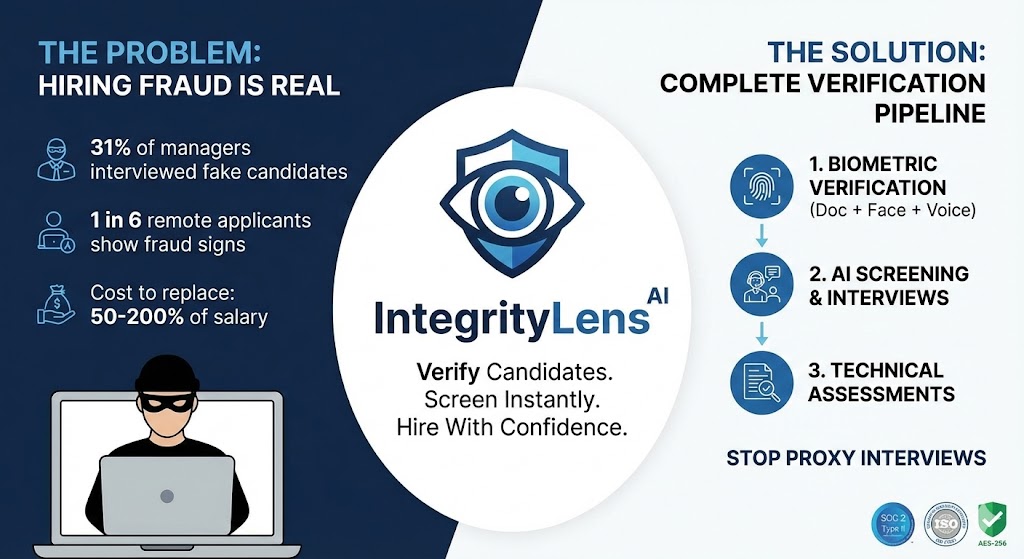
IntegrityLens AI supports project-based take-homes by keeping the workflow defensible without slowing your funnel. You run the full pipeline in one secure platform: ATS workflow, identity verification, fraud detection, AI screening interviews, and coding assessments. TA leaders and recruiting ops teams use it to standardize stages and SLAs, while CISOs use it to reduce identity and proxy risk with audit-ready controls. For take-homes specifically, IntegrityLens helps you gate assessment access with fast verification, capture integrity signals and reviewer decisions in one place, and generate Evidence Packs tied to the candidate record so you can explain why someone advanced or was stepped up.
Verify identity in under three minutes before assessment access
Run 24/7 AI screening interviews to validate narrative consistency before reviewer time is spent
Deliver assessments across 40+ languages and role types with consistent rubrics
Generate Evidence Packs for defensible decisions without retaining raw biometrics
Integrate events via idempotent webhooks to keep ATS stages synchronized
Sources
External stats referenced in this article:
Checkr, "Hiring Hoax (Manager Survey, 2025)" - https://checkr.com/resources/articles/hiring-hoax-manager-survey-2025
Key takeaways
- A fraud-resistant take-home is a time-boxed work sample with a constrained dataset, required trace artifacts, and a short live follow-up that verifies authorship.
- Integrity should be scored as signals, not vibes: suspicious patterns trigger a step-up review instead of automatic rejection.
- The fastest path is to optimize reviewer time: fewer, richer deliverables and a rubric that lets non-engineers spot gaps.
- Candidate time caps protect your employer brand and reduce funnel leakage, without sacrificing signal-to-noise if the task mirrors Day 1 work.
Use this as a starting policy for project-based take-homes with a 120-minute cap.
It defines required artifacts, stacked-signal escalation, manual review SLAs, and an appeal workflow to reduce false positives.
Map the actions to your ATS stages and route escalations to a dedicated review queue to prevent reviewer fatigue.
policyVersion: "2026-11-16"
assessment:
  name: "Analytics Take-Home: Funnel Drop Diagnosis"
  timeCapMinutes: 120
  allowedResources:
    - "Docs and references allowed"
    - "AI assistance allowed if disclosed in README"
  requiredDeliverables:
    - id: "analysis-notebook"
      type: "ipynb|sql|rmd"
      mustRunEndToEnd: true
    - id: "readme"
      type: "md"
      requiredSections:
        - "Assumptions"
        - "Data checks performed"
        - "What I would do next"
        - "Tooling used (including AI, if any)"
    - id: "validation"
      type: "sql|py"
      description: "At least one reproducible validation (row-count reconciliation, null scan, or outlier check)."

integritySignals:
  # Each signal adds points. Escalate only when signals stack.
  scoring:
    explainabilityFailure: 3   # cannot explain join keys, metric logic, or reproduce output
    liveEditFailure: 3         # cannot implement a small requested change in debrief
    provenanceMismatch: 2      # README conflicts with code or tools used
    suspiciousStyleShift: 1    # abrupt naming/formatting shift across files
    missingValidation: 1       # no sanity checks despite requirement
  thresholds:
    stepUpReviewAtPoints: 3
    stepUpVerificationAtPoints: 5

workflow:
  identityGate:
    required: true
    when: "before_assessment_access"
    slaMinutes: 3
    evidence: ["verification-event", "device-session-id"]
  review:
    queues:
      - name: "standard-review"
        slaHours: 48
      - name: "integrity-step-up"
        slaHours: 24
        requiresSecondReviewer: true
    decisions:
      - "advance"
      - "reject"
      - "step_up_verification"
      - "redo_assessment_with_proctoring"
  debrief:
    required: true
    durationMinutes: 15
    script:
      - "Walk me through your validation step and what it caught."
      - "Change one filter/segment and re-run the final output."
      - "What tradeoff did you make because of the time cap?"

governance:
  evidencePack:
    include:
      - "submission-hash"
      - "timestamps"
      - "rubric-scores"
      - "integrity-signal-score"
      - "reviewer-notes"
      - "appeal-outcome"
  retention:
    rawBiometrics: "zero-retention"
    assessmentArtifactsDays: 180
    accessLogsDays: 365
  candidateAppeal:
    enabled: true
    windowDays: 14
    handledBy: "recruiting-ops"
    requiresWrittenRationale: true
Outcome proof: What changes
Before
Take-homes were long and loosely defined, leading to inconsistent scoring, candidate drop-off, and late-stage surprises when finalists could not explain their work.
After
A standardized 120-minute project with trace artifacts and a short authenticity debrief produced comparable submissions, faster reviews, and a clear step-up path for suspicious cases without blanket rejections.
Implementation checklist
- Set a hard time cap (90-120 minutes) and state it in the instructions
- Provide a fixed dataset and a clear success definition tied to the role
- Require 2-3 trace artifacts (approach notes, assumptions, tests or checks)
- Use a rubric with anchored scoring and explicit partial credit
- Run a 15-minute authenticity follow-up (walkthrough + 2 edits)
- Escalate only when integrity signals stack (not on a single weirdness)
Questions we hear from teams
- Should we ban AI tools in take-home projects?
- No by default. Bans are hard to enforce and can increase false positives. A better control is disclosure plus an authenticity debrief where candidates explain choices and implement a small edit live.
- What is the right time cap for a project-based take-home?
- For most analytics and generalist roles, 90-120 minutes is the sweet spot. Longer assignments increase funnel leakage and make outsourcing more attractive.
- How do we avoid rejecting strong but nervous candidates?
- Use stacked integrity signals and a step-up review queue. Do not auto-reject on a single flag like similarity or formatting. Require a second reviewer for adverse decisions tied to integrity.
Ready to secure your hiring pipeline?
Let IntegrityLens help you verify identity, stop proxy interviews, and standardize screening from first touch to final offer.
Watch IntegrityLens in action
See how IntegrityLens verifies identity, detects proxy interviewing, and standardizes screening with AI interviews and coding assessments.