Stop Identity Farming in Hiring Without Slowing Revenue Teams
Identity farming turns your hiring funnel into a credential vending machine: one real person passes verification, then proxies assessments for many "candidates". This playbook shows how to detect reuse patterns early, step up checks only when risk justifies it, and keep time-to-hire fast and defensible.
Identity farming is not a candidate problem. It is a correlation problem: if you cannot connect reuse signals across candidates, one verified person can manufacture "top performers" all week.Back to all posts
The identity farming incident that hits revenue hardest
An SDR hiring sprint is behind and a "top candidate" clears identity verification, aces the assessment, and gets fast-tracked. Three weeks later, Sales Ops finds three new hires with overlapping environment metadata and eerily similar assessment traces. It is not a one-off cheater. It is a scaled identity farm that polluted your pipeline, wasted manager cycles, and created reputational risk with customers once performance collapses. By the end of this article, you will be able to implement a risk-tiered verification design that detects identity farming patterns early and forces step-up checks only when signals justify friction.
Why identity farming spreads in high-velocity funnels
Identity farming is fraud at scale: one real, verified operator completes tests for many candidate identities. RevOps feels it as funnel distortion: top-of-funnel quality looks great, then you pay the cost late in the cycle when humans finally notice inconsistencies. The operational signature is reuse across surfaces: the same device, network, face or voice, and timing patterns showing up across multiple candidate records. If you do not correlate across candidates, farms look like "strong applicants" until onboarding or quota performance exposes the mismatch.
Speed: keep low-risk candidates moving without adding universal friction.
Cost: stop wasting interviewer time on farmed profiles.
Risk: reduce the probability of a bad hire touching customer data or deals.
Reputation: avoid the internal narrative that your process is easy to game.
The directional market signal (and what it does not prove)
Checkr reports that 31% of hiring managers say they have interviewed a candidate who later turned out to be using a false identity. This implies identity deception is common enough to design for as a normal operating condition in remote hiring. It does not prove your org has the same rate, and it does not isolate identity farming specifically, but it is a strong justification to instrument controls instead of relying on gut checks.
Directionally: identity risk is not rare, and late-stage discovery is costly.
Not proven: your industry-specific baseline, or the exact share attributable to farming rings.
Ownership and flow that prevents tool sprawl and blame loops
Make ownership explicit so escalations are fast and defensible. Recruiting Ops owns workflow design, candidate communication, and review SLAs. Security owns risk policy, retention rules, and access control. Hiring Managers own decisioning, but only review evidence on escalations, not every candidate. Automate passive signals, risk scoring, step-up triggers, and evidence logging. Keep manual review for high-risk queues, ID exceptions, and candidate appeals. Treat the ATS as the system of record for stage changes and outcomes. Treat verification and assessment modules as systems of record for identity state and integrity signals, linked back to the ATS candidate id.
Automated: device and network correlation, velocity checks, verification state changes, idempotent webhook logging.
Manual: high-risk review tasks with time-bound SLAs, exception handling, and appeal outcomes.
How to stop identity farming without killing conversion
Lead with passive signals to keep velocity high, then apply step-up verification only when risk crosses thresholds. Treat verification as a continuous state. Identity farms rely on passing a one-time gate and then scaling handoffs. Your system should downgrade trust when environment or behavior changes appear. Correlate reuse across candidate profiles. Farms show up as repeated device fingerprints, repeated IP or ASN patterns, liveness similarity flags, and bursty assessment starts from the same environment. Bind the person to the session, not just the profile. Verify immediately before launching the assessment, re-check liveness on resume and long idle, and use session tokens tied to verified identity state. Design fallbacks so legit candidates do not churn: alternate doc capture paths, limited reschedule windows, and manual review only when risk signals justify it.
Device fingerprint seen across 5+ candidates in 7 days (tune to volume).
Assessment start bursts from the same device plus IP in under 60 minutes.
Verification state changes mid-funnel combined with network anomalies (VPN suspected plus region swing).
Mobile-friendly doc capture when desktop camera fails.
Manual review queue with a published SLA so deals are not delayed by uncertainty.
Appeal flow that lets strong candidates recover quickly from false positives.
Anti-patterns that make fraud worse
These three moves increase fraud success rates and create reviewer fatigue.
Fast-tracking "top" candidates around verification to protect time-to-fill.
One global threshold for all roles and regions, causing either friction spikes or easy bypass.
Manual-only review queues without SLAs, which creates backlogs and inconsistent outcomes.
A deployable policy artifact for identity farming defense
Use this policy pattern to detect cross-candidate reuse and enforce step-up checks only when needed. Tune thresholds based on funnel volume, region norms, and your false positive tolerance. Log every decision into an Evidence Pack for audit readiness.
Detect reuse across candidate profiles (device, network, velocity).
Escalate only medium and high risk into step-up checks or review.
Minimize stored toxic data with Zero-Retention Biometrics and hash-based correlation.
Where IntegrityLens fits
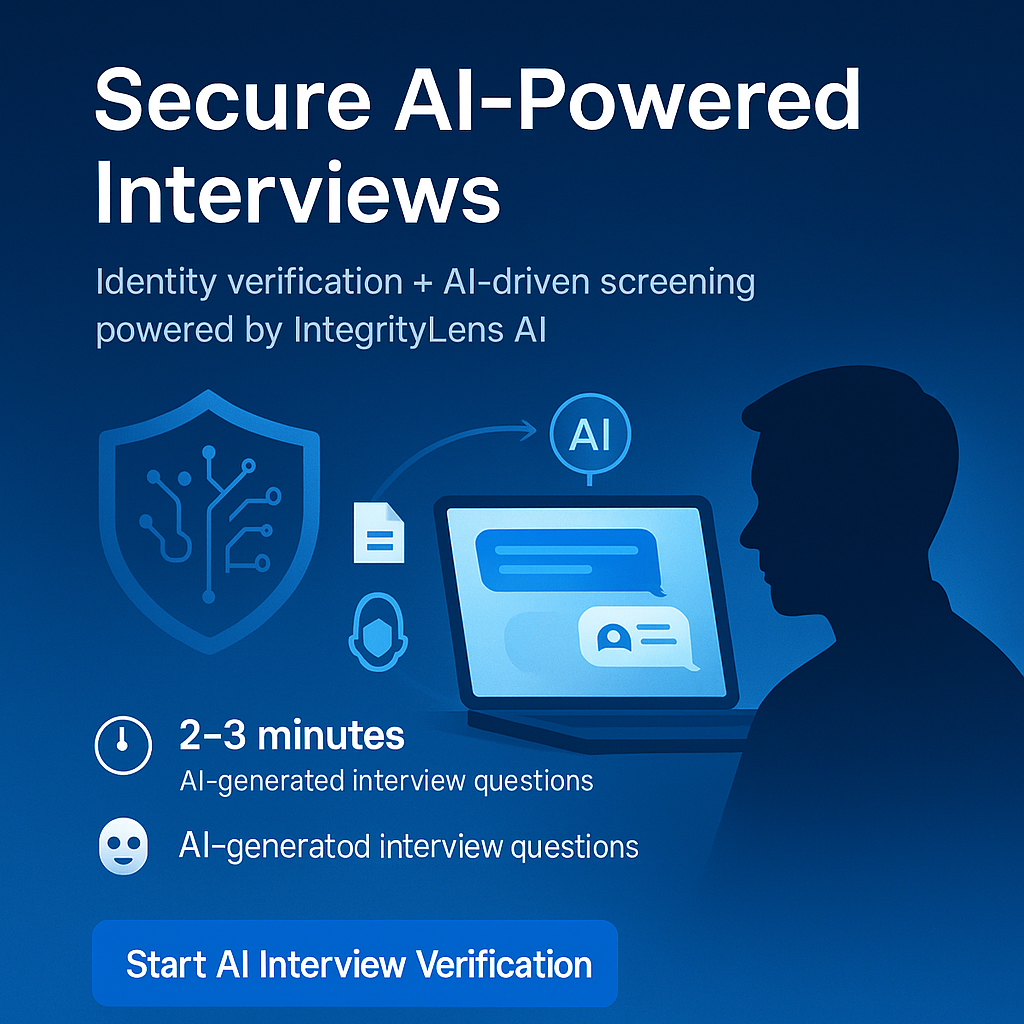
IntegrityLens AI is the first hiring pipeline that combines a full Applicant Tracking System with advanced biometric identity verification, AI screening, and technical assessments in one defensible workflow. For identity farming, IntegrityLens helps TA leaders, recruiting ops, and CISOs keep velocity while blocking scaled proxy operations. IntegrityLens enables Risk-Tiered Verification before interviews and assessments, typically in 2-3 minutes end-to-end (document plus voice plus face). Passive signals and fraud detection identify cross-candidate reuse patterns, then step-up checks are triggered only when risk justifies friction. AI screening interviews run 24/7 to reduce scheduling churn, and coding assessments cover 40+ languages with integrity signals tied to the same candidate record. Evidence Packs and idempotent webhooks keep the pipeline auditable.
Recruiting Ops: enforce consistent gates without spreadsheet workflows.
TA leaders: reduce late-stage surprises and wasted interviews.
CISOs: get audit-ready evidence and privacy-preserving controls.
Step-by-step rollout plan for RevOps speed and control
Pick the choke point: enforce verification state at assessment launch. That is where farms monetize.
Instrument passive signals first: device and network correlation across candidates, plus velocity. Log for 1-2 weeks before blocking to calibrate baselines (illustrative rollout practice, not a performance claim).
Define tiers and SLAs: medium risk gets automated step-up, high risk gets human review with a time budget and required artifacts.
Add step-up methods: liveness checks that re-bind the person to the session before the assessment starts.
Implement fallbacks: alternate capture paths and an appeal flow so legitimate candidates recover quickly.
Run weekly tuning: track false positive rates, review queue depth, and confirmed farming cases, then adjust thresholds.
False positive rate by tier (especially medium risk).
Median time added for step-up verification (latency).
Reviewer queue SLA compliance and re-open rates.
Correlation rule precision: how often a trigger is confirmed as farming vs benign reuse.
What changes when this is working
A revenue org with high remote hiring volume implemented cross-candidate correlation plus step-up verification at assessment launch. Before, they relied on a one-time verification pass and discovered issues late, after manager interviews and offer drafting. After, escalations moved earlier in the funnel, manual review volume stayed bounded because only high-confidence cases were queued, and Sales leadership regained confidence that assessment results mapped to the actual candidate. The biggest operational win was predictability: fewer late-stage reversals, cleaner funnel attribution, and less internal skepticism about remote hiring signals. No ROI numbers are claimed here because outcomes vary by role mix, region, and baseline fraud pressure.
Legal and Security sign-off is easiest when you can show minimization, tight retention, and auditable decision logs rather than raw media storage.
Evidence Packs reduce "he said, she said" by tying triggers, timestamps, and reviewer actions to the ATS candidate record.
Sources
Checkr (2025): 31% of hiring managers report interviewing someone using a false identity. https://checkr.com/resources/articles/hiring-hoax-manager-survey-2025
FAQ: common objections and operator answers
Q: Will this slow down hiring? A: Not if you lead with passive signals and reserve step-up verification for medium and high tiers. Low-risk candidates should not feel new friction. Q: What about co-working spaces or campuses where IPs are shared? A: Shared network is a weak signal. Combine it with device reuse, burst velocity, and verification state changes before escalating. Q: What evidence should we keep for disputes? A: Keep decision logs, rule triggers, timestamps, hashes, and reviewer notes in an Evidence Pack. Prefer Zero-Retention Biometrics and avoid storing raw ID images or biometric templates unless policy requires it.
Related Resources
Key takeaways
- Identity farming is a reuse problem: repeated devices, networks, faces, voices, and behavior across many candidate profiles.
- Start with passive signals to avoid friction, then apply step-up verification only when reuse risk crosses thresholds.
- Treat verification as a continuous state across interview and assessment surfaces, not a one-time gate.
- Design for fallbacks so legitimate candidates can complete verification without stalling the pipeline.
- Instrument everything into ATS-anchored Evidence Packs so decisions are auditable and appealable.
A practical policy that correlates device and network reuse across candidates, triggers step-up verification only when needed, and logs everything into Evidence Packs.
Designed to reduce reviewer fatigue by routing only high-confidence cases to manual review with SLAs.
Includes privacy-first retention and hash-based correlation instead of storing raw biometrics.
policyName: identity-farming-defense
version: 1
scope:
  roles:
    - sales-development-rep
    - solutions-engineer
    - software-engineer
signals:
  passive:
    deviceFingerprintHash: required
    ipAddressHash: required
    asn: optional
    geoCountry: optional
    vpnSuspected: optional
    sessionVelocity:
      windowMinutes: 60
      metric: assessments_started
  biometric:
    faceLiveness: optional
    voiceLiveness: optional
    selfieMatchToId: optional
correlationRules:
  - id: reuse-device-high
    description: "Same device fingerprint across many candidate profiles"
    when:
      signal: deviceFingerprintHash
      uniqueCandidatesSeenInLastDays: 7
      threshold: 5
    score: 70
  - id: reuse-ip-medium
    description: "Same IP hash across multiple candidates in a short window"
    when:
      signal: ipAddressHash
      uniqueCandidatesSeenInLastHours: 6
      threshold: 4
    score: 40
  - id: burst-assessment-high
    description: "High burst of assessment starts from same environment"
    when:
      signal: sessionVelocity
      groupBy:
        - deviceFingerprintHash
        - ipAddressHash
      threshold: 6
    score: 80
riskTiers:
  low:
    maxScore: 39
    actions:
      - allowAssessmentLaunch: true
      - logEvidencePack: true
  medium:
    minScore: 40
    maxScore: 79
    actions:
      - requireStepUpVerification:
          methods:
            - faceLiveness
            - voiceLiveness
          timeBudgetSeconds: 180
      - allowAssessmentLaunchOnPass: true
      - logEvidencePack: true
  high:
    minScore: 80
    actions:
      - blockAssessmentLaunch: true
      - createManualReviewTask:
          owner: recruiting-ops
          slaMinutes: 60
          requiredArtifacts:
            - correlationSummary
            - verificationAttemptLog
      - notify:
          channels:
            - security
            - revops
evidencePack:
  retentionDays: 30
  piiMinimization:
    storeRawIdImages: false
    storeRawBiometricTemplates: false
    storeOnlyHashesAndDecisionLogs: true
  exportFields:
    - candidateId
    - riskScore
    - triggeredRules
    - verificationStateTimeline
    - reviewerActions
webhooks:
  idempotencyKey: "candidateId:eventType:occurredAt"
  events:
    - verification.state_changed
    - fraud.rule_triggered
    - review.task_created
Outcome proof: What changes
Before
One-time identity check early in the process, limited cross-candidate correlation, and fraud discovered late after manager interviews or onboarding.
After
Continuous verification state with cross-candidate reuse detection, step-up verification at assessment launch for medium risk, and SLA-bound manual review for high risk.
Implementation checklist
- Define the fraud you are stopping: "one verified person completing assessments for multiple profiles" and what counts as evidence.
- Pick 3-5 passive signals to score risk (device, network, velocity, geolocation mismatch, reuse patterns).
- Set step-up triggers and thresholds (low, medium, high risk) and map each to a specific action.
- Create a fallback path (manual review SLA, alternate doc capture, reschedule rules) to avoid funnel loss.
- Log all signals and reviewer actions into an Evidence Pack tied to the candidate record in the ATS.
Questions we hear from teams
- Will step-up verification slow down time-to-hire?
- If you apply it to everyone, yes. If you apply it only to medium and high risk tiers using passive signals first, most candidates see no added friction and high-risk cases get resolved earlier.
- How do we avoid false positives from shared networks (campus, co-working)?
- Treat network reuse as a weak signal. Require corroboration such as repeated device fingerprints, bursty assessment starts, or verification state changes before you block or escalate.
- What should we retain for audits or disputes?
- Keep timestamps, triggered rules, risk scores, verification state transitions, and reviewer actions in an Evidence Pack linked to the ATS candidate record. Prefer minimized retention and avoid storing raw biometrics unless policy requires it.
Ready to secure your hiring pipeline?
Let IntegrityLens help you verify identity, stop proxy interviews, and standardize screening from first touch to final offer.
Watch IntegrityLens in action
See how IntegrityLens verifies identity, detects proxy interviewing, and standardizes screening with AI interviews and coding assessments.