Stop Identity Farming in Hiring Tests Without Slowing Down
Identity farming turns your assessment stage into a credential laundering service: one verified individual completes tests for dozens of candidates. This playbook shows how to block it with risk-tiered verification, continuous session binding, and privacy-first fallbacks that keep time-to-hire predictable.
Identity farming is a workflow problem: if verification is not bound to the assessment session and re-checked at handoffs, one real person can manufacture dozens of "top scorers."Back to all posts
The failure mode that blindsides PeopleOps
Picture this: you are in an exec update and your VP of Engineering asks why a "strong" candidate bombed the live interview after scoring in the 95th percentile on your assessment. Recruiting says the candidate was verified. The hiring manager says the work product does not match. Security asks for evidence and all you have is a pass/fail badge from a third-party tool. Identity farming is the play where one verified person becomes a high-volume test taker for dozens of candidate identities. It thrives on one-time verification and unbound assessment sessions. What you should expect if this is happening: repeated device and network signals across unrelated candidates, clusters of unusually fast completions, and a sharp drop from assessment performance to live interview performance.
Detect identity farming using passive signals before you add friction
Add step-up checks at the exact handoffs where farming happens
Define ownership, review SLAs, and an appeal flow that does not torch candidate experience
Generate an Evidence Pack that stands up to internal scrutiny
Why identity farming becomes a CHRO problem fast
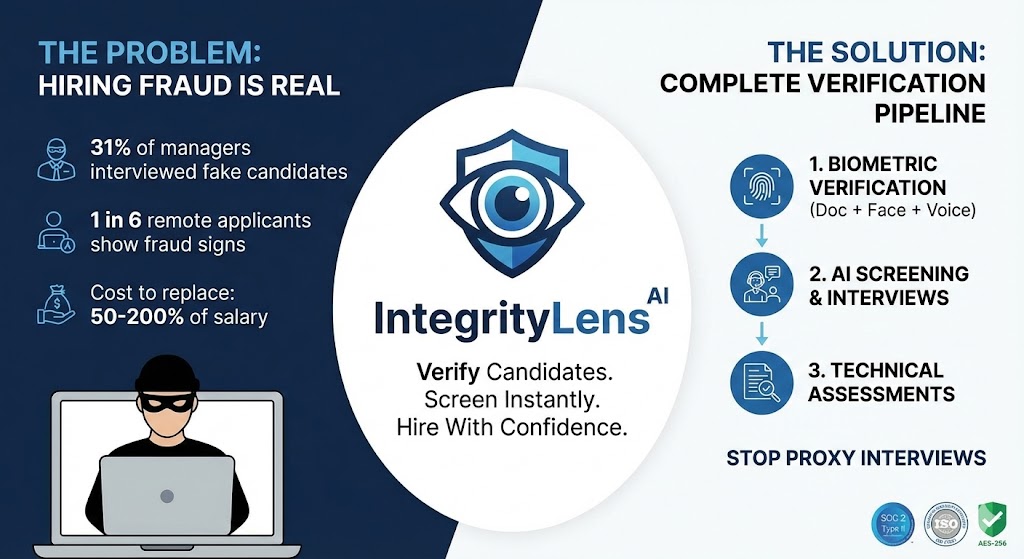
Treat identity farming as an integrity incident with downstream HR cost and reputation risk. The most expensive outcome is not the fraudulent test itself. It is the wrong hire, the team churn that follows, and the internal loss of trust in your process. A directional signal that this is not rare: 31% of hiring managers reported interviewing a candidate who later turned out to be using a false identity (Checkr, 2025). This implies identity deception is showing up in real hiring funnels, not just edge cases. It does not prove that 31% of your candidates are fraudulent or that the rate applies uniformly across roles, geographies, or assessment-heavy pipelines. Another directional data point: 1 in 6 applicants to remote roles showed signs of fraud in one real-world hiring pipeline (Pindrop). This suggests remote hiring workflows can be exploited at scale. It does not prove every company will see the same ratio, because tooling, role types, and applicant sources vary widely.
Funnel leakage when you add blanket friction after a scare
Reviewer fatigue when every odd case becomes a manual investigation
Audit findings when decisions cannot be reconstructed from evidence
Brand damage when legitimate candidates are falsely accused without a clean appeal path
Ownership, automation, and sources of truth
Make Recruiting Ops the process owner, with Security as the policy approver and escalation partner. Hiring managers should not be asked to adjudicate identity signals mid-funnel. Automate 90% of the flow: passive risk scoring, session binding, and step-up triggers. Reserve manual review for only the small set of candidates who trip high-confidence signals or fail a step-up challenge. Set sources of truth explicitly: the ATS is the system of record for candidate status, the verification service is the system of record for identity events and outcomes, and the assessment platform is the system of record for proctoring and submission telemetry. Your Evidence Pack is the stitched timeline across all three.
Recruiting Ops: owns thresholds, queues, and candidate communications
Security: signs off on signal use, retention, and access controls
Legal/Privacy: approves disclosures, consent language, and appeal handling
Hiring Manager: receives a clean hiring signal, not raw fraud telemetry
What is identity farming in assessments
Identity farming is different from a one-off proxy interview. It is repeatable and industrialized: the same operator or small group takes tests for many identities because the assessment session is not cryptographically and behaviorally tied to the verified person. You stop it by combining three controls: continuous verification state, session binding, and risk-tiered step-ups that activate only when passive signals indicate repeat operators.
Verification completed at application, but assessments happen days later with no re-check
Assessment links that can be forwarded without re-authentication
One proctoring signal (webcam) used as a single point of failure
Risk-tiered controls that stop one person taking 50 tests
Start with passive signals as the first line of defense, then step up only when risk is elevated. This keeps speed high for the median candidate and increases assurance where the downside is real. Step 1: Instrument passive signals at three moments: assessment invite, assessment start, and submission. Capture device fingerprint stability, IP ASN risk, VPN/proxy hints, time zone mismatch, and behavioral cadence anomalies (copy-paste bursts, tab switching frequency if available). Step 2: Bind the verified identity to the assessment session. Use a short-lived, non-transferable token that is minted only after verification and is checked at start and submit. If the token is missing or the session context changes materially, force re-verification. Step 3: Add step-up verification at handoffs. For medium risk, require a quick liveness check at assessment start. For high risk, require document plus face match or voice plus face match before unlocking the test. Step 4: Treat verification as continuous. If a candidate begins a session and then triggers a high-risk change (new device, new geography, impossible travel), pause and step up rather than letting the submission through. Step 5: Build fallbacks that do not become bypasses. If an ID will not scan, route to a controlled alternative: secondary document type, live selfie with stricter liveness, or a short supervised HR verification call. The fallback must produce the same Evidence Pack artifacts and retention clock.
Prefer low false positives on passive signals, then confirm with a step-up challenge
Make "repeat device across unrelated identities" a high-weight signal for farming
Use time-windowed clustering: the same device completing many tests in 24-72 hours is more suspicious than one repeat months apart
Keep an explicit exception list for corporate networks and shared testing centers
Disclose that re-verification can occur at key transitions to protect fairness
Give candidates a clear timer and retry path if a liveness check fails
Never accuse in messaging: frame it as "security check" plus support link
A policy artifact your team can implement this sprint
Use this as a starting point for a Risk-Tiered Verification policy focused on identity farming in assessments. It defines what is automated, when to step up, and when to require manual review, while keeping retention and access bounded.
Recruiting Ops sets the weights and review SLAs
Security approves the signal list and retention caps
Engineering maps these rules to your verification and assessment events
Anti-patterns that make fraud worse
Avoid these three moves that look decisive but create new attack surface or collateral damage.
Applying maximum verification to every candidate, which increases funnel leakage and pushes fraudsters to the same chokepoints
Relying on a single screenshot or webcam snapshot as "proof", which is easy to spoof and hard to defend in an appeal
Letting assessment links be forwarded or reused, which turns your test into a shared credential
Where IntegrityLens fits
IntegrityLens AI is built for teams that need speed plus defensibility in one system. It combines ATS workflow, biometric identity verification, fraud detection, AI screening interviews, and coding assessments so you can stop identity farming without stitching together five vendors. TA leaders and recruiting ops teams run the day-to-day workflow, while CISOs get the controls, logs, and Evidence Packs needed for audit readiness. In practice, IntegrityLens helps you:
verify identity in under three minutes before access to assessments,
continuously re-check identity state at handoffs,
detect repeat operators with passive signals, and
generate privacy-first Evidence Packs using Zero-Retention Biometrics and encrypted event logs.
ATS-native gating and status control across the funnel
Risk-Tiered Verification with step-up checks at assessment start and submit
Fraud signals across device, network, and behavior to detect farming patterns
AI interviews available 24/7 and coding assessments across 40+ languages
Evidence Packs for investigations and appeals with 256-bit AES encryption baseline
How to run the review queue without melting your team
Your goal is to keep manual review rare, fast, and consistent. Create a single queue with strict categories so reviewers are not debating from scratch every time. Recommended queue states: "Step-up required" (candidate can self-serve), "Manual review" (ops review within SLA), "Security escalation" (high-confidence farming cluster), and "Cleared with note" (allowed to proceed with monitored re-check at next handoff). Every reviewed case should output a standard Evidence Pack: the signals that triggered, the verification attempts, the session binding results, the reviewer decision, and the appeal link. This reduces ad hoc decision-making and makes internal comms cleaner when someone questions a hiring outcome.
Require two independent signals before blocking (example: repeat device plus failed liveness)
Prefer "step-up then proceed" over "reject" when uncertainty remains
Allow monitored progression for borderline cases and re-check at the live interview handoff
Sources
- Checkr, Hiring Hoax (Manager Survey, 2025): https://checkr.com/resources/articles/hiring-hoax-manager-survey-2025
Pindrop, hiring process as a cybersecurity vulnerability: https://www.pindrop.com/article/why-your-hiring-process-now-cybersecurity-vulnerability/
Related Resources
Key takeaways
- Treat verification as a continuous state across handoffs, not a single gate at application.
- Use passive signals (device, network, behavior) to detect repeat operators, then step up to liveness only when risk justifies it.
- Bind verification to the assessment session with short-lived tokens and re-checks at transitions (invite, start, submit).
- Design fallbacks so legitimate candidates can proceed without creating a fraud bypass.
- Generate Evidence Packs that show what happened, when, and why decisions were made, without retaining raw biometrics.
A configurable policy that uses passive signals first, then triggers step-up checks when farming patterns appear.
Designed to keep median candidates fast while producing consistent Evidence Packs for flagged cases.
Includes fallbacks so legitimate candidates do not get stuck when IDs fail to scan.
policyName: identity-farming-assessment-guardrails
version: 1.3
scope:
  stages:
    - assessment_invite
    - assessment_start
    - assessment_submit
sourcesOfTruth:
  ats: IntegrityLensATS
  verification: IntegrityLensVerify
  assessment: IntegrityLensAssess
riskModel:
  signals:
    - name: repeat_device_across_candidates_72h
      type: passive
      weight: 45
      description: Same device_fingerprint seen on 3+ distinct candidate_ids within 72h.
    - name: repeat_network_asn_across_candidates_72h
      type: passive
      weight: 20
      description: Same ASN + /24 subnet seen on 5+ distinct candidate_ids within 72h.
    - name: vpn_or_proxy_suspected
      type: passive
      weight: 15
      description: Network heuristics indicate VPN/proxy usage.
    - name: geo_velocity_impossible_travel
      type: passive
      weight: 30
      description: Candidate session appears in distant geos within an infeasible time window.
    - name: abnormal_completion_cadence
      type: behavioral
      weight: 15
      description: Completion time or interaction pattern far outside expected band for role level.
    - name: liveness_failed
      type: active
      weight: 60
      description: Face liveness challenge fails at assessment_start or submit.

thresholds:
  low: 0
  medium: 35
  high: 70

actions:
  - when:
      stage: assessment_invite
      riskAtOrAbove: medium
    then:
      - action: bind-session-token
        params:
          ttlMinutes: 30
          nonTransferable: true
          requireDeviceMatchOnStart: true
      - action: notify-candidate
        params:
          template: "security-check-at-start"

  - when:
      stage: assessment_start
      riskAtOrAbove: medium
    then:
      - action: step-up-verification
        params:
          method: face_liveness
          maxAttempts: 2
          fallback:
            method: assisted-review
            slaMinutes: 60
      - action: mint-assessment-access
        params:
          requireSessionToken: true

  - when:
      stage: assessment_start
      riskAtOrAbove: high
    then:
      - action: step-up-verification
        params:
          method: document_plus_face_match
          maxAttempts: 1
          fallback:
            method: assisted-review
            slaMinutes: 30
      - action: place-in-review-queue
        params:
          queue: "identity-farming"
          priority: "high"

  - when:
      stage: assessment_submit
      riskAtOrAbove: medium
    then:
      - action: recheck-session-binding
        params:
          enforceDeviceMatch: true
          enforceGeoConsistency: true
      - action: step-up-verification
        params:
          method: face_liveness
          maxAttempts: 1
          fallback:
            method: allow-submit-with-hold
            holdReason: "verification-pending"

review:
  manualQueueRules:
    - routeWhen:
        any:
          - signal: repeat_device_across_candidates_72h
          - signal: liveness_failed
      reviewerRole: RecruitingOps
      slaMinutes: 120
      escalation:
        toRole: Security
        when:
          riskAtOrAbove: high

evidencePack:
  include:
    - candidate_id
    - job_id
    - timestamps
    - risk_score_breakdown
    - verification_outcomes
    - session_token_audit
    - device_network_summary
    - reviewer_decision
  biometricHandling:
    mode: zero-retention
    storeDerivedSignalsOnly: true
  retention:
    defaultDays: 30
    flaggedCaseDays: 180
  accessControl:
    leastPrivilegeRoles:
      - RecruitingOps
      - Security
      - LegalAuditView
Outcome proof: What changes
Before
Assessments were unlocked after a one-time identity check at application. Reviewers relied on ad hoc screenshots and gut feel when performance did not match later interviews.
After
Assessment access was bound to a verified session with passive-signal risk scoring and step-up verification at assessment start and submission. Flagged cases produced consistent Evidence Packs and a documented appeal path.
Implementation checklist
- Define what counts as identity farming in your hiring policy (repeat devices, repeat voice/face match attempts, abnormal completion patterns).
- Instrument passive signals at invite, start, and submit for every assessment.
- Add risk-tiered step-up verification at the assessment start and on suspicious mid-session events.
- Bind identity checks to a single session with short-lived, non-transferable tokens.
- Create a human-review queue with strict SLAs and an appeal path for candidates.
- Produce an Evidence Pack per flagged case: signals, timestamps, decision, reviewer, and retention clock.
Questions we hear from teams
- How do you catch identity farming without punishing honest candidates?
- Start with passive signals and only step up when multiple signals cluster (for example, repeat device plus geo-velocity). Let most candidates pass with no extra steps, and make step-ups fast with a clear retry and fallback path.
- Where should re-verification happen in the funnel?
- At the moments fraudsters exploit: assessment start and submission, plus any major session context change (new device, new geography, missing session token). Verification should be treated as a continuous state across handoffs.
- What is a defensible reason to hold an assessment submission?
- A high-risk session binding break (device mismatch) combined with a failed or missing step-up verification. The key is consistency: pre-defined thresholds, documented rules, and an appeal route.
- What if a candidate cannot scan their ID or fails liveness due to lighting?
- Use controlled fallbacks that preserve integrity: alternate document types, a second liveness attempt, or an assisted review with an SLA. Avoid fallbacks that silently bypass verification.
Ready to secure your hiring pipeline?
Let IntegrityLens help you verify identity, stop proxy interviews, and standardize screening from first touch to final offer.
Watch IntegrityLens in action
See how IntegrityLens verifies identity, detects proxy interviewing, and standardizes screening with AI interviews and coding assessments.