Make Verification Look Like You, Not a Third Party
A compliance-first runbook for branding identity verification so candidates complete it quickly, your logs stay defensible, and fraud does not hide behind third-party confusion.

Branding your verification flow is not a marketing decision. It is how you make consent, exceptions, and identity gating defensible under audit while keeping the funnel moving.Back to all posts
When verification feels like a third party, you create an audit gap
Branding your verification flow as your company is a compliance control because it reduces abandonment, reduces exception volume, and makes candidate consent and disclosures defensible. Scenario: a candidate receives an interview invite, clicks a link, and lands on an unfamiliar verification page with a different brand and domain. They abandon, email the recruiter, and you route them around verification to hit a time-to-offer target. Two weeks later, a hiring manager flags suspicious behavior and Legal asks a simple question: "If legal asked you to prove who approved this candidate, can you retrieve it?" This is where time delays cluster at moments where identity is unverified. The operational failure shows up as: (1) SLA breach because manual handling replaces self-serve completion, (2) legal exposure because disclosures and consent are not consistently captured, and (3) fraud risk because exceptions become an unlogged bypass path. Industry pressure is not hypothetical. Checkr reports 31% of hiring managers say they have interviewed a candidate who later turned out to be using a false identity. If your candidate thinks a third party is asking for biometrics, you will see more drop-off and more backchannel exceptions. Shadow workflows are integrity liabilities. Cost is not just fraud. Every reroute adds cycle-time. Every manual exception adds reviewer labor and creates a defensibility gap. A decision without evidence is not audit-ready.
Unlogged exceptions: recruiter emails become the de facto approval system.
Consent ambiguity: you cannot prove what the candidate saw and accepted.
Vendor confusion: candidates assume phishing, then you pressure teams to bypass controls.
Accommodation failures: accessibility issues become both legal and operational escalation.
WHY LEGACY TOOLS FAIL: The market optimized for checks, not control
Fixing "scary third-party" verification is hard because most hiring stacks were built as disconnected point solutions, not an instrumented access workflow. Legacy pattern: the ATS sends a candidate out to a verification vendor, then out again to an interview tool, then to a coding test. These are sequential checks that slow everything down and create multiple brands, multiple logins, and multiple consent moments. Market failure modes operators see repeatedly: no unified immutable event log, no evidence packs that bind identity to interview and assessment artifacts, and no review-bound SLAs. Each tool has its own status definitions, so you end up with spreadsheet reconciliation and inbox approvals. Standardized rubric storage is missing, so the only "why" behind a decision lives in free-text notes. When fraud is suspected, you cannot reconstruct who verified what, when, and under which policy version. If it is not logged, it is not defensible. The result is predictable: candidates hesitate, teams bypass, and your compliance posture is only as strong as the least disciplined coordinator.
More than one domain or sender identity across candidate-critical steps.
Any approval captured in email or chat instead of the system of record.
Any "complete" status without supporting artifacts (doc check, liveness, face match).
Any manual workaround that is faster than the verified path.
OWNERSHIP & ACCOUNTABILITY MATRIX: Stop debating in the incident
Assign ownership now, not after a suspected proxy interview. Branding and disclosure language is a compliance deliverable with operational owners. Below is the minimum viable matrix that avoids "everyone thought someone else owned it."
Recruiting Ops owns: candidate comms templates, branded touchpoints, funnel sequencing, SLA monitoring for completion and retries.
Security owns: identity policy thresholds, step-up rules, access control, audit policy, and retention controls including zero-retention biometrics where applicable.
Hiring Manager owns: rubric discipline, evidence-based scoring, and refusal to advance candidates without a completed identity gate or logged exception.
Analytics/RevOps owns: segmented risk dashboards, time-to-event metrics, and SLA breach reporting by stage and region.
Legal/Privacy owns: disclosure text, consent capture requirements, accommodation commitments, and jurisdictional variations.
MODERN OPERATING MODEL: Brand verification as your policy, instrument it like access management
Recommendation: treat verification as identity gating before access, and present it as your company policy with clear, time-bound steps and a recovery path. The operating model is an instrumented workflow: a candidate should never wonder who is asking, why it is required, how long it takes, and what happens if something fails. Clarity is the best user experience because it reduces support load and abandonment. Implement the flow as event-based orchestration: when a candidate reaches a stage, the system triggers verification in parallel with scheduling and prep, but gates privileged steps (live interview link, assessment access, offer generation) until the identity gate is satisfied or explicitly waived. Capture evidence automatically: the disclosure shown, the consent acknowledgement, device and session metadata, verification outcomes, retries, and manual review decisions. Store these as an immutable event log and package them into an evidence pack tied to the candidate record. Measure perceived speed with timestamps: invite-sent to start, start to completion, completion to review decision, and exception approval time. Segment by device type, region, and accommodation path to find friction clusters. Accessibility is a control surface. WCAG 2.1-aligned UI patterns and an accommodation route reduce failure-rate variance and avoid discriminatory outcomes that look like "low completion" in certain groups.
Explain the owner: "This verification is required by [Your Company] to protect candidates from identity misuse."
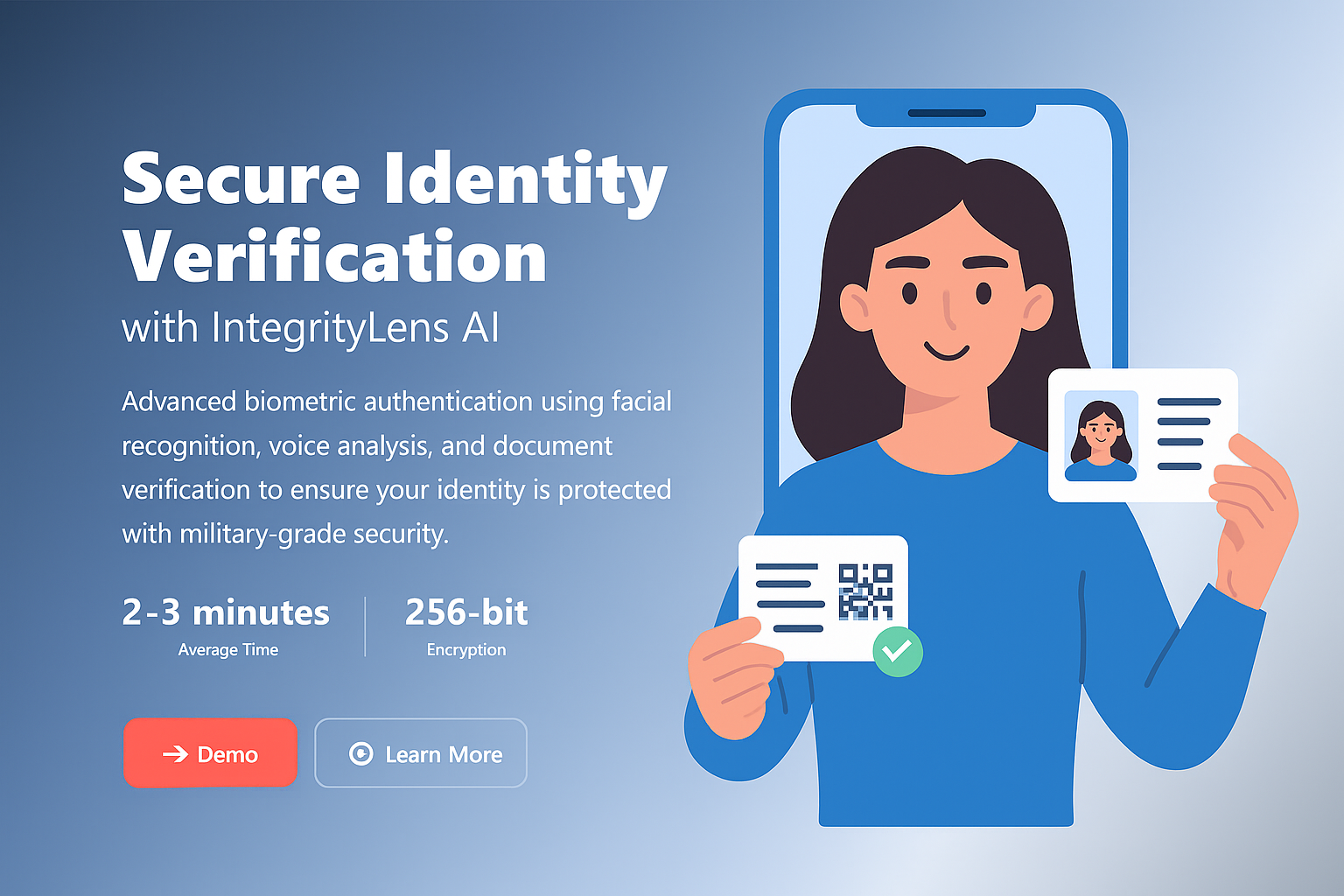
Explain the time bound: "Most candidates finish in 2-3 minutes."
Explain what is collected: "We verify a government ID and a live selfie. We do not store your biometric templates beyond verification."
Explain the recovery path: "If your camera fails, you can retry, switch devices, or request assisted verification."
What it enables operationally
IntegrityLens AI supports a branded identity gate that stays ATS-anchored, evidence-backed, and reviewable under SLA, so your team does not trade speed for defensibility. It enables:
Identity gating before access using biometric verification signals (liveness, document authentication, face matching) captured as time-stamped events.
Immutable evidence packs that bind identity outcomes to the candidate record with reviewer notes and policy versions.
Zero-retention biometrics architecture options to reduce privacy exposure while still producing audit-ready outcomes.
AI screening interviews available 24/7 so verification and screening can be sequenced without calendar delays.
An ATS plus verification in one pipeline so status, evidence references, and exceptions do not drift into shadow workflows.
ANTI-PATTERNS THAT MAKE FRAUD WORSE
Do not "improve experience" by removing controls. You will only move the risk into unlogged channels. Exactly three anti-patterns to avoid:
Bypass-by-email: letting recruiters advance candidates after a screenshot or a phone call. Manual review without evidence creates audit liabilities.
Unbranded redirects: sending candidates to a different domain with no explanation. This increases abandonment and increases the probability of social-engineering claims.
One-way gates: no retry, no alternate device path, no accommodation route. This forces exceptions, and exceptions are where fraud hides.
IMPLEMENTATION RUNBOOK: Brand, gate, log, and recover under SLA
Implement this in one sprint by treating branding as a compliance deliverable and the verification flow as an SLA-bound queue. Runbook steps below include owner, SLA, and what must be logged. Use it as your day-one operating model.
Step 1: Publish controlled disclosure and consent text. Owner: Legal/Privacy with Compliance. SLA: 2 business days to approve v1. Evidence: policy version ID, jurisdiction mapping, and approval record in your policy repository.
Step 2: Configure branding and sender identity across invitations and verification pages. Owner: Recruiting Ops. SLA: 1 business day. Evidence: template IDs, domain configuration record, and a screenshot hash stored with the policy version.
Step 3: Define the identity gate. Owner: Security. SLA: same day as launch. Evidence: gate rules (who is required, step-up conditions), exception roles, and access expiration by default for interview links.
Step 4: Instrument event logging and ATS write-backs. Owner: Recruiting Ops + Security. SLA: 2 business days. Evidence: immutable event log fields (invite_sent, verification_started, verification_completed, manual_review_started, manual_review_decided, exception_requested, exception_approved) with timestamps and actor IDs.
Step 5: Set review-bound SLAs and routing. Owner: Compliance with Recruiting Ops. SLA: 24 hours to stand up queue. Evidence: queue definitions, escalation policy, and breach alerts. Suggested SLAs: candidate completion target of 15 minutes from start, manual review decision within 4 business hours, exception approval within 2 business hours.
Step 6: Build recovery paths. Owner: Recruiting Ops. SLA: 1 business day. Evidence: retry count, alternate device flow, assisted verification ticket link, and accommodation tagging stored on candidate record.
Step 7: Enforce rubric discipline at the gate boundary. Owner: Hiring Manager. SLA: ongoing. Evidence: rubric completion required before "advance" action; all overrides require a logged reason code.
Step 8: Monitor segmented risk dashboards weekly. Owner: Analytics. SLA: weekly review. Evidence: time-to-event distributions, drop-off by device/region, exception rate, and fraud flags correlated with bypass paths.
Related Resources
Key takeaways
- Branding is a control, not a design preference. It reduces abandonment and makes consent and disclosure defensible because the policy owner is unambiguous.
- Treat verification like identity gating before access: candidates should not receive interview links, assessments, or recruiter time until the gate is complete or explicitly waived with evidence.
- Your compliance risk is mostly in the gaps: exceptions handled in email, unverifiable disclosures, missing timestamps, and unlogged manual overrides.
- Operationalize perceived speed: show a time bound, step count, and a recovery path. Log every failure mode and resolution as an immutable event.
- Accessibility is not optional. WCAG 2.1-aligned flows reduce disparate impact claims and lower support burden by preventing avoidable failure states.
Use this as a controlled policy artifact. Store it in your policy repo, version it, and reference the policyVersion in every candidate event log.
It focuses on brand continuity, consent capture, SLA-bound review queues, and exception governance. Adapt jurisdictions and roles to your org chart.
version: "2026-03-12"
policyId: "branded-verification-v1"
owner:
  primary: "Head of Compliance"
  recruitingOps: "Recruiting Ops Manager"
  security: "Security Lead"
  legalPrivacy: "Privacy Counsel"
scope:
  appliesTo:
    - "all-remote-roles"
    - "roles-with-system-access"
branding:
  senderDomain: "mail.yourcompany.com"
  displayName: "YourCompany Talent Team"
  verificationPageBrand:
    logoAssetId: "brand-logo-primary"
    supportUrl: "https://yourcompany.com/hiring-verification-help"
    helpEmail: "verification-help@yourcompany.com"
    copyVersionId: "disclosure-copy-v3"
disclosureAndConsent:
  requireConsentCheckbox: true
  logConsentEvent: true
  consentTextKeyPoints:
    - "Verification is required by YourCompany to protect candidate identity."
    - "Typical completion time is 2-3 minutes."
    - "If you cannot complete, you can retry, switch devices, or request assisted verification."
    - "Accommodation requests are available."
identityGate:
  gateBefore:
    - "live-interview-link"
    - "coding-assessment-access"
    - "offer-generation"
  verificationSteps:
    - "document-auth"
    - "liveness"
    - "face-match"
  stepUpRules:
    onSignals:
      - "deepfake-risk-flag"
      - "proxy-interview-suspected"
      - "multiple-failed-attempts"
    action: "manual-review-required"
slas:
  candidateCompletion:
    targetMinutesFromStart: 15
  manualReview:
    targetBusinessHoursToDecision: 4
    escalationAfterBusinessHours: 2
  exceptionApproval:
    targetBusinessHoursToDecision: 2
exceptions:
  allowedReasons:
    - "accessibility-accommodation"
    - "device-unavailable"
    - "jurisdictional-restriction"
  approvers:
    - role: "Security Lead"
    - role: "Head of Compliance"
  requirements:
    - "reason-code"
    - "time-bound-access"
    - "reviewer-notes"
logging:
  writeBackToATS: true
  immutableEvents:
    - "verification_invite_sent"
    - "verification_started"
    - "consent_acknowledged"
    - "verification_completed"
    - "manual_review_started"
    - "manual_review_decided"
    - "exception_requested"
    - "exception_approved"
  requiredFields:
    - "candidateId"
    - "jobId"
    - "policyId"
    - "policyVersion"
    - "timestamp"
    - "actorId"
    - "outcome"
accessibility:
  standard: "WCAG-2.1"
  assistedPath:
    enabled: true
    routingQueue: "assisted-verification"
privacy:
  biometrics:
    retentionMode: "zero-retention"
  encryption:
    atRest: "AES-256"
reviewCadence:
  weekly:
    owner: "Analytics"
    metrics:
      - "verification-start-rate"
      - "verification-completion-rate"
      - "median-time-start-to-complete"
      - "exception-rate"
      - "sla-breach-count"
      - "fraud-flags-by-bypass-path"
Outcome proof: What changes
Before
Candidates were redirected to an unfamiliar third-party verification experience. Drop-offs were handled via recruiter email exceptions, and consent language varied by coordinator. Audit reconstruction required pulling records from multiple tools and inbox threads.
After
Verification was branded as company policy, gated before interview and assessment access, and routed through SLA-bound review queues with immutable event logs and evidence packs referenced from the ATS.
Implementation checklist
- Publish a single policy statement that explains why verification is required and who to contact for help or accommodation.
- Add your domain, logo, and sender identity so candidates never feel redirected into an unknown workflow.
- Gate access to interviews and assessments on verification completion or a logged exception.
- Define SLAs for completion, manual review, and exception approval. Instrument breach alerts.
- Log disclosures, consent, retries, and outcomes into an ATS-anchored audit trail.
- Implement recovery paths: retry, alternate device, assisted verification, and accommodation routing.
Questions we hear from teams
- How do you brand verification without hiding that a vendor is involved?
- Disclose the vendor relationship in the privacy notice, but keep the candidate-facing flow anchored to your company policy: your domain, your support channel, and a clear explanation of why verification is required. Log the disclosure and consent shown to each candidate with a policy version so it is defensible.
- What should be the system of record for verification results?
- The verification service is the system of record for the underlying evidence, but the ATS should be the system of record for candidate stage and the reference pointers: event IDs, timestamps, outcomes, policy version, and any exception approvals.
- What is the minimum viable SLA set for compliance?
- Set SLAs for candidate completion time from start, manual review decision time, and exception approval time. Enforce escalation on SLA breach and log the breach event so you can prove queue governance.
- How do you handle candidates who cannot complete biometric steps?
- Provide an assisted verification path and an accessibility accommodation route. Treat it like a controlled exception with reason codes, named approvers, and time-bound access while the issue is resolved. Log every step and outcome.
Ready to secure your hiring pipeline?
Let IntegrityLens help you verify identity, stop proxy interviews, and standardize screening from first touch to final offer.
Watch IntegrityLens in action
See how IntegrityLens verifies identity, detects proxy interviewing, and standardizes screening with AI interviews and coding assessments.