Language Parity Rubrics: One Bar for Java and Python
When scoring differs by language, you get inconsistent hiring decisions you cannot defend. This briefing shows how to standardize rubrics across Java and Python using an instrument
Rubric parity is not a training problem. It is a control problem: versioned standards, evidence packs, and identity gating before access.Back to all posts
1) Hook: Real hiring problem
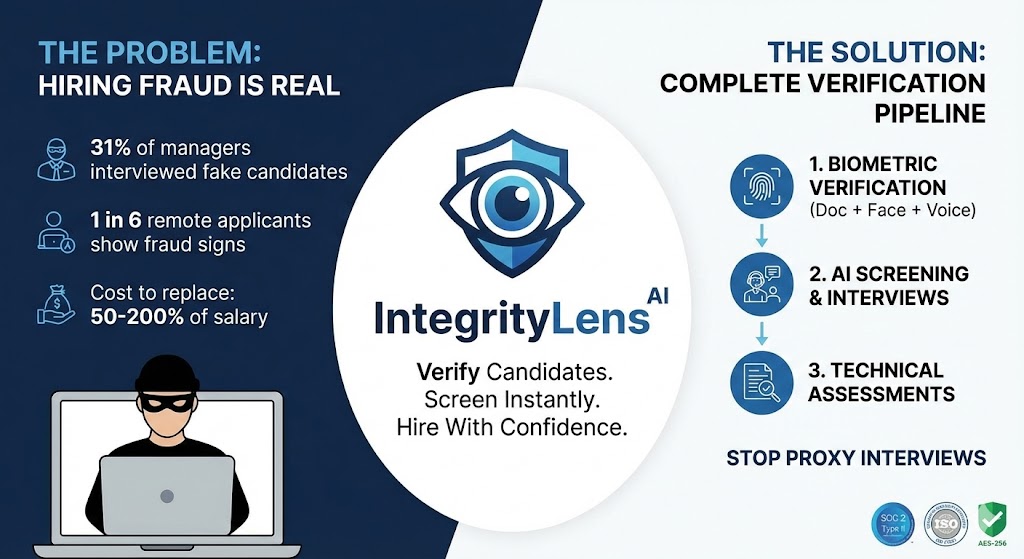
You are asked to explain why pass rates differ between Java and Python candidates for the same role level. The deeper issue is that you do not have a defensible measurement system. Rubrics differ by language, rubric versions are not consistently attached to scorecards, and code evidence is fragmented across tools. Operationally, this creates a review-bound SLA breach: candidates sit in "needs review" while teams reconcile scoring mismatches. Legally, you risk a defensibility failure because you cannot show that the same job-relevant standard was applied. Financially, the cost of a mis-hire is not abstract. SHRM estimates replacement costs can range from 50% to 200% of annual salary depending on role, which makes parity drift an expensive leak, not a philosophical debate. Fraud turns parity into an access control problem. If identity is not gated before assessment and interview access, you are not comparing candidates. You are comparing sessions. Checkr reports 31% of hiring managers say they have interviewed a candidate who later turned out to be using a false identity.
2) Why legacy tools fail
Legacy stacks treat technical evaluation as content, not as an instrumented control. An ATS stores stages, a coding tool stores answers, and identity checks run somewhere else, each with different identifiers and retention rules. That fragmentation breaks parity in predictable ways: - Sequential workflows force late-stage reconciliations and rework, which shows up as time-to-offer volatility. - No immutable event log means you cannot prove which rubric version was used when a score was entered. - No unified evidence pack means disputes get resolved by meetings, not by code playback and telemetry. - No standardized rubric storage means language-specific rubrics drift and quietly embed different expectations (example: Java candidates penalized for verbosity while Python candidates are rewarded for concision). - Shadow workflows (spreadsheets, offline normalization) become the de facto system of record, but they are unlogged and not audit-ready.
3) Ownership and accountability matrix
Parity is a governance problem. Assign owners and lock sources of truth. Recruiting Ops owns: workflow sequencing, SLAs, and rubric publishing controls. They ensure every candidate goes through the same identity gate before accessing high-signal steps and that every scorecard is complete before stage movement. Security owns: identity policy, step-up verification rules, access expiration by default, and audit trail retention. They define what fraud signals require escalation and what evidence must be captured. Hiring Manager owns: rubric discipline and scoring calibration. They approve competency weights and enforce that reviewers score to the rubric, not preferences. People Analytics owns: parity monitoring and drift detection dashboards. They publish language parity reports and open corrective actions when distributions diverge beyond agreed thresholds. Sources of truth: the ATS is the lifecycle record. The assessment and interview artifacts must write back as evidence packs with timestamps, rubric versions, and reviewer identities. Verification events must be linked to the candidate entity, not a session ID.
Automated: identity gating, rubric version attachment, telemetry capture, plagiarism signals, risk-tiering, and SLA timers.
Manual: scoring justification, exception review for parity drift, fraud escalations requiring human judgment, and calibration sessions with documented outcomes.
4) Modern operating model: instrumented rubric parity
A language parity rubric is a control system with three layers. Layer 1: Language-agnostic competencies. Score what must be true regardless of Java or Python: correctness, complexity tradeoffs, test strategy, debugging approach, and code readability relative to team standards. Weight these heavily. Layer 2: Language-specific addendum with capped influence. Allow small, explicit criteria for idiomatic usage or ecosystem tooling, but cap the weight so language choice cannot dominate the outcome. Layer 3: Evidence requirements. Every score must be linked to code playback and execution telemetry, with rubric version and reviewer identity recorded in an immutable event log. Operational sequencing matters. Identity verification before access prevents you from running high-signal steps on an unverified actor. Event-based triggers replace handoffs: when identity is verified, the assessment becomes available; when an assessment is submitted, a review queue SLA starts; when SLA breaches, escalation triggers. This creates ATS-anchored audit trails and time-to-event analytics you can trust. For People Analytics, parity becomes measurable: compare score distributions by language while holding role level and question set constant, then segment by interviewer and time window to isolate drift versus talent supply changes.
Score distribution drift by language and role level (weekly).
SLA heatmap: assessment submit-to-scorecard complete.
Exception rate: parity overrides and regrades per interviewer.
Fraud signal incidence by language cohort (to avoid confounding parity with integrity).
5) Where IntegrityLens fits
IntegrityLens AI is used as the control plane that keeps parity enforceable across languages and reviewers. - Run AI coding assessments in 40+ languages, so Java and Python candidates can be evaluated on the same competencies using comparable prompts, while capturing plagiarism signals and execution telemetry. - Gate assessment and interview access with biometric identity verification and step-up verification when risk signals appear, keeping identity stable across steps. - Capture code playback, reviewer notes, rubric version, and timestamps into immutable evidence packs that write back into the ATS as the system of record. - Use fraud prevention signals such as deepfake detection, proxy interview detection, behavioral signals, and device fingerprinting to reduce cohort contamination that breaks analytics. - Operate with zero-retention biometrics and encryption controls aligned to GDPR/CCPA-ready policies and SOC 2 Type II audited infrastructure.
6) Anti-patterns that make fraud worse
- Letting candidates pick a language and then switching to a different rubric with different weights, without logging the rubric version and rationale in the scorecard. - Running assessments before identity gating, then trying to "verify later" after a strong performance. Time delays cluster at moments where identity is unverified. - Allowing offline score normalization in spreadsheets or chat threads. Shadow workflows are integrity liabilities and destroy audit readiness.
7) Implementation runbook
Publish the parity rubric spec (SLA: 5 business days). Owner: People Analytics. Evidence: rubric schema, weights, and language-specific addenda stored with version IDs.
Identity gate before access (SLA: under 3 minutes typical). Owner: Security. Evidence: timestamped verification events (document, face, voice) linked to candidate; access granted only after pass.
Assign language-agnostic assessment with language choice (SLA: instant availability, async). Owner: Recruiting Ops. Evidence: assessment ID, question set ID, language selected, start time, device fingerprint.
Collect execution telemetry and code playback (SLA: captured at submit). Owner: System automated, overseen by Security. Evidence: run logs, test results, time-on-task, code playback link stored in evidence pack.
Reviewer scoring to parity rubric (SLA: 24 hours from submission). Owner: Hiring Manager. Evidence: scorecard with rubric version, required written justification per competency, reviewer identity, timestamp.
Parity check and drift monitor (SLA: weekly batch, daily alerts on thresholds). Owner: People Analytics. Evidence: segmented risk dashboards, drift report, and corrective action tickets when thresholds breach.
Exception handling and step-up verification (SLA: 4 hours for escalation decision). Owner: Security for fraud, Hiring Manager for rubric exception, Recruiting Ops for scheduling. Evidence: exception reason code, who approved, timestamps, and linked artifacts.
Offer decision evidence pack lock (SLA: before offer creation). Owner: Recruiting Ops. Evidence: immutable evidence pack attached to ATS record: verification events, assessment telemetry, scorecards, and approvals. If legal asked you to prove who approved this candidate, can you retrieve it?
8) Sources
9) Close: implementation checklist
If you want to implement this tomorrow, focus on controls and timestamps, not more meetings. - Publish a single parity rubric with language-agnostic competencies and a capped language-specific addendum. - Require rubric version IDs on every scorecard and block stage movement if missing. - Enforce identity gating before assessment and interview access, with step-up verification for flagged sessions. - Attach code playback and execution telemetry to every assessment result so disputes are resolved from evidence, not memory. - Set review-bound SLAs for scoring completion and escalation paths with named owners. - Stand up a weekly parity drift report: distribution drift by language, interviewer, and role level, plus exception rate and SLA breaches. Outcomes you should expect when the system is instrumented: reduced time-to-hire variance because rework drops, defensible decisions because evidence packs are complete, lower fraud exposure because identity is stable across steps, and standardized scoring across teams so People Analytics can trust funnel metrics again.
Related Resources
Key takeaways
- Treat rubric parity as a control: if scoring is not comparable across languages, analytics and legal defensibility collapse.
- Anchor scoring to language-agnostic competencies (correctness, complexity, testing discipline, debugging) and keep language-specific items explicitly bounded.
- Instrument every scoring decision with timestamps, reviewer identity, and code playback so disputes can be resolved from evidence, not memory.
- Use risk-tiered funnel design: step-up verification at the points where unverified identity and high-value evaluation intersect.
- Measure parity with time-to-event metrics and score distribution drift by language, interviewer, and role family.
A versioned rubric policy that enforces language-agnostic scoring, caps language-specific variance, and specifies evidence requirements for audit readiness.
Intended owner: People Analytics publishes, Hiring Managers approve weights, Recruiting Ops enforces stage gates, Security enforces identity and fraud escalations.
```yaml
policy_id: rubric-parity-backend-v1
version: 1.0.0
role_family: backend-engineering
levels: [L3, L4, L5]
scoring_scale: {min: 1, max: 5}
weights:
  language_agnostic:
    correctness: 0.30
    complexity_tradeoffs: 0.20
    testing_discipline: 0.20
    debugging_and_iteration: 0.15
    readability_and_maintainability: 0.15
  language_specific_addendum_cap: 0.10
language_specific_addenda:
  java:
    criteria:
      - id: java-idioms
        description: "Uses standard library and common patterns appropriately. No over-abstracting for the level."
      - id: jvm-performance-awareness
        description: "Basic awareness of allocations, data structures, and runtime tradeoffs when relevant."
  python:
    criteria:
      - id: python-idioms
        description: "Uses built-ins and standard library appropriately. Avoids unnecessary cleverness."
      - id: python-runtime_awareness
        description: "Basic awareness of time complexity and pitfalls (mutability, recursion limits) when relevant."
controls:
  identity_gate_before_access: true
  step_up_verification_on:
    - risk_signal: "proxy_suspected"
      action: "reverify_before_review"
    - risk_signal: "device_fingerprint_change"
      action: "reverify_before_next_stage"
  scorecard_requirements:
    must_include:
      - rubric_policy_id
      - rubric_version
      - reviewer_id
      - timestamp_scored
      - competency_scores
      - written_justification_per_competency
      - code_playback_link
      - execution_telemetry_link
  stage_gates:
    block_offer_if_missing_evidence_pack: true
sla_targets:
  verify_identity: "3m"      # typical end-to-end verification time
  scorecard_complete_after_submit: "24h"
  parity_exception_triage: "4h"
audit:
  log_to_immutable_event_log: true
  retain_evidence_pack_days: 365
```
Outcome proof: What changes
Before
Pass rates and score distributions differed materially by language, with frequent regrades and late-stage "second looks" that stretched time-to-offer. Disputes were resolved in meetings because code playback and rubric versions were not consistently attached to scorecards.
After
A single versioned parity rubric was enforced across languages with capped language-specific variance. Identity was gated before assessment access, and every decision shipped with an ATS-anchored evidence pack including rubric version, reviewer identity, code playback, and telemetry.
Implementation checklist
- Define 4-6 language-agnostic competencies and weight them per role level.
- Create language-specific addenda with capped weight (example: 10-15%) and explicit criteria.
- Require code playback links and execution telemetry to be attached to every scorecard.
- Calibrate monthly using distribution drift reports by language and interviewer.
- Set review-bound SLAs for scoring completion and parity exceptions.
- Gate access to assessments with identity verification and step-up verification for high-risk signals.
Questions we hear from teams
- How do we avoid penalizing language choice while still allowing idiomatic code?
- Keep the rubric language-agnostic by default, then allow a language-specific addendum with a hard weight cap. Log the selected language, rubric version, and addendum criteria in the evidence pack so parity can be audited.
- What parity metric should People Analytics monitor first?
- Start with score distribution drift by language within the same role level and question set, then segment by reviewer. Pair it with SLA metrics like submit-to-scorecard-complete so you can separate scoring drift from review delays.
- What makes a parity exception audit-ready?
- An exception needs a reason code, approver identity, timestamps, and linked artifacts (code playback, telemetry, rubric version). Without those, you have an undocumented override that Legal cannot defend.
Ready to secure your hiring pipeline?
Let IntegrityLens help you verify identity, stop proxy interviews, and standardize screening from first touch to final offer.
Watch IntegrityLens in action
See how IntegrityLens verifies identity, detects proxy interviewing, and standardizes screening with AI interviews and coding assessments.