Embed Verification Status in ATS Profiles to Stop Swivel-Chair Risk
A CISO-focused operating model for making identity and fraud controls visible where hiring decisions happen: inside the ATS profile view, not in side portals.

If verification status is not visible in the ATS profile view, it will be bypassed under SLA pressure and you will not have a defensible audit trail.Back to all posts
Swivel-chair recruiting is an audit gap, not an annoyance
Embed verification status directly in the ATS candidate profile view because that is where approvals happen under SLA pressure. When verification evidence lives in a separate portal, teams will unintentionally bypass identity gating, creating fraud exposure and non-defensible decisions. Operationally, the failure shows up as time-to-offer volatility: interviews get scheduled before verification clears, then get canceled or re-run. Legally, it shows up as missing proof: no single export that ties identity checks, reviewer approvals, and stage changes to timestamps. External signals support the risk framing: 31% of hiring managers say they interviewed someone later found to be using a false identity, and 1 in 6 remote applicants showed signs of fraud in one pipeline. A mis-hire can cost 50-200% of annual salary, which makes "verification drift" a material business risk, not an edge case.
Decision surface is the ATS profile view; control surface is elsewhere.
Exceptions get approved in chat, not in a tamper-resistant log.
Recruiters optimize for visible fields, not hidden portals.
Why legacy tools fail to stop swivel-chair behavior
Legacy ATS, verification, and assessment tools optimize for their own UI, not for a unified, instrumented workflow. The market failed to solve this because vendors treat integration as "link out" instead of "write back controls". Common failure modes are operationally consistent: sequential checks that become bottlenecks, no immutable event log across tool boundaries, no unified evidence packs, and no SLA enforcement for manual review. Rubrics and reviewer rationale are often unstructured, which makes later defensibility fragile. The predictable outcome is shadow workflows and data silos: screenshots, pasted URLs, and stage changes that are not causally tied to verification outcomes. If it is not logged, it is not defensible.
Portals over embedded controls.
Waterfall workflows over parallelized checks.
Narrative notes over structured, exportable evidence.
Ownership and accountability matrix (make the audit trail someones job)
Assign owners by function and bind them to timestamps. This prevents the default failure mode where "everyone assumed someone else checked." Recruiting Ops owns: ATS stage design, required fields, and candidate profile layout. Security owns: identity policy, step-up rules, reviewer access controls, and exception governance. Hiring Managers own: rubric completeness and decision rationale, but they do not own identity overrides. Analytics owns: dashboards for SLA misses, fraud flags, and reconciliation drift. Define sources of truth explicitly. ATS is the source of truth for stage transitions and final decisions. Verification system is the source of truth for identity evidence and risk signals. The integration layer is the source of truth for event delivery, retries, idempotency keys, and reconciliation reports.
Automate: status write-back, evidence-pack link creation, stage gating rules, drift alerts.
Manual: exception approvals, ambiguous document reviews, high-risk proxy interview investigations.
Modern operating model: instrument the hiring funnel like access management
Treat hiring like secure access management: identity gate before access. The recommendation is to make verification status visible and enforceable in the ATS profile header, then gate privileged steps (live interviews, technical assessments, offer) on that status with risk-tiered step-up verification. Run the workflow as event-based orchestration. When a candidate is moved to a stage, emit an event. In parallel, trigger verification and screening steps. Write outcomes back as structured ATS fields with timestamps. Use idempotency keys so retries do not create duplicate status updates or conflicting badges. Automate evidence capture. Every verification outcome produces an evidence pack with a stable URL, a hashable reference, and a time-stamped event sequence. Store reviewer notes as tamper-resistant feedback tied to user identity and time. This is what makes decisions audit-ready. Measure time-to-event, not vanity averages: time from application to verification started, verification started to verified, verified to interview scheduled, and SLA breaks by stage. Segment by risk tier so you do not slow low-risk candidates while still step-up verifying higher-risk profiles.
Identity verification before privileged access steps.
Event-based triggers with retries and idempotency.
ATS-anchored audit trails and evidence packs.
Risk-tiered funnel with step-up verification.
Segmented risk dashboards tied to timestamps.
Where IntegrityLens fits (embed controls into the ATS decision surface)
IntegrityLens AI acts as the control plane that writes verification state and evidence back into the ATS profile view so recruiters and managers do not have to swivel-chair. It enables: - Biometric identity verification with liveness detection, document authentication, and face matching, executed before high-trust stages. - Fraud prevention signals including deepfake detection, proxy interview detection, and behavioral signals to support a risk-tiered funnel. - Immutable evidence packs with time-stamped logs and reviewer notes so approvals are exportable and defensible. - Zero-retention biometrics design to reduce data liability while preserving proof of verification events. - A single ATS-anchored workflow that reduces shadow workflows and keeps verification status visible at decision time.

You are not buying a feature. You are buying a provable gate tied to timestamps.
Evidence packs turn "we checked" into "here is the record."
Anti-patterns that make fraud worse (do not do these)
These patterns increase fraud exposure because they remove enforcement at the decision surface: - Using ATS comments or free-text notes for verification outcomes instead of structured fields with timestamps and immutable links. - Allowing stage transitions (interview, assessment, offer) to proceed on "pending" verification without a logged, time-bound exception owner. - Relying on emailed PDFs or screenshots as evidence instead of an evidence pack referenced in the ATS and backed by an immutable event log.
Free-text is not queryable at scale for compliance sampling.
"Pending" becomes permanent during rush periods.
Screenshots break chain of custody and reviewer accountability.
Implementation runbook: embed verification status into ATS profiles
Define statuses and fields (SLA: 2 business days). Owner: Recruiting Ops with Security approval. Evidence: data dictionary, required-field rules, and profile layout screenshots stored in change control.
Event triggers from ATS stages (SLA: 5 business days). Owner: Recruiting Ops and Engineering. Evidence: event schema, idempotency key design, retry policy, and mapping document. Log: immutable event log entries for stage_changed and verification_requested.
Verification initiation at identity gate (SLA: automated within 60 seconds of trigger). Owner: Security policy, implemented by Recruiting Ops/Engineering. Evidence: policy file, event IDs, verification session ID written back to ATS.
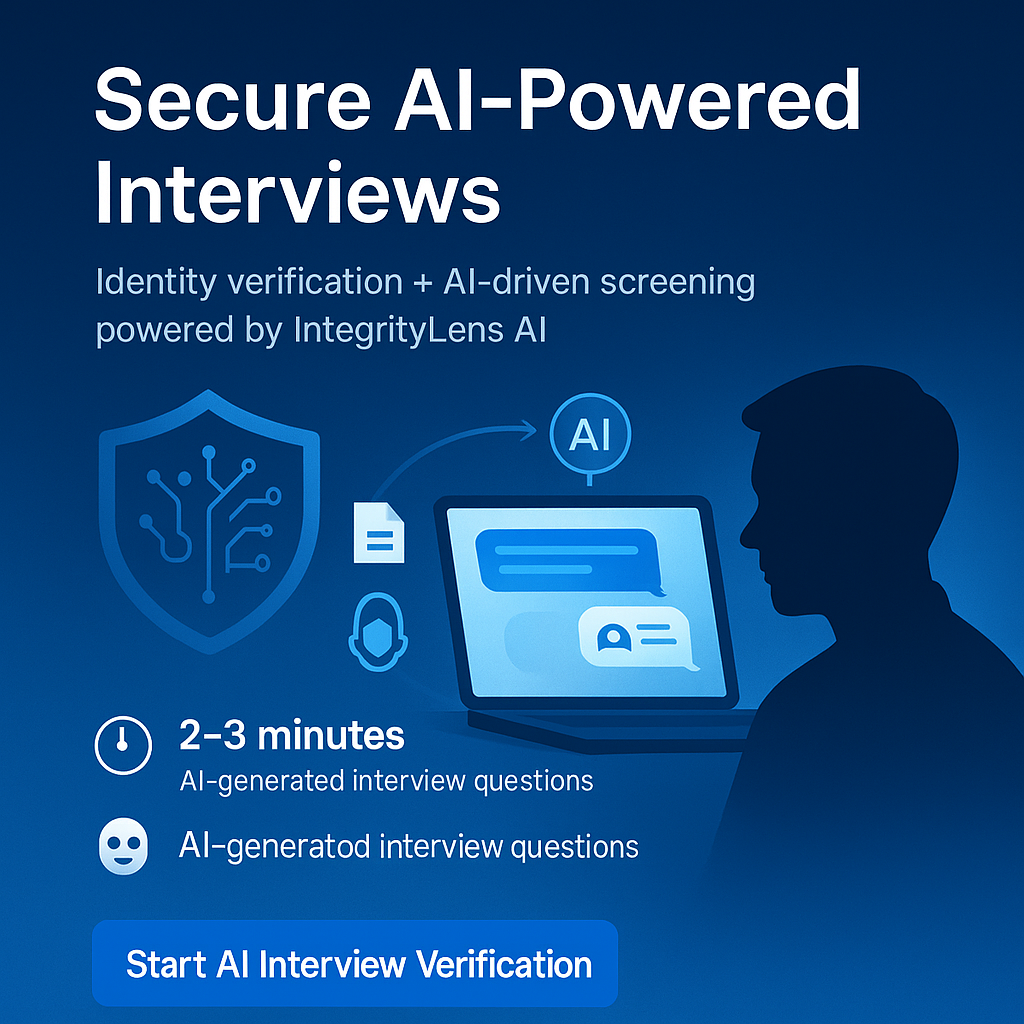
Automated verification and risk tiering (SLA: complete within typical 2-3 minutes for document + voice + face when the candidate completes the flow). Owner: Security. Evidence: evidence pack with time-stamped steps and outcome; ATS fields updated with verified-at and risk tier. Log: verification_completed event with hash reference to evidence pack.
Manual review queue for exceptions (SLA: 4 business hours for high-risk candidates; 1 business day for medium risk). Owner: Security. Evidence: reviewer identity, decision rationale, and time stamps appended to evidence pack. Log: review_started, review_completed.
Stage gating (SLA: real time). Owner: Recruiting Ops. Evidence: ATS workflow rule configuration. Log: stage_transition_blocked with reason codes when verification is not sufficient.
Reconciliation and drift monitoring (SLA: daily). Owner: Analytics with Security oversight. Evidence: drift report listing candidates where ATS status != verification status, with remediation timestamps. Log: reconciliation_run, drift_detected, drift_resolved.
Audit export drill (SLA: quarterly 30-minute exercise). Owner: Security. Evidence: exported sample of candidates including ATS stage timeline, verification status, and evidence pack links. If legal asked you to prove who approved this candidate, can you retrieve it? This is where you find out.
Verification status: Not started, In progress, Verified, Failed, Needs review.
Risk tier: Low, Medium, High with reason codes.
Verified-at timestamp and reviewer (if applicable).
Evidence-pack link that is stable and exportable.
Idempotency: one verification status per candidate per stage trigger.
Retries with backoff: do not silently drop webhook failures.
Reconciliation: daily job to resolve mismatches between systems.
Related Resources
Key takeaways
- If verification evidence is not visible in the ATS profile view, it will be skipped or misinterpreted under SLA pressure.
- Treat identity verification like access management: gate high-trust steps (interviews, assessments, offer) on verified status with step-up rules.
- Instrument the workflow with immutable event logs, timestamps, and evidence packs so Security can answer who approved what, and when.
- Use event-based orchestration with idempotency and reconciliation to prevent status drift between systems.
- Reduce fraud exposure without adding recruiter burden by writing verification outcomes back into the ATS as structured fields, not comments.
Use this as a starting point to define which ATS stages are gated by which verification outcomes, plus SLAs and exception controls. Store it in change control and tie every update to an approval ticket.
This policy assumes the ATS is the decision surface and must display status, risk tier, timestamps, and evidence-pack link in the candidate profile header.
version: 1
policy_name: ats-embedded-verification-status
ats_fields:
  verification_status: { type: enum, values: [not_started, in_progress, verified, failed, needs_review] }
  verification_risk_tier: { type: enum, values: [low, medium, high] }
  verification_verified_at: { type: datetime }
  verification_reviewer: { type: string }
  verification_evidence_pack_url: { type: url }
slas:
  auto_initiate_after_stage_change_seconds: 60
  manual_review_high_risk_hours: 4
  manual_review_medium_risk_hours: 24
stage_gates:
  phone_screen:
    required_status: [in_progress, verified, needs_review]
  onsite_or_panel_interview:
    required_status: [verified]
  coding_assessment:
    required_status: [verified]
  offer:
    required_status: [verified]
exceptions:
  allow_time_bound_override: true
  override_ttl_hours: 24
  override_roles_allowed: [security_reviewer]
  override_logging_required_fields:
    - override_reason_code
    - approved_by
    - approved_at
    - expiry_at
logging:
  immutable_event_log_required: true
  events:
    - stage_changed
    - verification_requested
    - verification_started
    - verification_completed
    - stage_transition_blocked
    - exception_granted
    - exception_expired
    - reconciliation_run
    - drift_detected
    - drift_resolved
Outcome proof: What changes
Before
Recruiters and hiring managers relied on separate verification portals. Verification outcomes were pasted into ATS notes and exceptions were approved in chat, creating status drift and non-exportable evidence during customer audits.
After
Verification status and evidence-pack links were embedded into the ATS candidate profile header with stage gates. Manual review ran in an SLA-bound queue owned by Security, and daily reconciliation flagged mismatches.
Implementation checklist
- Define the ATS as the decision surface and require verification status to be visible in the candidate profile header.
- Implement a risk-tiered funnel: allow low-risk steps to proceed while step-up verification gates privileged steps.
- Set SLAs for automated checks and manual review queues, with named owners and escalation paths.
- Write back structured fields (status, risk tier, verified-at timestamp, evidence-pack link, reviewer) into the ATS.
- Log every status transition with immutable timestamps and reviewer identity.
- Run daily reconciliation to detect drift between the verification service and the ATS record.
Questions we hear from teams
- What is the minimum data Security should require in the ATS profile view?
- At minimum: verification status, risk tier, verified-at timestamp, reviewer identity (if manually reviewed), and a stable evidence-pack link. Free-text notes are not sufficient for audit sampling or reconciliation.
- How do you prevent status drift between the verification system and the ATS?
- Use idempotent write-backs for every status transition and run a daily reconciliation job that compares ATS fields to the verification system of record. Log drift_detected and drift_resolved events with timestamps and owners.
- Will gating interviews on verification slow hiring?
- It reduces rework by preventing late-stage reversals. Use a risk-tiered funnel so low-risk candidates proceed with minimal friction, and step-up verify only when the candidate reaches high-trust stages like live interviews, assessments, or offer.
- How do you handle false positives without creating legal exposure?
- Route failed or ambiguous cases to an SLA-bound manual review queue owned by Security, require documented reason codes, and store reviewer rationale in an immutable evidence pack. Automation should recommend, not finalize, when signals are ambiguous.
Ready to secure your hiring pipeline?
Let IntegrityLens help you verify identity, stop proxy interviews, and standardize screening from first touch to final offer.
Watch IntegrityLens in action
See how IntegrityLens verifies identity, detects proxy interviewing, and standardizes screening with AI interviews and coding assessments.