Dynamic Coding Difficulty That Separates Top 1% From Top 10%
A finance-first playbook to get granular skill signal without inflating assessment time, fraud risk, or re-review costs.
If your assessment cannot separate top 1% from top 10%, you are underwriting senior compensation with mid-level evidence.Back to all posts
The budget-cycle mis-hire nobody can amortize
It is week three of budget season. You just approved a headcount exception for a senior engineer because the roadmap is slipping. The candidate aces a standard coding test, clears interviews, and starts. Six weeks later, delivery velocity does not improve, incident tickets spike, and the hiring manager quietly admits, "They are good, but not at the level we paid for." From a CFO seat, this is not a talent problem. It is a measurement problem. Your assessment produced a pass/fail outcome, but you needed a finer read: top 1% versus top 10% capability, under real-world constraints, without letting proxying or AI-assisted cheating inflate the score. Dynamic difficulty gives you that granularity by increasing measurement resolution only when the decision is expensive.
Why dynamic difficulty is a finance control, not an HR preference
Use adaptive difficulty to reduce two kinds of waste: over-testing and under-measuring. Over-testing is when strong candidates churn because the test is too long or irrelevant. Under-measuring is when a single mid-level test cannot distinguish high performers, so you pay senior compensation for senior-looking scores. Fraud pressure makes the measurement problem worse. Checkr reports that 31% of hiring managers say they have interviewed a candidate who later turned out to be using a false identity. Directionally, that implies identity and proxy risk is common enough to justify gating high-cost roles. It does not prove your company will see the same rate, since it is survey-based and varies by role, region, and remote exposure. Pindrop notes that 1 in 6 applicants to remote roles showed signs of fraud in one real-world pipeline. Directionally, that supports treating remote hiring as an attack surface. It does not prove intent or confirm fraud in every flagged case, because "signs" are indicators and pipelines differ in thresholds and applicant mix. Dynamic difficulty pairs well with integrity signals because both aim at the same operator goal: fewer expensive decisions made on low-confidence evidence.
Cost: reduce re-review cycles and late-stage rework when a "pass" hides true variance.
Speed: keep top candidates moving by avoiding blanket hard tests for everyone.
Risk: make offers based on documented evidence, not vibes, when a decision is challenged.
Reputation: avoid heavy friction on low-risk candidates while still tightening controls on high-risk paths.
Ownership, automation, and systems of truth
Set ownership explicitly before you tune difficulty. Otherwise, you will get shadow policies and inconsistent overrides, which is exactly what auditors and candidate advocates will challenge. Recommendation: Recruiting Ops owns the assessment policy and routing. Security owns identity and fraud controls plus retention and access. Hiring Managers own the job-relevant rubric and item bank quality. Finance is a stakeholder for cost of delay, false positives, and re-review labor. Automate scoring, routing, and evidence capture. Manually review only edge cases: high performance with elevated risk signals, or low performance with strong work history and low risk indicators. Sources of truth should be singular: the ATS is the system of record for stage and disposition, the assessment system is the system of record for item-level telemetry and score traces, and the verification service is the system of record for identity and liveness events. Do not accept "screenshots in Slack" as evidence.
Automated: baseline test assignment, adaptive step-up decisions, time-on-task telemetry, proctoring and identity events, Evidence Pack generation.
Manual: adjudication queue for escalations, appeal handling, and periodic item bank audits (difficulty drift and leakage).
Recruiting Ops: thresholds, SLAs, and routing rules.
Security/Privacy: data retention, access controls, biometric handling, and incident response.
Hiring Manager: job-relevance, rubric quality, and calibration samples.
What is dynamic difficulty calibration in hiring assessments?
Dynamic difficulty calibration is a controlled approach where the assessment adapts question difficulty based on a candidate's demonstrated performance, with stop rules that minimize time while maximizing confidence. In practice, you are building a ladder: everyone starts at a baseline that screens for role fit. Candidates who clear it quickly and cleanly get step-up items that measure deeper skill. Candidates who struggle get a shorter path to a "no" with enough evidence to be fair. This is not about making the test harder. It is about making the signal sharper at the top of the distribution, where compensation, level, and business impact change materially.
Baseline band: Day 1 tasks (debugging, code comprehension, small feature).
Step-up band: complexity and ambiguity (tradeoffs, performance, edge cases).
Expert band: system constraints and reasoning (design choices, failure modes, testing strategy).
Stop rules: exit once confidence is high enough for a hire/no-hire decision.
How to implement adaptive difficulty without breaking the funnel
Start with one role, one level, and one business outcome you can defend. Then harden the process with routing rules that link performance confidence and integrity confidence. Step 1: Calibrate difficulty against your own bar. Take 15 to 30 anonymized solutions from current employees (mix of high and solid performers). Score them with the rubric and measure time-to-complete. This anchors "top 1%" to your internal definition, not an internet leaderboard. Step 2: Build an item bank with tags. Every question needs: skill tag, difficulty band, expected time, and known shortcuts. Without tags, you cannot adapt responsibly. Step 3: Define confidence, not just score. Add rules like: "two independent step-up items above band X" or "one step-up plus strong explanation trace". CFO lens: you are reducing variance in the decision, not optimizing average score. Step 4: Add integrity-aware routing. When risk signals elevate, do a step-up on verification or proctoring, not a silent reject. Preserve candidate trust and reduce false positives. Step 5: Instrument funnel leakage. Track drop-off by band, time-to-complete, re-review rate, and dispute rate. If your "expert" band causes abandonment, you are taxing the wrong cohort. Step 6: Run a monthly drift review. Items leak, candidates share, and models get better. Retire compromised items and re-calibrate difficulty bands.
Item-level timestamps (start, first edit, submit) and compile/run frequency.
Delta between baseline and step-up performance (consistency matters).
Plagiarism similarity indicators and explanation-to-code coherence.
Identity and liveness events, plus any step-up challenges triggered.
Cap total candidate time (for example, 45-60 minutes) and use stop rules to stay inside it.
Use a review SLA for escalations to avoid offer delays.
Treat false positives as a measurable cost: track appeals and reversals, not just catches.
A policy you can actually ship: adaptive ladder plus risk-tier routing
Below is a concrete policy artifact you can hand to Recruiting Ops and Security. It connects performance bands to difficulty step-ups and ties integrity signals to routing, evidence, and review SLAs.

Anti-patterns that make fraud worse
These patterns increase fraud success rates or increase false positives, which creates reputational blowback and noisy hiring data.
One fixed "hard test" for every candidate, which drives high-skill drop-off and pushes cheaters to optimize a single leaked item set.
Auto-rejecting on a single integrity flag, which trains fraudsters to probe thresholds and punishes legitimate candidates caught in edge cases.
Unlogged manual overrides, which creates an un-auditable backdoor and guarantees inconsistent decisions across recruiters and teams.
Where IntegrityLens fits
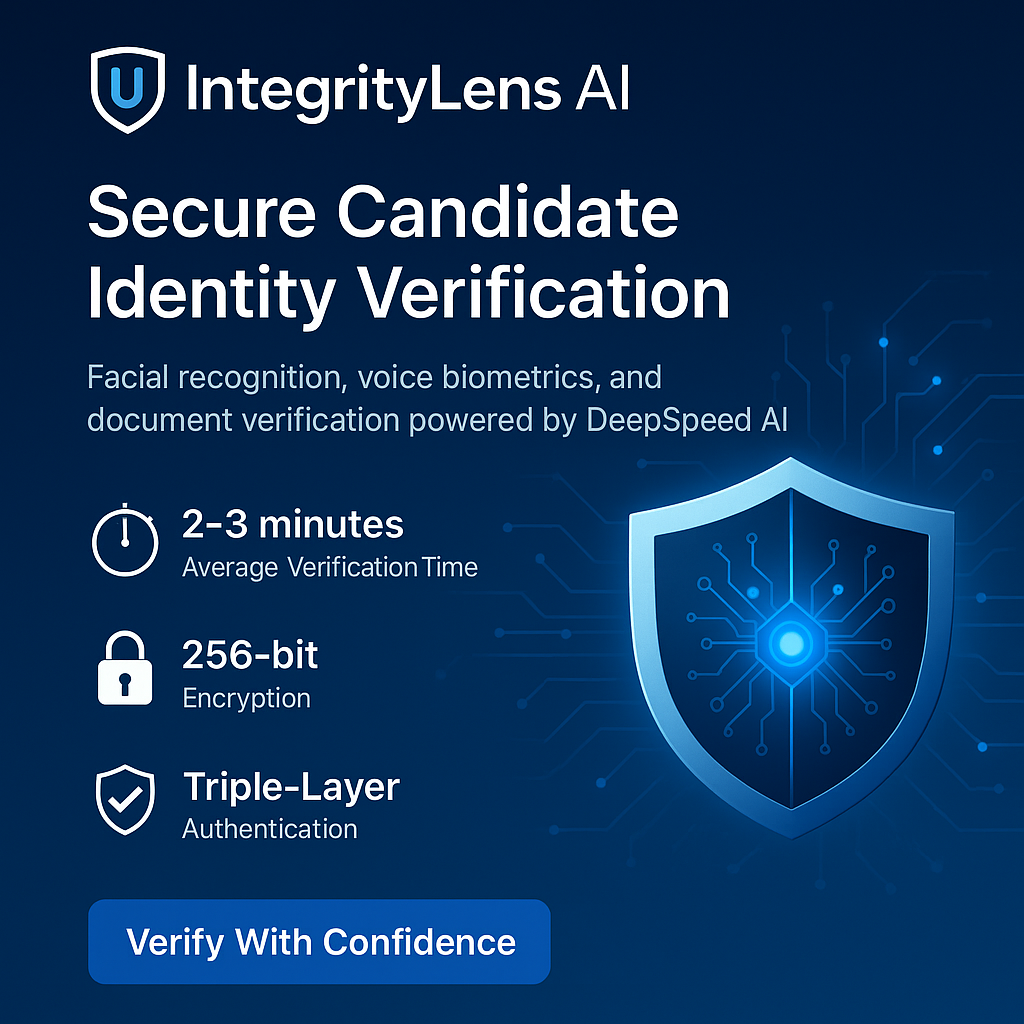
IntegrityLens AI sits in the middle of this operating model so adaptive difficulty and integrity routing happen in one defensible pipeline. It combines ATS workflow, biometric identity verification, fraud detection, AI screening interviews, and coding assessments so you can gate risk before it hits your most expensive interviewer time. Teams use it like this: Recruiting Ops configures the adaptive ladder and review queues, TA leaders monitor funnel leakage and time-to-offer, and CISOs validate controls and evidence quality. Identity can be verified in under three minutes (typical 2-3 minutes for document + voice + face), and AI interviews run 24/7 for global speed. Technical assessments support 40+ languages, with 256-bit AES encryption and SOC 2 Type II and ISO 27001-certified infrastructure posture. You get Evidence Packs per candidate, and operators get idempotent webhooks to keep the ATS as the source of truth.
Fewer late-stage surprises due to clearer separation at the top of the skill distribution.
Lower operational drag from reduced re-review and tighter escalation handling.
Cleaner audit narratives when hiring decisions are challenged.
Metrics and governance a CFO can defend
Your goal is not a higher average score. Your goal is decision reliability with controlled operating cost. Track four tiers of metrics: (1) funnel health: completion rate and time-to-complete by band, (2) decision quality proxies: hiring manager confidence and post-start ramp signals, (3) integrity ops: escalation volume, adjudication time, and appeal reversal rate, (4) audit readiness: Evidence Pack completeness and access logs. Set thresholds as policy, not preference. For example, treat a "top 1%" classification as "high confidence" only if the candidate clears at least one expert-band item with stable telemetry and no unresolved identity discrepancies. This is a control, not a vibe. Do not promise ROI in advance. Use a 30-day pilot and report deltas against your own baseline. If you need a cost anchor, SHRM notes replacement cost can be 50-200% of annual salary depending on role. Directionally, that makes even a small reduction in mis-hires valuable. It does not tell you your exact savings, because replacement cost varies widely by job family, market, and internal onboarding costs.
Weekly: monitor drop-off and escalation SLA breaches.
Monthly: item bank drift review and leakage retirement.
Quarterly: re-calibrate difficulty bands against current top performers and role changes.
Sources
Checkr, Hiring Hoax (Manager Survey, 2025): https://checkr.com/resources/articles/hiring-hoax-manager-survey-2025 Pindrop, hiring process as a cybersecurity vulnerability: https://www.pindrop.com/article/why-your-hiring-process-now-cybersecurity-vulnerability/ SHRM, replacement cost estimates: https://www.shrm.org/in/topics-tools/news/blogs/why-ignoring-exit-data-is-costing-you-talent
Key takeaways
- Dynamic difficulty improves signal-to-noise by spending more assessment time only where the decision is ambiguous (top 1% vs top 10%).
- Treat integrity signals as routing inputs, not auto-reject triggers, to avoid false positives and reputation damage.
- Calibrate an item bank against internal benchmarks (your current high performers) so difficulty maps to real job outcomes, not trivia.
- Keep CFO-grade governance: documented thresholds, appeal flow, and Evidence Packs that explain what happened and why.
Use this as a starting point for Recruiting Ops and Security to align on dynamic difficulty, step-up rules, escalation SLAs, and Evidence Pack requirements.
It is designed to minimize candidate time while increasing confidence at the top end, and to treat integrity signals as routing inputs rather than auto-reject triggers.
version: "1.0"
policyName: "adaptive-difficulty-ladder-v1"
roleFamily: "Software Engineering"
levelScope: ["L4", "L5"]

assessment:
  timeBudgetMinutes:
    softCap: 55
    hardCap: 70
  bands:
    baseline:
      intent: "Day-1 execution"
      itemsRequired: 2
      itemTagsAny: ["debugging", "code-reading", "unit-tests"]
      expectedMinutes: 25
      passRule:
        minScore: 0.72
        maxAnomalyScore: 0.35
    stepUp:
      intent: "Ambiguity + tradeoffs"
      itemsRequired: 1
      itemTagsAny: ["performance", "edge-cases", "api-design"]
      expectedMinutes: 20
      unlockRule:
        baselineScoreGte: 0.80
        baselineTimeMinutesLte: 30
    expert:
      intent: "Senior reasoning"
      itemsRequired: 1
      itemTagsAny: ["system-constraints", "failure-modes", "test-strategy"]
      expectedMinutes: 20
      unlockRule:
        stepUpScoreGte: 0.78

scoring:
  components:
    correctnessWeight: 0.55
    efficiencyWeight: 0.15
    testQualityWeight: 0.15
    explanationCoherenceWeight: 0.15
  telemetryFlags:
    anomalyScore:
      definition: "Composite of copy-paste bursts, inactive-to-submit gaps, and compile/run patterns"
      ranges:
        low: "0.00-0.35"
        medium: "0.36-0.60"
        high: "0.61-1.00"

integrityRouting:
  riskTiers:
    low:
      criteria:
        identityVerified: true
        anomalyScoreLte: 0.35
      action:
        route: "normal"
        evidencePack:
          requiredArtifacts: ["score-trace", "item-timestamps", "submission-hash"]
    medium:
      criteria:
        identityVerified: true
        anomalyScoreBetween: [0.36, 0.60]
      action:
        route: "review-queue"
        slaHours: 24
        evidencePack:
          requiredArtifacts: ["score-trace", "item-timestamps", "keystroke-summary", "explanation-transcript"]
    high:
      criteria:
        identityVerified: false
        OR:
          - anomalyScoreGte: 0.61
          - identityMismatchSignal: true
      action:
        route: "verification-step-up"
        requiredStepUp: ["document", "voice", "face-liveness"]
        blockOfferUntilResolved: true
        evidencePack:
          requiredArtifacts: ["verification-events", "score-trace", "audit-log"]

decisioning:
  hireSignals:
    top10Percent:
      rule: "baseline.pass AND stepUpScoreGte: 0.70"
      note: "Strong contributor band"
    top1Percent:
      rule: "expertScoreGte: 0.78 AND explanationCoherenceGte: 0.75 AND anomalyScoreLte: 0.35"
      note: "High confidence senior band"
  manualOverride:
    allowedRoles: ["RecruitingOpsLead", "HiringManager", "SecurityAdjudicator"]
    requires:
      justificationText: true
      linkedEvidencePackId: true
      auditLog: true

privacy:
  biometrics:
    mode: "zero-retention-biometrics"
    retentionDays: 0
  evidencePackRetentionDays: 90
  accessControl:
    minimumRoles: ["RecruitingOpsLead", "SecurityAdjudicator"]
    exportDisabledByDefault: true
Outcome proof: What changes
Before
Single fixed coding test produced many clustered pass scores, heavy manual review, and frequent "senior-on-paper" offers that were hard to defend when performance lagged. Integrity checks were inconsistent across teams, creating audit anxiety and candidate complaints.
After
Rolled out an adaptive difficulty ladder with integrity-aware routing and standardized Evidence Packs. Recruiting Ops owned thresholds, Security owned verification and retention controls, and Hiring Managers owned rubric calibration. Edge cases moved to a staffed review queue with an appeal path instead of silent rejects.
Implementation checklist
- Start with one role family (for example, backend or data) and a single job level.
- Build a calibrated item bank with tags: skill, difficulty, time-to-solve, and common failure modes.
- Define an adaptive ladder: baseline -> step-up -> expert path, with stop rules.
- Add integrity routing: low risk stays friction-light, elevated risk triggers verification step-up before or during the assessment.
- Instrument funnel leakage: drop-off by stage, time-to-complete, re-review rate, and dispute rate.
- Ship an appeal flow with documented criteria and retention limits.
Questions we hear from teams
- How do you separate top 1% from top 10% without making the test longer?
- Use stop rules and adaptive step-ups. Most candidates finish after the baseline or baseline plus one step-up. Only candidates who clear the baseline with high confidence see the expert item, which concentrates time on the expensive decision boundary.
- Will adaptive difficulty increase legal risk by treating candidates differently?
- It can reduce risk if the rules are documented, job-related, and consistently applied. The key is to adapt based on performance and predefined integrity routing criteria, not on subjective interviewer preference, and to maintain an appeal path for reviewed cases.
- What integrity signals should Finance care about?
- Signals that change decision confidence and operating cost: identity verification status, anomaly indicators that correlate with proxying or AI-assisted cheating, and the volume and SLA of escalations. Finance should not demand zero fraud at the expense of false rejections and cycle time.
- Do integrity flags mean the candidate cheated?
- No. Flags are indicators, not verdicts. Treat them as inputs to step-up verification or manual review, and document the outcome in an Evidence Pack so decisions are defensible and reversible when appropriate.
Ready to secure your hiring pipeline?
Let IntegrityLens help you verify identity, stop proxy interviews, and standardize screening from first touch to final offer.
Watch IntegrityLens in action
See how IntegrityLens verifies identity, detects proxy interviewing, and standardizes screening with AI interviews and coding assessments.