Device Farm Incident Response for Candidate Fraud
An operator briefing for Talent Ops leaders on detecting shared browser fingerprints across multiple applicants without slowing the funnel or creating legal exposure.

Device farms are not a recruiter problem. They are an identity gating and evidence logging problem.Back to all posts
Real hiring problem
Device farms rarely show up as a single obvious fake. They show up as an operations incident: the same browser fingerprint reused across 20 "unique" applicants, all reaching expensive steps and quietly breaking your time-to-offer SLA. The risk is not just wasted recruiter and interviewer hours. It is defensibility. If Legal asked you to prove who approved a candidate and on what evidence, and your answer is a Slack thread, you have an audit liability. Replacement costs can be significant. SHRM estimates replacement cost can range from 50-200% of annual salary depending on role, before any downstream access or incident response impact is counted.
Time-to-event spikes at screening and assessment steps because reviewers sense something is off but lack a policy-backed route.
Offer approvals slow down because identity is still unverified when the candidate reaches privileged steps.
Reviewers create shadow workflows to compare notes across "separate" candidates, creating compliance gaps.
Why legacy tools fail
Legacy ATS, background check, interview, and coding tools were not built to detect cross-candidate operator reuse. Signals arrive late, live in silos, and cannot be tied to a single evidence pack. The market failure is structural: sequential checks slow the funnel, there is no unified immutable event log, SLAs are informal, and rubric evidence is not stored in a standardized, retrievable way. Shadow workflows become the default coordination layer, and shadow workflows are integrity liabilities.
Waterfall sequencing: verification after expensive steps.
No ATS-anchored audit trail: approvals are not reconstructable.
No unified evidence pack: screenshots replace timestamps.
No review queue SLAs: fraud review becomes best-effort.
Ownership and accountability matrix
You cannot run device-farm response as a vague "be careful" instruction. Assign owners, define what is automated, and document sources of truth. Recruiting Ops owns workflow design, queue ergonomics, and ATS stage transitions. Security owns thresholds, step-up verification requirements, access control policy, and audit posture. Hiring Managers own rubric discipline and adherence to identity gates. Analytics owns segmented risk dashboards and time-to-event reporting.
Automate: fingerprint clustering, risk-tier assignment, queue creation, evidence pack capture, ATS write-back.
Manual review: adjudication for adverse outcomes, candidate communication decisions, exception approvals.
ATS: candidate stage, disposition, approvals, timestamps.
Verification layer: identity artifacts and verification events.
Interview and assessment tools: structured evidence contributors that must write back to ATS and evidence pack.
Modern operating model: instrumented workflow
Treat hiring like secure access management. The recommendation is simple: identity verification before access, event-based triggers, automated evidence capture, dashboards for time-to-event, and standardized rubrics. A device farm is an integrity control failure where one operator reuses a device identity to move multiple claimed identities through privileged steps. Your workflow must detect clusters, route them under SLA, and resolve them with step-up verification and logged approvals.
Identity gate before access to live interviews and offers.
Immutable event log entries for every cluster trigger and decision.
Evidence packs attached to the ATS record for audit reconstruction.
Risk-tiered funnel routing so the whole pipeline does not stall.
Where IntegrityLens fits
IntegrityLens acts as the control plane between Recruiting Ops and Security so device-farm clusters are handled as policy-driven workflow, not ad hoc debate. It enables identity gating and step-up verification before privileged steps, captures tamper-resistant evidence packs, and keeps decisions ATS-anchored with timestamps so they are audit-ready.
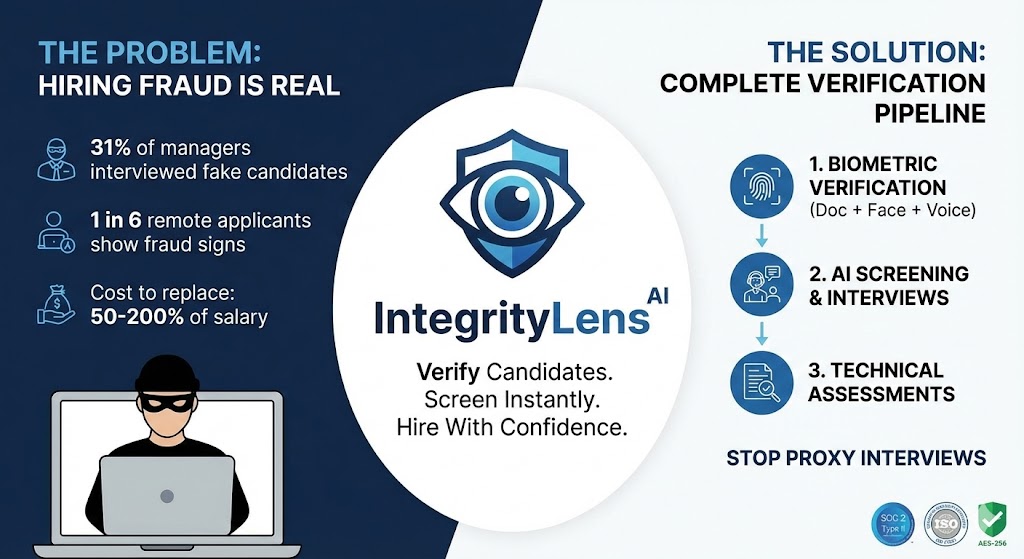
Biometric identity verification with liveness, document authentication, and face match to enforce identity gates.
Fraud prevention signals including deepfake detection, proxy interview detection, behavioral telemetry, and device fingerprinting for cross-candidate clustering.
AI screening interviews available 24/7 with structured rubrics and behavioral signal capture to reduce reviewer bottlenecks.
Immutable evidence packs and compliance-ready audit trails tied to ATS stages and approvers.
Risk-tiered verification routing so step-up checks run in parallelized checks instead of waterfall workflows.
Anti-patterns that make fraud worse
Do not turn a device fingerprint into a one-shot verdict. Device farms require defense in depth and false positive management. These three anti-patterns repeatedly increase legal exposure and slow the funnel.
Rejecting or blocking based on fingerprint alone instead of routing to step-up verification with evidence capture.
Letting reviewers coordinate in chat threads without writing decisions and artifacts back to the ATS and evidence pack.
Deferring identity checks to post-offer, which concentrates delays exactly where identity is unverified and access stakes are highest.
Implementation runbook (SLAs, owners, evidence)
Implement a cluster policy that triggers an SLA-bound review queue, step-up verification, and two-person controls for adverse outcomes. The goal is to keep throughput high while ensuring every decision is reconstructable from the immutable event log and evidence pack.
Step 0 Policy: Security publishes thresholds and outcomes. Recruiting Ops implements routing. Log policy version and approvers. SLA: 5 business days.
Step 1 Instrumentation: Recruiting Ops ensures fingerprint capture at screening and assessments. Log fingerprint ID, step, timestamp. SLA: 2 weeks.
Step 2 Trigger: System creates clusterId and routes candidates to "Fraud Review - Device Farm". Log trigger event within 1 minute.
Step 3 Triage: Recruiting Ops reviews queue for obvious false positives and ensures step-up verification is requested. Log triage notes. SLA: 30 minutes (business hours).
Step 4 Step-up verification: Security requirements enforced before live interview and offer. Log doc auth, liveness, face match with timestamps. SLA: 24 hours.
Step 5 Adjudication: Security adjudicates, Recruiting Ops updates ATS disposition. Require two-person approval for adverse outcomes. Log approvers and timestamps. SLA: 24 hours adjudication, 48 hours disposition.
Step 6 Analytics: Analytics reviews cluster rates, SLA breaches, and clear-rate weekly. Log dashboard snapshots monthly for audit readiness.
Sources
SHRM replacement cost estimate (50-200% of annual salary): https://www.shrm.org/in/topics-tools/news/blogs/why-ignoring-exit-data-is-costing-you-talent
Close: If you want to implement this tomorrow
Publish the policy, instrument the events, and enforce identity gates before privileged steps. Device-farm response works when it is a controlled workflow with timestamps, not an argument about intent. Use this checklist to start with defensibility and throughput, then tune thresholds based on your false positive rates and reviewer SLA performance.
Define a device-farm cluster threshold and create a named review queue with SLAs and escalations.
Instrument browser fingerprint capture at screening interview and assessment entry points and write to an immutable event log.
Enforce step-up verification before live interview access and before offer creation. No exceptions without logged approval.
Require an evidence pack link on every adverse action disposition, stored with the ATS record.
Add dashboards for time-to-event: trigger-to-triage, triage-to-verification, verification-to-disposition, and SLA breach rate.
Standardize scoring rubrics and require structured write-back to the ATS for every decision.
Related Resources
Key takeaways
- Treat repeated device fingerprints as an integrity incident, not a recruiter hunch. Route by policy, log every decision, and preserve evidence packs.
- Use a risk-tiered funnel: do not block on one signal. Step-up verification and controlled manual review reduce false positives and legal exposure.
- Make the ATS the source of truth for disposition and timestamps, but keep tamper-resistant evidence packs attached to each candidate record.
- Measure time-to-event and SLA breaches: device-farm clusters create hidden cycle-time waste when unverified candidates reach expensive steps.
- Operationalize reviewer ergonomics: clusters need queueing, batching, and accountable approvals with timestamps.
Use this policy to define when repeated browser fingerprints trigger a review queue, step-up verification, and two-person approval for adverse outcomes.
Store the policy version and approvers, then reference it in your immutable event log so every decision is tied to a known control.
policyName: device-farm-cluster-response
version: "1.0"
effectiveDate: "2026-07-01"
triggers:
  - name: browser-fingerprint-cluster
    condition:
      fingerprintMatch: true
      minDistinctCandidates: 20
      lookbackDays: 7
    actions:
      - routeToQueue: "Fraud Review - Device Farm"
      - applyRiskTier: "step-up-verification"
      - blockPrivilegedSteps:
          - "live-interview"
          - "offer"
      - notify:
          - team: "RecruitingOps"
          - team: "Security"
reviewSLA:
  initialTriageMinutes: 30
  securityAdjudicationHours: 24
  candidateDispositionHours: 48
manualReviewRequirements:
  requireEvidencePack: true
  requireTwoPersonApprovalForAdverseAction: true
  allowedOutcomes:
    - "clear"
    - "step-up-verification-required"
    - "decline-for-integrity-risk"
logging:
  writeToATS: true
  immutableEventLog: true
  fields:
    - "candidateId"
    - "fingerprintId"
    - "clusterId"
    - "triggeredAt"
    - "reviewerId"
    - "decision"
    - "decisionAt"
    - "evidencePackLink"
Outcome proof: What changes
Before
Recruiting Ops saw recurring "same-device" anomalies but handled them via Slack escalations and spreadsheet notes. Live interview capacity was periodically consumed by clustered applicants, and disposition decisions were difficult to defend because artifacts were not consistently attached to ATS records.
After
Device-farm cluster triggers routed candidates into an SLA-bound review queue, enforced step-up verification before live interviews and offers, and attached evidence packs to each candidate record with timestamps and approver IDs.
Implementation checklist
- Instrument device fingerprint capture at every privileged step (screening interview, coding assessment, live interview).
- Create a cluster rule (example: same fingerprint across 20 applicants in 7 days) that triggers step-up verification.
- Define a manual review queue with SLAs and an escalation path to Security for high-confidence clusters.
- Require an evidence pack before any adverse action or fraud label is applied.
- Track time-to-event metrics: time from cluster trigger to disposition, and percent of offers issued after step-up verification.
Questions we hear from teams
- Is a shared browser fingerprint enough to decline a candidate?
- No. A repeated fingerprint is a routing signal, not a verdict. Use it to trigger step-up verification and a documented review. Declines should require an evidence pack and two-person approval so the decision is defensible.
- Where should the identity gate sit in the funnel?
- Before privileged steps: live interviews, offer creation, and any access to sensitive systems or take-home environments. The operational rule is identity verification before access, with logged exceptions only.
- How do we manage false positives without slowing hiring?
- Use a risk-tiered funnel. Route clusters into an SLA-bound triage queue, step-up verify quickly, and clear alerts with documented rationale. Measure clear-rate and SLA breaches weekly to tune thresholds.
- What does "audit-ready" mean in this context?
- It means you can reconstruct who approved what, when, and why using ATS-anchored audit trails, immutable event logs, and evidence packs that contain verification artifacts and reviewer notes.
Ready to secure your hiring pipeline?
Let IntegrityLens help you verify identity, stop proxy interviews, and standardize screening from first touch to final offer.
Watch IntegrityLens in action
See how IntegrityLens verifies identity, detects proxy interviewing, and standardizes screening with AI interviews and coding assessments.