Detect Copilot Dependency Before It Becomes a Mis-Hire
A hiring pipeline that cannot prove independent coding ability is an integrity liability. This briefing shows how to instrument assessments so People Analytics can quantify AI-assist dependency, enforce SLAs, and keep decisions audit-ready.
A decision without evidence is not audit-ready. If you cannot reconstruct the assessment session, you cannot defend the offer.Back to all posts
Real hiring problem
You do not have a Copilot problem. You have an evidence problem: you cannot prove whether the candidate could execute without heavy assistance when it mattered. In practice, Copilot dependency becomes visible after start date. By then, your only controls are performance management and re-hiring, and your audit trail for the original decision is thin. That is how a technical screen turns into a People Analytics fire drill: explain why the model of "competent in test" did not predict "competent on job". Industry signals indicate the fraud surface is not hypothetical. Pindrop reports that 1 in 6 applicants to remote roles showed signs of fraud in one real-world hiring pipeline. Even if your case is "AI dependency" rather than proxying, the operational control is the same: identity gating plus session evidence.
SLA breach: review queues explode because there is no risk-tiering, so every suspicious session becomes a bespoke escalation.
Legal exposure: inconsistent expectations across teams (some allow heavy AI, others do not) without a stored rubric.
Cost of mis-hire: replacement and backfill costs escalate, and requisitions re-open after avoidable ramp failures.
Why legacy tools fail
Legacy tooling treats technical screening like a one-off test, not like privileged access to a controlled environment. That is why it fails under scrutiny. Sequential checks slow time-to-offer and push teams into exceptions. No unified event log means you cannot answer basic audit questions: who accessed the test, from what device, what identity proof was collected, and who approved the score override. Coding tools often return a score without operational context. Without execution telemetry, paste and run patterns, and code playback, you cannot distinguish "strong engineer" from "strong prompt workflow" in a way that holds up in dispute resolution.
Results exported as PDFs with no underlying event stream.
Rubrics stored outside the ATS, so criteria are not versioned or tied to requisitions.
No SLA controls for manual review, so exceptions become backlog debt.
Candidates can start assessments without identity gating or step-up verification.
Ownership and accountability matrix
If you want defensible AI-assist policy enforcement, assign owners like you would for access reviews. Recruiting Ops: owns funnel design, stage triggers, and review queue SLAs. Security: owns identity gate, step-up verification policy, and audit retention. Hiring Manager: owns rubric anchors and final adjudication rules. People Analytics: owns risk segmentation, drift detection, and KPI definitions (time-to-event, exception rate, and re-review rate). Automation should handle the first 95 percent: instrument, score risk, route, and build evidence packs. Humans should only review when the risk tier requires it, and every override must be time-stamped and attributable.

ATS: candidate stage, disposition, and final decision with approver identity.
Verification layer: identity events (document auth, liveness, face match) and step-up outcomes.
Assessment layer: code playback, plagiarism checks, and execution telemetry.
Immutable event log: joins all three into an ATS-anchored audit trail.
Modern operating model
Recommendation: implement a risk-tiered, instrumented workflow that measures independent execution, not just correctness. Start by defining what you are trying to detect. You are not banning AI. You are measuring dependency risk: whether the candidate can reason, edit, run, and debug with minimal external generation under timed constraints. Then operationalize it: identity gate before access, event-based triggers during the session, automated evidence capture, dashboards segmented by role and region, and standardized rubrics stored with the requisition. Every decision should map to a logged event, a score, and an approver. For People Analytics, the win is measurement integrity. You can correlate dependency signals with downstream outcomes: ramp time, code review rework, incident participation, and early attrition. That turns debate into an instrumented feedback loop.
Paste-to-keystroke ratio and paste burst timestamps.
Edit-to-run cadence and time-to-first-execution.
Tab focus changes and inactivity windows during timed sections.
Code playback diffs to show iterative reasoning vs bulk insertion.
Reviewer override rate with required justification text.
Where IntegrityLens fits
Multi-layered fraud prevention controls, including deepfake detection, behavioral telemetry, device fingerprinting, and continuous re-authentication to reduce proxy and tool-switch abuse.
Identity gate before assessment access using biometric verification (liveness, face match, document authentication) to bind the session to a real person.
Immutable evidence packs: timestamped logs, reviewer notes, and code playback tied to the candidate record for dispute resolution.
Zero-retention biometrics architecture support, aligning with Security and Legal constraints on sensitive data handling.
Fewer late-stage surprises because risk is scored early and routed to SLA-bound review queues.
Higher audit readiness because every override and approval is attributable and time-stamped.
Anti-patterns that make fraud worse
Letting hiring managers invent per-candidate exceptions in Slack or email, instead of routing to a logged review queue with SLAs.
Scoring only the final output, not the event stream, which encourages bulk insertion workflows that look correct but are not independently produced.
They remove your ability to reconstruct who did what, when, and under which policy version.
They increase inconsistency across teams, which is where legal challenges concentrate.
Implementation runbook
Define rubric and allowed-assist policy. SLA: 5 business days per role family refresh. Owner: Hiring Manager. Logged: rubric version, requisition ID, scoring anchors, allowed tools.
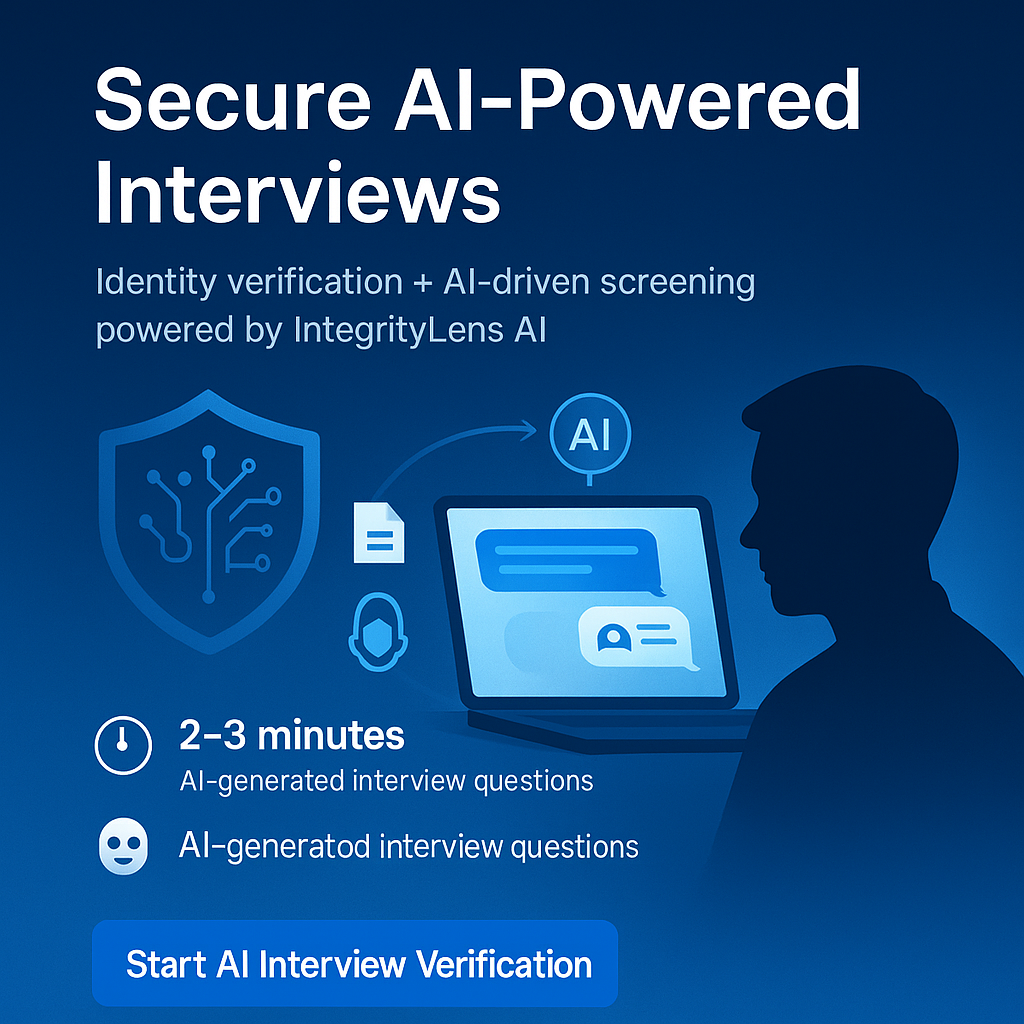
Identity gate before assessment access. SLA: under 3 minutes typical end-to-end verification time (document plus voice plus face). Owner: Security. Logged: verification start and end timestamps, outcome, step-up triggers.
Start assessment with telemetry capture. SLA: immediate on access grant. Owner: Recruiting Ops. Logged: device fingerprint, session start, environment, timers.
Automated dependency risk scoring and routing. SLA: within 1 minute of submission. Owner: People Analytics defines thresholds, Recruiting Ops owns routing. Logged: risk tier, feature values, model or ruleset version.
High-risk step-up verification and secondary review. SLA: review complete within 8 business hours for high-risk, 24 hours for medium-risk. Owner: Security for step-up, Hiring Manager for re-score. Logged: reviewer identity, timestamps, rationale, final disposition.
Evidence pack attachment to candidate record. SLA: within 5 minutes of final disposition. Owner: Recruiting Ops. Logged: evidence pack ID, hash, access policy, retention schedule.
Analytics monitoring. SLA: weekly. Owner: People Analytics. Logged: exception rates, SLA breaches, downstream quality signals by cohort.
Related Resources
Key takeaways
- Treat coding assessments as privileged access: identity gate first, then instrument the session and log every decision.
- Measure dependency with event data (paste bursts, edit-to-run ratios, time-to-first-keystroke, tab switching) and tie thresholds to a documented rubric.
- Make the decision reconstructable: an evidence pack with timestamps, reviewer notes, and code playback is what keeps Legal and Security out of escalation.
- Parallelize checks: verify identity, run assessment telemetry, and route to review queues without slowing time-to-offer.
- Assign ownership explicitly so exceptions do not become shadow workflows.
A versioned policy that routes candidates into standard, step-up, or manual review paths based on telemetry signals. Store the policy version with every assessment event so People Analytics can measure drift and Legal can trace which rules applied.
version: "2026-02-01"
policy_name: "copilot_dependency_risk_routing"
owners:
  recruiting_ops: "workflow-orchestration"
  security: "identity-gate-and-step-up"
  hiring_manager: "rubric-and-final-adjudication"
  people_analytics: "thresholds-and-monitoring"
inputs:
  telemetry:
    paste_chars_total: int
    typed_chars_total: int
    paste_burst_max_chars: int
    time_to_first_keystroke_sec: int
    tab_focus_changes: int
    runs_count: int
    edit_events_count: int
  verification:
    identity_verified: bool
    step_up_completed: bool
routing:
  - name: "block-unverified"
    if: "verification.identity_verified == false"
    action:
      route_to: "identity-gate"
      sla: "15m"
      log_event: "ASSESSMENT_ACCESS_DENIED_UNVERIFIED"
  - name: "high-risk-step-up"
    if: "telemetry.paste_chars_total > 3 * telemetry.typed_chars_total or telemetry.paste_burst_max_chars >= 800 or telemetry.time_to_first_keystroke_sec >= 180"
    action:
      route_to: "step-up-verification-and-manual-review"
      sla: "8h"
      log_event: "DEPENDENCY_RISK_HIGH"
      require:
        - "verification.step_up_completed"
        - "reviewer_rationale_text"
  - name: "medium-risk-review"
    if: "telemetry.tab_focus_changes >= 12 or telemetry.runs_count == 0 or telemetry.edit_events_count < 15"
    action:
      route_to: "manual-review"
      sla: "24h"
      log_event: "DEPENDENCY_RISK_MEDIUM"
  - name: "standard"
    if: "true"
    action:
      route_to: "auto-score"
      sla: "5m"
      log_event: "DEPENDENCY_RISK_LOW"
audit:
  evidence_pack_required: true
  store_policy_version_with_events: true
  override_controls:
    allowed_roles: ["HiringManager", "SecurityReviewer"]
    require_reason: true
    log_event: "RISK_OVERRIDE"
Outcome proof: What changes
Before
Coding tests were evaluated on final output only. Exceptions were handled in email and Slack. People Analytics could not segment failures by assessment behavior versus role fit.
After
Identity gating was moved ahead of assessment access. Telemetry-based risk tiers routed only flagged sessions to review. Every disposition had an evidence pack with timestamps, reviewer identity, and rubric version.
Implementation checklist
- Define what "independent coding" means for the role in a stored rubric with scoring anchors.
- Add an identity gate before assessment access, with step-up verification for flagged sessions.
- Instrument assessments with execution telemetry and tamper-resistant logs (paste, runs, environment, tab focus).
- Set review-bound SLAs for flagged sessions and track SLA breaches as operational incidents.
- Require evidence packs for every reject or offer, including reviewer identity and timestamps.
Questions we hear from teams
- Is using Copilot automatically disqualifying?
- No. The defensible approach is to define allowed assistance by role, then measure dependency risk with telemetry and require the same rubric-based decision path for every candidate.
- What do you show if a candidate disputes a rejection?
- You produce the evidence pack: rubric version, timestamps, code playback, telemetry summary, identity events, and the reviewer rationale tied to an accountable approver.
- How do you avoid slowing time-to-offer?
- Risk-tier the funnel. Most sessions auto-score. Only flagged sessions trigger step-up verification and an SLA-bound review queue, so exceptions do not block the entire pipeline.
- Who should own the dependency thresholds?
- People Analytics should own threshold calibration and drift monitoring. Hiring Managers own rubric definitions. Security owns the step-up verification policy. Recruiting Ops owns routing and SLA staffing.
Ready to secure your hiring pipeline?
Let IntegrityLens help you verify identity, stop proxy interviews, and standardize screening from first touch to final offer.
Watch IntegrityLens in action
See how IntegrityLens verifies identity, detects proxy interviewing, and standardizes screening with AI interviews and coding assessments.